
SpaceX says their rocket’s lunar collision was unintentional
What happens when part of a rocket weighing 4,000 kilograms hits the moon at about 8,700 km per hour?
Thankfully, nothing catastrophic. But it does pose a more long-term issue that has scientists speaking up.
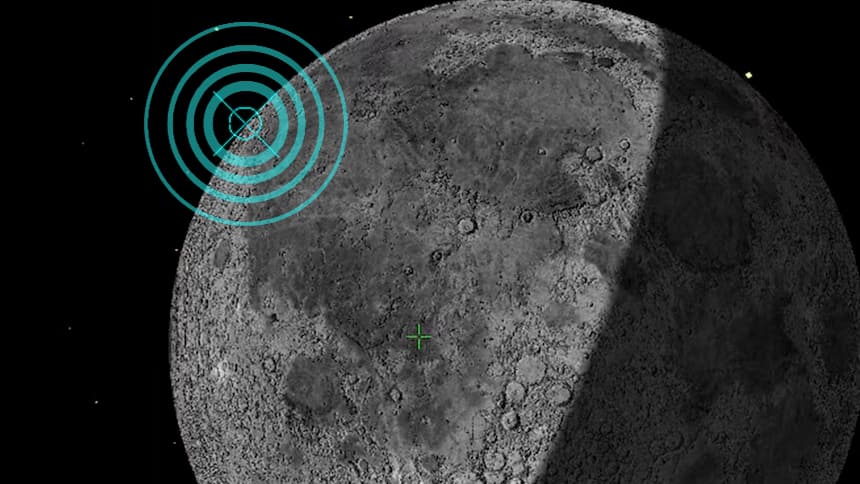
On Aug. 5, part of a rocket collided with the moon after drifting off course from its original, expected trajectory.
The part belonged to a SpaceX Falcon 9 rocket that launched two private spacecraft to the moon back in January 2025.
Scientists say the impact does have some benefits for science, but it contributes to the issue of space junk and could pose problems for future lunar missions.
How did this happen?
Typically, when a rocket is used to launch things like satellites, parts of the rocket float back down to Earth and burn up in the atmosphere.
However, after SpaceX launched Firefly Aerospace’s Blue Ghost and iSpace’s Resilience into space for their 2025 lunar missions, its rocket didn’t come back down.

A composite of satellite images shows the surface of the moon on Oct. 1, 2015, left, and after the crash of part of a SpaceX rocket on Aug. 5, 2026. (Image credit: NASA/KARI/KASA/Reuters)
The high amount of thrust needed to launch the spacecraft meant that the rocket remained in space, left to float aimlessly.
“After it did its job, SpaceX really did not care where it ended up, as near as I can tell,” said Paul Delaney, professor emeritus of physics and astronomy at York University in Toronto, Ontario.
Earlier this year, astronomers realized the rocket part was headed for the moon.
SpaceX representatives said that wasn’t their intention.
“What has happened is, essentially, a mixture of solar activity and gravity forces have put it on a path toward the moon,” Julianna Scheiman, SpaceX director of NASA science and Dragon programs, told reporters on Aug. 3.
Benefits to science
Scientists say the crash landing can provide us with a lot of useful information.
For example, planetary scientists and geologists who study what the moon is made of can get a better idea of what’s under the moon’s top layer of rock.
“When something big crashes into the moon, like pieces of a rocket, it can uncover those layers, and scientists can then use special tools to study them,” University of Montreal astrophysicist Nathalie Ouellette told CBC Kids News.

The SpaceX Falcon 9 rocket that crashed into the moon is seen here on Jan. 15, 2025, launching with two lunar landers at the Kennedy Space Center in Cape Canaveral, Florida. (Image credit: John Roaux/The Associated Press)
Aaron Boley, an associate professor of physics and astronomy at the University of British Columbia, said the impact can also help us better understand how moon craters are formed.
He said we don’t typically know when things hit the moon, so being able to observe the crash presents a rare opportunity.
“In the case of the old rocket body, we knew the time and location of its impact with the moon, as well as its size and mass,” he told CBC Kids News.
“This can be used to form a good picture of the formation of the resulting crater and how dust was transported on the moon due to that impact.”
The space junk issue
Space junk has been a growing problem over the years, particularly the debris from former space missions that floats within Earth’s orbit.
It can pose a lot of serious issues for satellites and space missions.
Learn more about space junk in this video:
If we’re not careful, scientists say the same problem could happen with the lunar orbit, especially as traffic to the moon is slated to increase.
“With human settlements occurring soon, we do not want to impact the moon in uncontrolled ways,” said Delaney.
He said the moon’s orbit is relatively clear — like the Earth’s orbit was in the early days of space exploration — but that could change.
“Bottom line, let us learn from our mistakes in Earth’s orbit and not repeat them around the moon.”
Lunar junk is also a “safety concern for astronauts” and should be taken seriously, Boley said.
“Whether the space junk is around the Earth or around the moon, it is part of the same problem,” he said.
“We need to clean up after ourselves, even when sending things into space.”
Have more questions? Want to tell us how we’re doing? Use the “send us feedback” link below. ⬇️⬇️⬇️
With files from Reuters