
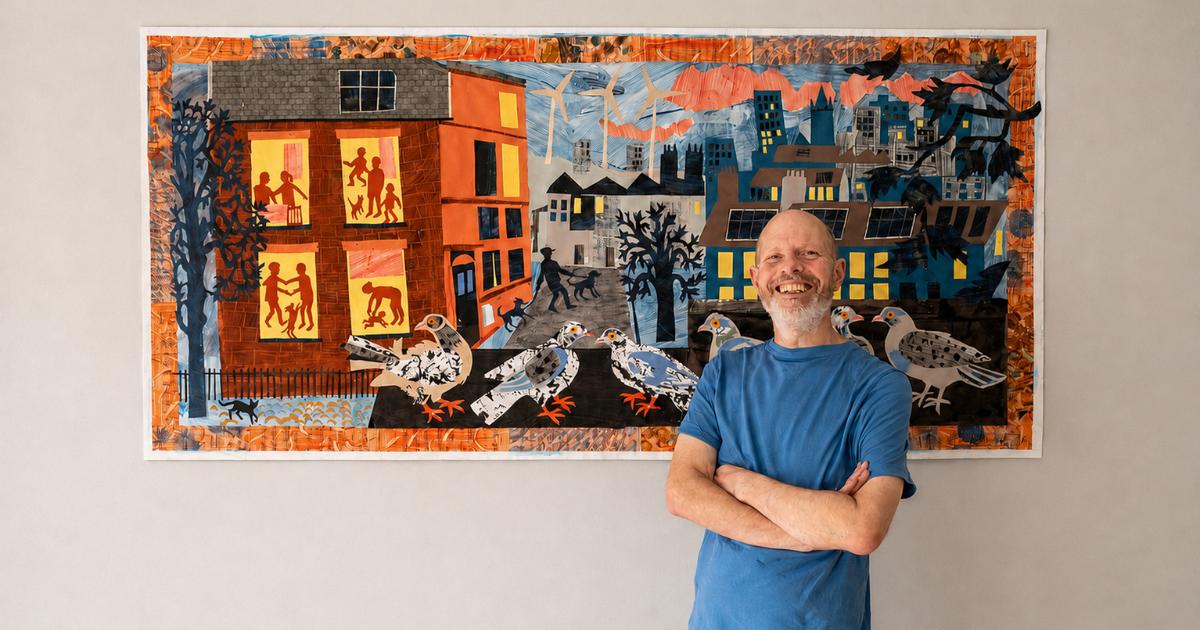
Glasgow has been reimagined in a new collage by artist Mark Hearld. (Image: Supplied)
Three collages have been created as part of the project, focusing on Glasgow, Sheffield and the East End of London.
The artworks were developed through a partnership with schools and E.ON’s New Energy Academy.
Hearld’s Glasgow collage features pigeons on a roofscape, with solar panels and home batteries representing greener energy and more affordable energy costs for low-income families.
The artist said he was inspired by artworks from the 19th-century Industrial Revolution while creating the series, and wanted to show nature flourishing alongside redevelopment and cleaner energy production.
Glasgow has been reimagined in a new collage by artist Mark Hearld. (Image: Supplied)
Children also took part in workshops connected to the project, creating their own collages and contributing their ideas.
The wider ReIndustrial Revolution project is supported by an E.ON report examining how smarter energy choices could help businesses cut costs, improve resilience and reduce carbon emissions.
The report suggests technologies including on-site energy generation and waste heat recovery could reduce manufacturers’ annual gas consumption by 15.2 TWh and electricity use by 8.8 TWh by 2035.
That would be equivalent to the gas needs of more than 1.2 million average UK homes and the electricity demand of 3.3 million homes.
The three collages will be exhibited at NeX26 – the New Energy Experience at the Elbphilharmonie in Hamburg on September 16.
Glasgow has been reimagined in a new collage by artist Mark Hearld. (Image: Supplied)
Mark Hearld said: “When E.ON asked me to make a series of collages as part of its ReIndustrial Revolution campaign, to celebrate its commitment to sustainable growth and with a nod to the artworks of 19th-century industrial revolution, it provided me with a bold visual starting point.
“All growth should be sustainable.
“E.ON’s campaign is a such a positive initiative.
“I was excited by the dynamic challenge of showing nature flourishing alongside the architecture of redevelopment and greener energy production.
“A derelict Mill at Silvertown on the Thames about to be redeveloped sustainably, a biomass power station with a ‘black paper cut’ silhouette rising up from a wildflower meadow alive with oxeye daisies in Sheffield, and finally pigeons roosting on the foreground ridge of a roofscape in Glasgow, with its solar panels and home batteries to make energy costs more affordable for low income families.”
Hearld added: “Children care about the world they live in, and it was a joy to see such creative optimism in the collages they made during our workshops.
“Similarly, it was huge fun to see the playful inventiveness in their choice of materials.
“There’s no doubt that their creative engagement has a vital role to play in the future of our world.”
Chris Norbury, chief executive of E.ON UK, said: “Businesses don’t need to wait for tomorrow’s technology to start seeing the benefits of cleaner, smarter energy.
“We have the solutions and we have them now.
“Energy can be a source of resilience, competitiveness, and growth.
“Removing barriers to investment means more businesses can cut costs, reduce carbon, and help build the resilient energy system Britain needs.”