
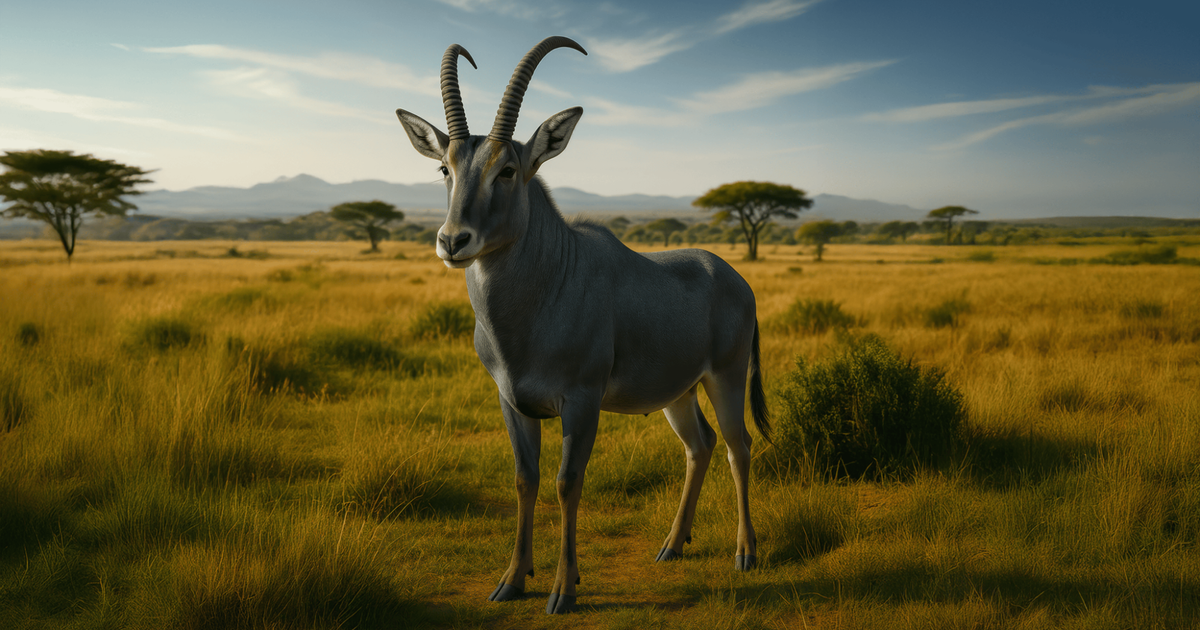
That thin record is one reason the bluebuck has stayed largely unknown, even as Colossal Biosciences names it as a de-extinction target and builds educational content around its story. It was a medium-sized grazing antelope with backward-sweeping, ringed horns and a coat that could look blue-gray in certain light. And it’s an animal most people have never heard of, which its history helps explain.
The rarest antelope you’ve never heard of
The bluebuck was never abundant, and it was never famous. It lived quietly on the grasslands of South Africa’s southern Cape for thousands of years without entering the written record at all, until a German astronomer named Peter Kolbe arrived at the Cape in 1719 and described what he called a “blue goat.” By the time naturalists began paying close attention, the animal was already fading. It was scientifically named in 1766 and gone roughly 34 years later.
Its obscurity runs so deep that even the physical evidence is contested. A 2021 genetic study found that of the small number of museum specimens long attributed to the bluebuck, only four could be confirmed as genuine, and not a single skull among them. An entire species is represented today by a few verified pieces of skin. The paleontologist Stephen Jay Gould once observed that no large mammal could match the blue antelope in obscurity.
A quiet extinction
The bluebuck’s disappearance wasn’t a slow, natural decline. Genomic analysis of surviving specimens found that the species had persisted for thousands of years at low population size, and concluded that colonial-era human impact, rather than any long-term biological weakness, was the decisive factor in its extinction. The animal was stable until its world changed. As its grassland habitat was converted to farmland and its herds were displaced, it vanished within decades.
That pattern, a species lost quietly and quickly once its habitat is disturbed, is a common one. Many of the plants and animals disappearing today generate no headlines and leave little cultural record. The bluebuck sits at an extreme of it: a large, distinctive mammal that slipped away before science had even finished describing it.
Why Colossal chose it
For Colossal, the bluebuck is also an entry point into a group of animals the company says conservation has underserved. It is the company’s first effort focused on antelope, and the stakes extend well beyond a single lost species. According to the International Union for Conservation of Nature, 29 of the world’s roughly 90 antelope species are currently threatened with extinction.
“African antelopes have long been neglected in global conservation,” Beth Shapiro, chief science officer at Colossal Biosciences, said in a statement. “We’re bringing back a species that played a vital role in its ecosystem, and building the scientific foundation for antelope conservation before more of its relatives are lost.”
The company has framed the effort as one whose methods should carry over to living species. Every reproductive technology and genome-editing protocol developed through it, Ben Lamm, Colossal’s co-founder and CEO, has said, is designed to scale and benefit the 29 antelope species now at risk.
The bluebuck’s story holds up on two levels. One is the account of an animal that was lost and is now being reconstructed from fragments. The other is what its living relatives still face, and the tools that studying the bluebuck could put within reach for the antelope still on the landscape.