
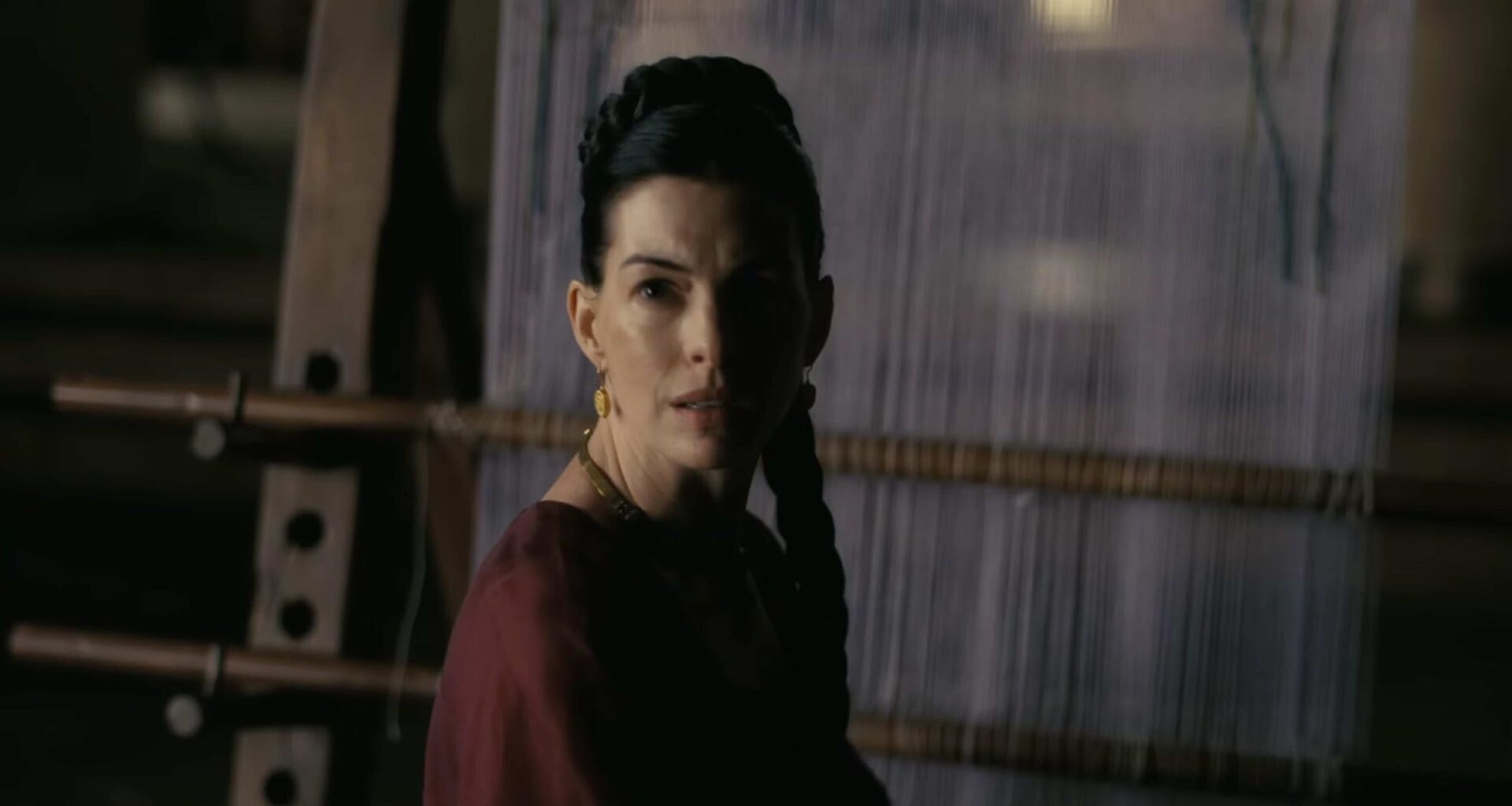
Hanging in the Meinolf Weaving School in San Anselmo is a rare piece of movie history. Surrounded by colorful creations by owner Travis Meinolf and the school’s other weavers, this special purple weaving Meinolf created plays a prominent role in “The Odyssey,” Christopher Nolan’s recent summer blockbuster.
It’s the piece Penelope, Odysseus’ wife, who awaits his return in Ithaca, works on throughout the film, claiming that she’ll marry one of her suitors once she finishes it, but every night undoes her work. Anne Hathaway, who plays Penelope, learned how to weave with Meinolf to bring this artistic craft authentically to the big screen.
“Christopher Nolan and Emma Thomas found me the most amazing, extraordinary teacher in Northern California who is an expert at weaving thread with ancient kinds of looms,” Hathaway told MEGA Magazine in July. “We began with a simple starter loom and worked our way up to a much bigger one.
“There was a moment when everything just clicked, like I was connecting with a skill that is foundational to being a human being. To be clear, it takes years to learn how to make something truly beautiful and intricate with a loom. But I am grateful I learned what I did so I cast the illusion of it and make you believe Penelope herself had spent years at her loom.”
The Lagunitas weaver, who has been teaching the craft for around 20 years, didn’t hesitate when they got a cold call asking if they’d be willing to work on a feature film that involved weaving.
“I love spreading knowledge of this practice through whatever means is made available to me. So I was just like, yes, yes, yes,” said Meinolf, who learned later that the film in question was “The Odyssey.”
The props department wanted someone to create work for the film as well as teach Hathaway the ancient Greek weaving style that was period-appropriate for the film.
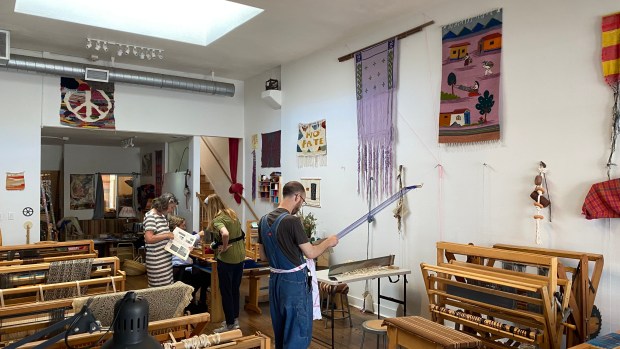 A weaving made for “The Odyssey” hangs at the Meinolf Weaving School. (Courtesy of Travis Meinolf)
“They knew me as somebody who was a more flexible weaving teacher, ready to cross cultures and techniques in order to provide the most simplified and best weaving experience for each person.
“They knew that while I wasn’t specializing in this very niche type of weaving, they knew that I was up for it, and so when I got the call and they described what they needed, I was like, I can bone up on that technique and build one of those kinds of looms, which I hadn’t worked with for maybe over a decade.
Rediscovering it with the help of people in my studio and seeing what I encountered and what they encountered really made me prepared for the intensive,” said Meinolf, who worked with Hathaway for a few days as well as supported her on set during the film, including running over and unweaving what she did during the scene before the start of each new take.
For Meinolf, who spent around two weeks in Los Angeles in early 2025 for the project, it was inspiring to be on set and see the dedication and care given to the movie, from the giant Cyclops Polyphemus being an actual huge puppet to hearing them discuss dyeing bows to get accurate colors and how to get wax into the actors’ ears in another scene.
“It was really amazing being behind the scenes for an artistic project with that level of detail,” said Meinolf, who did around three months of prep work. “Watching six guys pushing this giant IMAX camera closer and closer to look over Anne’s shoulder at her hands doing the weaving and the details of weaving while she’s having a discussion of royal family politics. Weaving is part of the movie, and I’m very proud of that.”
Meinolf, who taught Hathaway on an ancient Greek-style weighted warp loom that they’d built, was blown away by her acting.
“Before she knew anything about what she was doing, her face looked like she had been doing it for 20 years,” Meinolf said.
“Of course, designing the weaving pattern to be made was its own thing, looking at mood boards, talking about what kind of patterning I would actually be able to teach and what weavings I would actually be able to produce in the time frame that we had.”
When Meinolf was able to see the final film, they were struck by the “visual storytelling.”
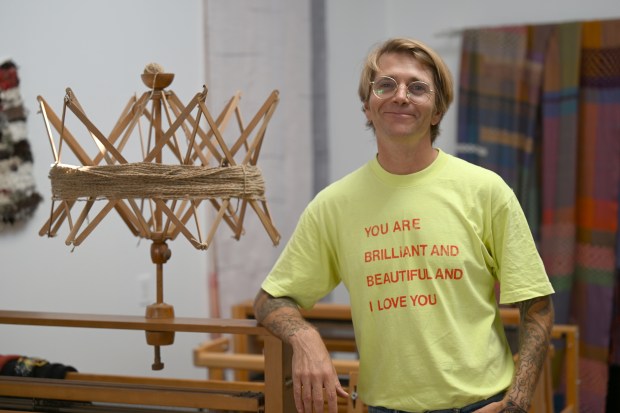
Alan Dep/Marin Independent Journal
Lagunitas weaver Travis Meinoff worked on “The Odyssey.” (Alan Dep/Marin Independent Journal)
“I’m excited that that weaving is recorded there alongside everything else,” Meinolf said. “Looking at the cinematography of the whole film and thinking about people expressing themselves through images on cloth with the weaving in the movie, it made me think about the way film itself is a human expression of culture on textiles because it’s these light images that are getting projected on there.”
Ultimately, Meinolf feels that the students they’ve taught over the years helped prepare them for this opportunity.
“I got to shoot an interview for the film’s extras. They asked me who I would send a thanks shoutout to, and I was like, every person who I have had a teaching experience with has helped me develop the way that I find the different lines into getting different people to understand how to weave, because not everybody conceptualizes it the same way, and especially with this time frame, it was like, OK, what’s her attack? And having done it a thousand times made it possible.”