
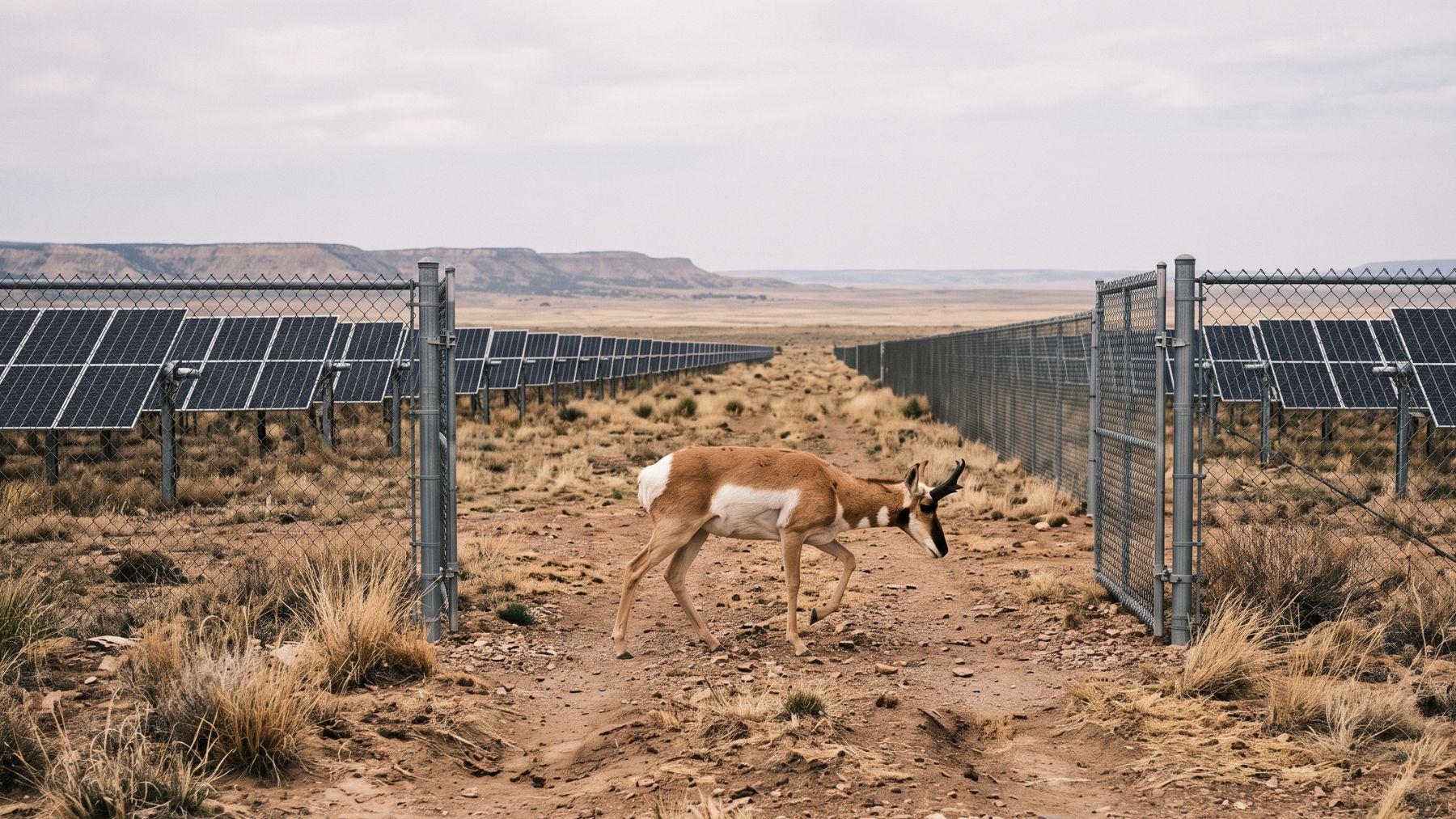
Just after dawn on the high desert of northern New Mexico, a pronghorn walks toward a solar fence.
It does not wheel around and bolt, the way the field guides say it should.
It drops its head, finds a gap between two fenced blocks of panels, and steps through.
A tracking collar on its neck logs the whole thing.
A thousand miles of cheap panels built that fence, and that gap.
So what is the fastest animal in the Americas doing inside a solar farm?
The animal that slipped through instead of turning back
The surprise in the data was how little the pronghorn seemed to mind. Near a new solar farm in New Mexico, collared animals kept coming right up to the fences rather than avoiding them, and most of those living nearby passed within a few hundred feet. There was no sign they read the site as a wall to flee.
The collars logged a position every hour, and the tracks kept drifting toward the panels, not away.
They went through, not over.
Related
Where the fenced arrays left a gap, the pronghorn threaded it, using the open lanes between panel blocks as pronghorn passages across ground that looked, on a map, like solid infrastructure. The animals had turned a barrier into a route.
Why a pronghorn cannot just jump over
To see why the gaps matter, start with the animal. A pronghorn is built for flat out speed, the fastest land runner in the Americas, and it evolved on open plains with nothing to leap. Faced with a fence, it does not clear it like a deer. It looks for a way underneath.
A solid barrier simply stops it.
That one limit has shadowed roads, pipelines and railways across the West for more than a century. So when a solar farm drops a continuous fence across open range, the question is not whether the pronghorn will jump it, but whether the layout leaves any way through. Get that wrong and the fence does what a canyon or a river never could, splitting a range in two.
How cheap panels reached the range
The reason these farms spread so fast comes down to price. A global glut of solar panels has sent their cost into free fall, roughly halving module prices in a single recent year as factories churned out far more than the world could install. Cheap panels made sprawling projects easy to justify.
Developers snapped up flat, sunny acres across the West, and one modern farm can now cover a couple of square miles of open ground.
Someone paid for that collapse. The biggest Chinese panel makers, five firms alone, shed about 87,000 workers last year, close to a third of their staff, as prices sank below the cost of building the panels. The same overcapacity that erased those jobs is what carpeted parts of the American West in low cost solar.
What the collars actually showed
The New Mexico numbers are still early, but pointed. Researchers fitted 75 pronghorn with tracking collars across two areas, and of the thirty living near the new farm, eighteen came within about 330 feet of the fencing, the same patient tracking that maps an offshore wind site.
But they were picky about which gaps they used. The animals favored the wide passages between arrays and mostly skipped the long, narrow ones, though a field study found they would still squeeze through a tight lane to reach food or water they needed. That mattered, because a passage an animal will not use is, for a migrating herd, the same as a solid wall.
Related
So the shape of the gap decides everything.
A generous lane reads as open country, while a long slot between fences reads as a trap, which means a solar farm can either keep a migration route open or seal it off, depending only on how its arrays are spaced. And the work is preliminary, one facility watched for a single year, so nobody is calling it the final word yet.
The gap no one is required to leave
Here is the catch. Those useful passages are purely accidental, a product of how one contractor happened to lay out one project. A different crew on a different parcel could raise a fence with no real gaps, and the pronghorn would simply be shut out.
Nothing yet requires a builder to leave room.
That is starting to change. Several western states are weighing rules that would set minimum gap widths for large solar farms, turning a lucky accident into a design standard, the way planners now leave room for a fox to move around some solar panels. Federal land managers have begun funding the wildlife research to back it, treating solar development as something that has to share the range.
Some plans would cover only the largest projects, where a blocked corridor would do the most harm.
A gap costs the builder almost nothing. Leaving it out can cost a herd its oldest route.