
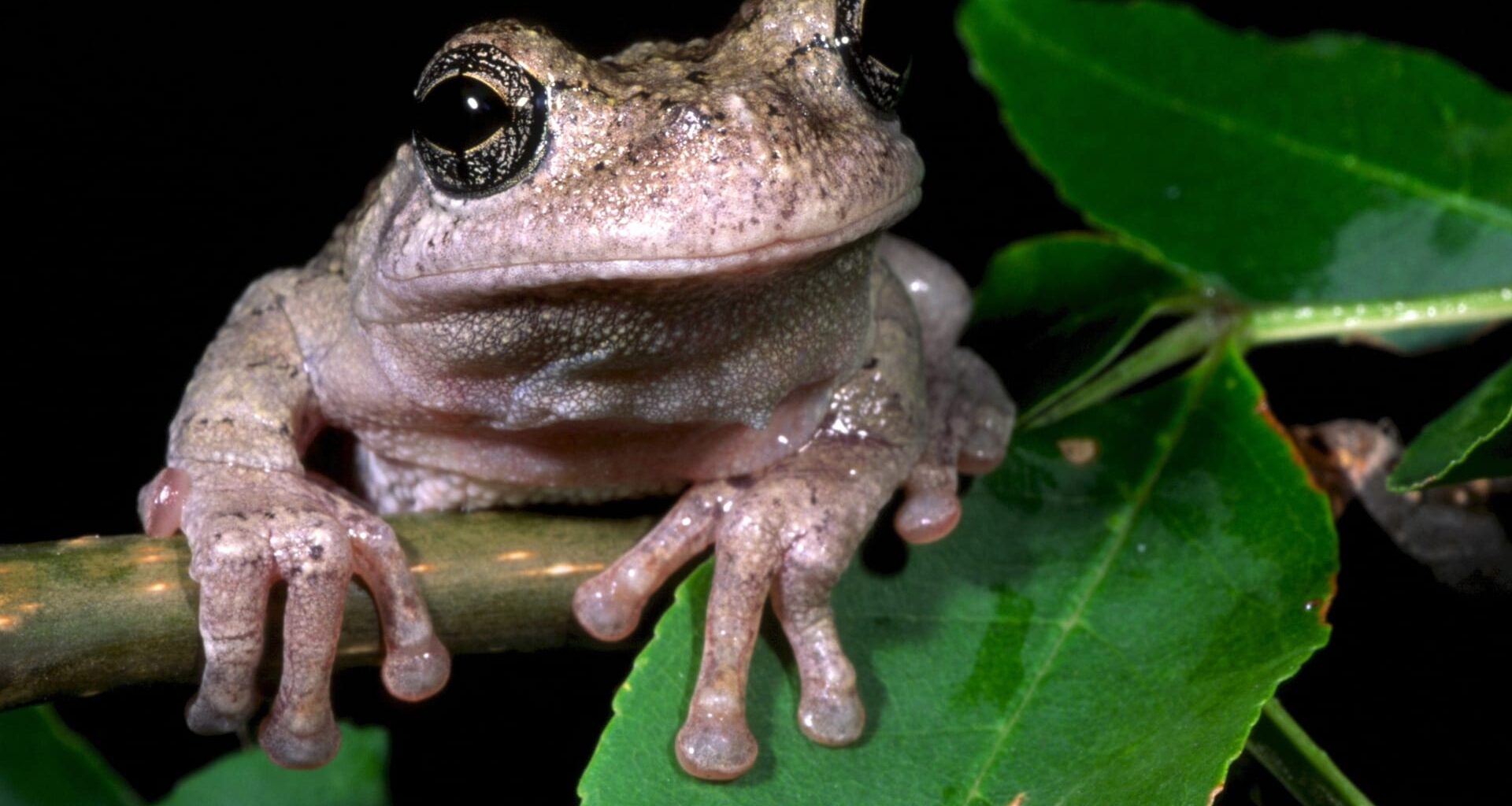
Female treefrogs experience choice overload when too many males call at once, making mate selection slower, less accurate, and less likely.
Animal courtship can look simple from the outside. Males advertise, females compare their options, and one potential mate wins their attention.
In a crowded breeding group, however, a female may have to sort through many signals at once.
New research on female Cope’s gray treefrogs shows that this flood of information can make mate choice slower, less accurate, and less likely to occur.
The results point to choice overload, which happens when having more options makes a decision harder instead of easier.
In these frogs, the challenge remained even when researchers separated the number of calls from the effects of background noise.
Crowded choruses make choosing harder
During the breeding season, male Cope’s gray treefrogs gather in large groups across eastern North America and call at the same time.
Each male tries to attract a female, but the combined chorus can become a dense wall of sound.
A female listening nearby must distinguish individual mating calls while many others compete for her attention. Several males may call at once, turning mate choice into a demanding task.
Researchers have often focused on energetic masking, which occurs when overlapping sounds make one signal harder to hear.
A second problem may arise even when the calls remain audible: The female may face more options than she can easily compare.
Separating noise from options
The team tested these possibilities in a laboratory by playing recorded mating calls through speakers.
Females heard one designated target call alongside varying numbers of competing calls. Researchers also changed the amount of background noise.
The setup tested whether females struggled because noise masked the calls, because they faced too many choices, or because both problems occurred together.
The frog version of dating apps
The researchers wanted to determine why female treefrogs have trouble finding a mate.
“Whether it’s because they have trouble hearing males against a noisy backdrop, or if the females simply become overwhelmed by the number of options,” said lead author Claire Hemingway, an assistant professor at the University of Tennessee.
“In human terms, is it like entering a crowded bar and not being able to hear anyone talk, or is it like using a dating app and not being able to choose among the many options?”
Hemingway is also a research associate at the Smithsonian Tropical Research Institute.
Treefrog females struggled as choices grew
When females heard only two calls, they pursued a mate 97 percent of the time. When the number rose to eight, that share fell to 82 percent.
This decline showed that some females did not complete a choice under the more crowded condition.
The frogs also became less likely to select the target call as the number of options grew. With two calls, females chose the target 76 percent of the time. With eight calls, they chose it only 25 percent of the time.
Decision speed changed as well. Females took an average of 114 seconds to reach the target when they heard two calls, compared with 183 seconds when eight calls competed for their attention.
Noise did not explain everything
Researchers saw the same overall pattern with and without added background noise.
Females performed worse across several measures as the number of calls increased, even when noise could not fully explain the decline.
“We were shocked by how straightforward the results were,” said Jessie Tanner, the paper’s senior author and an assistant professor at the University of Tennessee.
“With or without noise, when we presented more calls to the females at once, their performance declined in several ways, making the effect of choice overload clear.”
Overlapping sounds may still affect mate choice. However, the experiment shows that the number of available calls can create a separate challenge beyond hearing one male against a noisy background.
Brain limits shape treefrog mating
Choice overload reflects a cognitive limit on how much information the brain can process and compare at one time.
A female may hear several males clearly but still struggle to sort through the calls, evaluate them, and commit to one option.
That limit could affect sexual selection, the process through which traits associated with mating success become more or less common over generations. Too many competing calls could cause females to overlook some males.
The findings therefore shift some attention from the signal to the listener. Mating outcomes may depend not only on the signals males produce but also on how much information females can process in a crowded setting.
The work also raises broader questions about animals that choose among many signals. The results suggest that similar limits may matter in other species, but they do not prove that every species experiences choice overload in the same way.
Real ponds may work differently
Using recorded calls and speakers gave the team control over the number of options and the amount of noise. This control helped researchers separate two problems that occur together in a natural chorus.
However, a laboratory setup cannot reproduce every feature of a real breeding site. The findings show how females responded under the tested conditions, not how every female will behave in every pond or population.
The experiment also does not show that choice overload always matters more than sound masking.
Instead, it shows that increasing the number of calls can create a separate, measurable challenge even when researchers account for background noise.
Choice overload shapes animal mating
A breeding chorus gives female treefrogs access to many possible mates, but more options do not always lead to better decisions.
In this experiment, a larger number of calls made females less likely to pursue a mate or select the target call. It also increased the time they needed to decide.
These results provide a clearer view of animal choice as a mental task. Hearing a call is only the first step. A female must also compare the alternatives before choosing a mate.
The main takeaway is cautious but important: Crowded social environments can shape mating behavior by placing additional demands on an animal’s ability to process information.
The study is published in the journal iScience.
—–
Like what you read? Subscribe to our newsletter for engaging articles, exclusive content, and the latest updates.
Check us out on EarthSnap, a free app brought to you by Eric Ralls and Earth.com.
—–