

According to the latest Statistics Canada data, the number of active businesses across the country (now approximately 935,000) fell by 4,400 between March 2024 and March 2026. Too few new businesses are opening to replace the ones that close.
This isn’t an isolated data point—Canadian entrepreneurship is declining across nearly every measure. That matters because new businesses create jobs, introduce innovations, and push incumbents to improve. When business formation stalls, the whole economy feels it, with slower productivity growth and less opportunity.
Canada’s poor performance can be reversed. High-performing business-formation nations show that certain policy choices create conditions for entrepreneurship to flourish. For many years, Canada has moved in the opposite direction, building a system that actively discourages business formation through regulatory complexity, reduced competition, and uncompetitive taxation. This DeepDive looks at countries that got it right, and what Canada, as a small open economy, can learn from them.
International comparisons
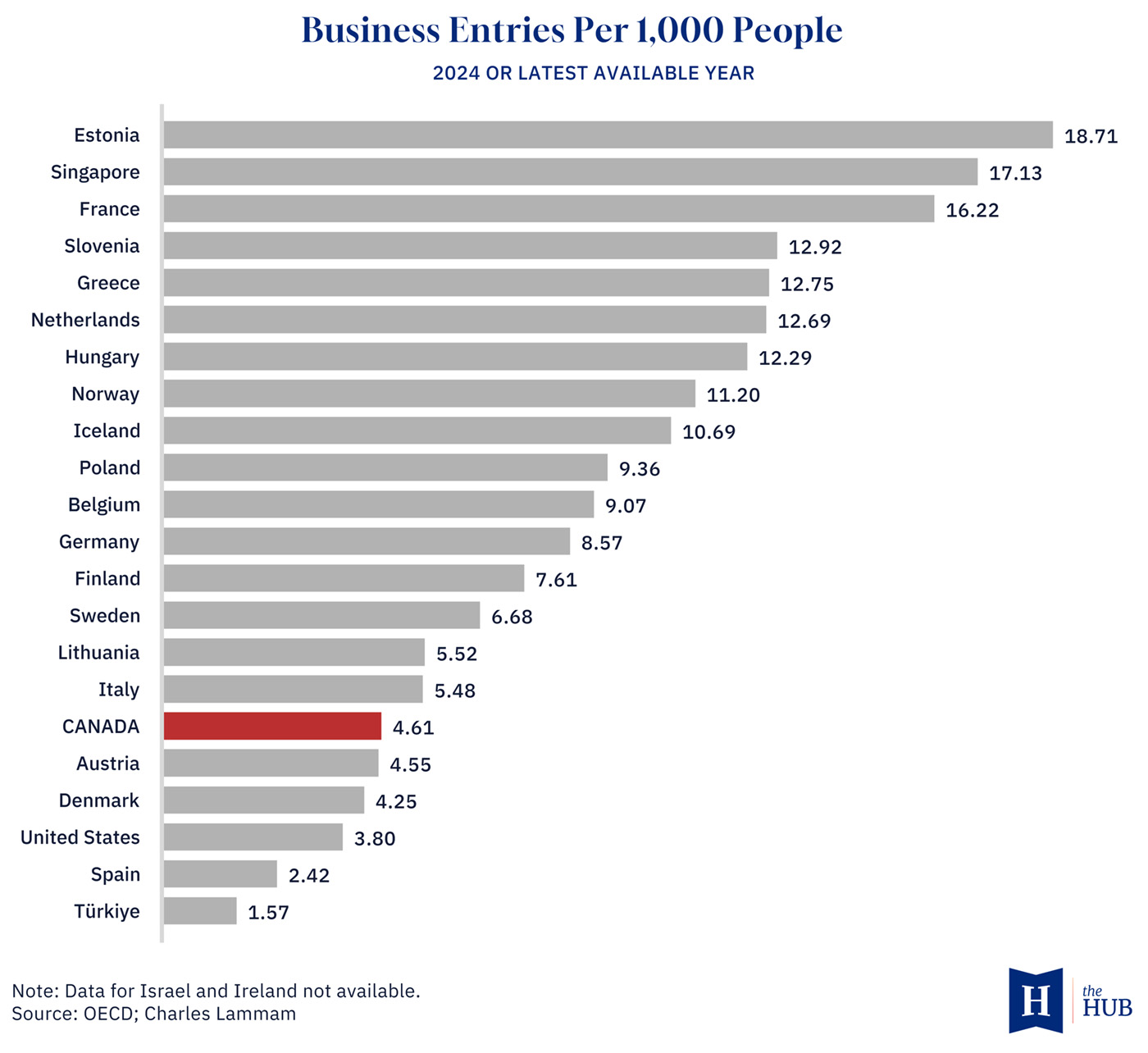
Canada ranks 17th out of 22 advanced countries with available data on business entries per capita—just 4.61 new businesses per 1,000 people. Estonia leads at 18.71, Singapore at 17.13, and France at 16.22. Even the United States, despite its reputation as an entrepreneurial powerhouse, manages only 3.80, placing 20th.
Graphic Credit: Janice Nelson.
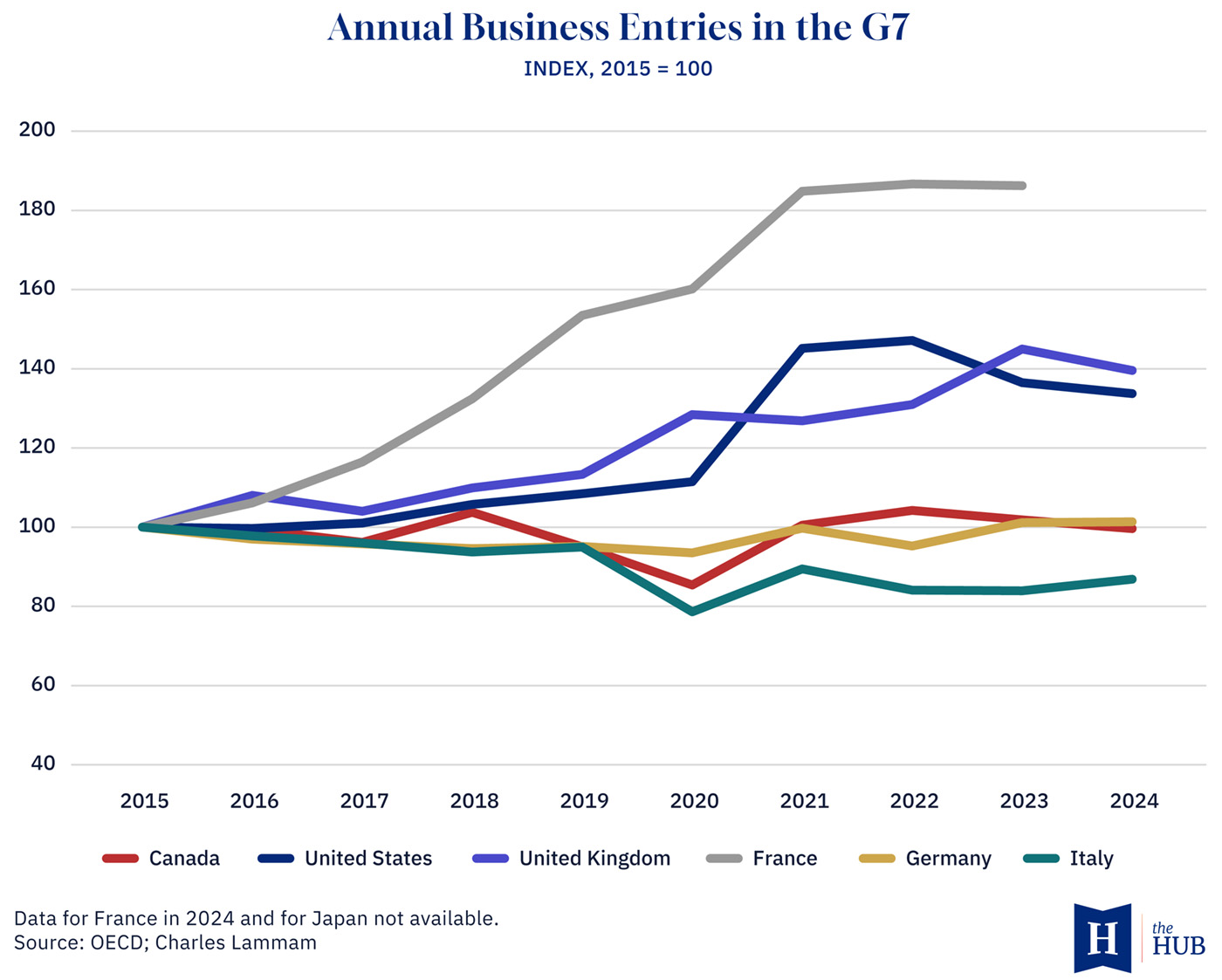
Since 2015, business entries show a clear divergence between Canada and G7 peers. While other major economies expanded their entrepreneurial capacity over the past decade, Canada flatlined. In 2015, Canadians created about 191,000 new businesses. By 2024, the figure was 190,399, essentially unchanged despite substantial population growth. The U.S. saw annual business entries rise by 34 percent over the same period, while the U.K. and France posted increases of 40 percent and nearly 86 percent, respectively.
Graphic Credit: Janice Nelson.
The United States is a puzzle: it ranks 20th in business entries per capita, yet it has the world’s largest and most dynamic venture capital market. The puzzle disappears once you separate formation from scaling. The U.S. may lag countries like France, with its simplified auto-entrepreneur system (more on this later), in getting companies off the ground. But once a company exists, it has access to deep capital markets, sophisticated investors, and a culture that tolerates failure and rewards success.
The challenge isn’t choosing between formation and scaling but excelling at both. Canada, however, falls short on both dimensions. Business formation here lags Estonia and Singapore, while scaling infrastructure lags the U.S. In fact, Canadian companies and entrepreneurs increasingly relocate down south for growth capital and opportunities.
Estonia, Singapore, Ireland, and Israel rank among the world’s top business-formation nations. Each took a different path, yet all share common policy foundations. Meanwhile, France provides an instructive case of a large European economy that improved business formation through a targeted policy measure. But France left broader framework conditions unchanged, making it a cautionary tale rather than a model to emulate.
These countries aren’t the only entrepreneurial success stories, but between them they span very different approaches—Estonia’s light touch to Israel’s more activist government, comprehensive tax reform to a single administrative change—enough range to see what they have in common.

What sets the leaders apart
The countries that excel at business formation share three broad framework conditions: competitive taxation, less restrictive regulation, and more competition in product markets. They largely get the framework right first, then use targeted programs to close specific gaps. Framework conditions affect every business, while support programs only help the ones that qualify.
Estonia: Tax competitiveness champion
Estonia consistently ranks first in the Tax Foundation’s International Tax Competitiveness Index among countries belonging to the Organization for Economic Cooperation and Development (OECD). Its top score comes from many positive features, including a single 22 percent tax rate on corporate income, applied only when profits are distributed to shareholders. Companies pay zero tax on retained and reinvested earnings, so every dollar a growing business earns can go straight back into hiring, product development, or market expansion without triggering immediate tax consequences. This encourages long-term capital formation rather than short-term profit extraction.
The personal income tax system stands out. A flat 22 percent rate applies broadly, but dividend income from Estonian companies receives special treatment since the corporate level already taxes distributions. This integration prevents double taxation while maintaining simplicity. All earners face the same marginal rate, eliminating the disincentives that come with steeply progressive systems.

i
The cafe area of co-working space Crew, is seen in the former Royal Bank of Canada headquarters Friday, November 18, 2016 in Montreal. Ryan Remiorz/The Canadian Press.
Consumption taxes complete the competitive structure. Estonia relies on a value-added tax with a standard rate of 24 percent, higher than many OECD countries and applied broadly with few exemptions. This broad-based approach generates revenue efficiently without creating the distortions that come from selective exemptions and multiple rates.
In Estonia, property tax applies only to the value of land, not to buildings, equipment, or other improvements, encouraging productive investment in real capital while capturing economic rents from land.
The country also has a territorial system that exempts foreign profits earned by domestic corporations.
Digital infrastructure reinforces these tax advantages. In Tallinn, starting a company can take minutes, with registration, taxation, and contracts handled online without a single interaction with a civil servant. The e-Residency program extends this digital access globally.
When a jurisdiction makes it easy and affordable to start and scale companies, investors and entrepreneurs respond, and the results are telling: Estonia raised $1,056 per capita in venture capital in 2022, far exceeding the European average of just $140.

Singapore: Competitive framework with targeted supports
Singapore combines a low headline corporate tax rate of 17 percent with targeted incentive schemes that reduce effective rates during the early growth phase.
Personal income taxation is highly competitive with a top marginal rate of 24 percent and generous personal exemptions. The system uses progressive rates but maintains international competitiveness at high income levels to attract talent. The top rate applies on income over $1 million SGD versus approximately$258,000 CAD in Canada. Capital gains receive no tax, encouraging risk-taking and investment.
Consumption taxes follow a straightforward structure with a Goods and Services Tax (GST) of 9 percent. The broad-based approach with limited exemptions generates revenue efficiently while keeping compliance costs manageable for businesses.
The Double Tax Deduction for Internationalization scheme supports scaling. Eligible expenses such as overseas marketing, trade fairs, and market research qualify for a 200 percent tax deduction, directly lowering the cost of international expansion—a key challenge for businesses in Singapore’s small domestic market.
Singapore also employs targeted measures such as the Startup Tax Exemption Scheme, which gives new companies substantial relief in their first three years. That includes a 75 percent tax exemption on the first $100,000 SGD of taxable income and 50 percent on the next $100,000 SGD, so a company earning $200,000 SGD in its first year pays tax on only $75,000 SGD. More capital stays in the business during the period when cash flow matters most.

i
An office worker talks on the phone in the financial district of Toronto, June 2, 2016. Eduardo Lima/The Canadian Press.
After this initial three-year period, all companies benefit from the Partial Tax Exemption Scheme, receiving a 75 percent exemption on the first $10,000 SGD of chargeable income and 50 percent on the next $190,000 SGD. Even mature businesses end up well below the headline rate.
These targeted incentives, while helpful for new ventures, can create “cliff effects” as firms scale beyond eligibility thresholds. Canada faces this challenge with its small business tax rate, which applies a preferential rate to the first $500,000 of active business income. Firms passing the threshold face a sharp jump in their marginal rate that can double or triple, depending on the province. Unlike Singapore’s temporary incentives for new companies, based on firm age and designed to help them reach viability, Canada’s permanent small business rate creates ongoing distortions that discourage growth.
Research and development (R&D) also receives special treatment. Businesses can claim up to a 400 percent tax deduction on approved R&D expenses, with eligible costs including staff wages, materials, testing, and IP registration. Companies can opt for a cash payout of up to $20,000 SGD instead of deductions, providing immediate liquidity for smaller firms.

Ireland: Comprehensive transformation
Ireland’s transformation from European laggard to startup magnet began in the 1990s with fundamental tax reforms that created the foundation for today’s thriving entrepreneurial ecosystem.
The centrepiece was a dramatic reduction in the corporate income tax rate to 12.5 percent (from 50 percent in the 1980s) for trading income, implemented in phases through the 1990s and early 2000s. This rate, one of the lowest in the developed world, attracted multinational corporations and created a competitive environment for domestic businesses. A simple, transparent rate structure avoids the complexity that plagues many other corporate tax systems.
Personal income tax reforms accompanied the corporate changes. Ireland reduced top marginal rates from over 50 percent in the late 1980s to 40 percent (excluding the Universal Social Charge), broadened tax bands, and increased standard exemptions, improving incentives for entrepreneurship and talent attraction.
Intellectual property received favourable treatment through a patent box, allowing companies to pay a reduced 6.25 percent corporate rate on qualifying IP income. This encouraged companies to locate valuable intangible assets in Ireland and supported R&D-intensive business models. The R&D tax credit recently increased from 30 percent to 35 percent for accounting periods starting in 2026, with a raised first-year payment threshold providing cash flow support for smaller firms.
Ireland’s model is reinforced by non-tax advantages too, including a pro-investment regulatory environment, a skilled English-speaking workforce, close ties to the U.S., openness to foreign investors, strong industry-academia links, and EU market access.

i
Pedestrians walk by CIBC’s office tower in Vancouver, Friday, Dec. 12, 2003. Richard Lam/CP Photo.
Israel: “Startup nation” with unique features
Israel shows how policy, culture, and institutional support can produce entrepreneurship despite challenging circumstances from ongoing security threats, a small domestic market, and geographic isolation from major trading partners. With more than 7,000 active startups and tech companies, Israel ranks among the top countries globally for startups and venture capital per capita. It leads the world in R&D investment relative to GDP, spending around 6 percent annually.
U.S. firms account for nearly two-thirds of the more than 300 R&D centres established by multinational companies in Israel. Israel has 135 companies listed on the NASDAQ—the fourth most after the United States, Canada, and China. That integration gives Israeli firms access to capital and customers abroad, and reinforces the country’s role as a technology supplier to the world.
View reader comments (3)
The Israeli model is more interventionist than Estonia’s or Ireland’s, with direct government support coming through multiple channels. The Israel Innovation Authority operates grant programs for early-stage companies, incubators, and research collaboration. The landmark example is Yozma, a 1993 program that used $100 million in public capital to seed 10 hybrid public-private venture funds, each pairing an Israeli investor with a foreign VC. Government exited its stake within a decade, leaving a fully private VC market behind.
A recent government initiative is the Startup Fund, collaborating with private investors to inject over half a billion shekels annually into seed, pre-seed, and Series A rounds. Tel Aviv also offers tax incentives for startups, including reduced corporate tax rates.
The ecosystem runs on tight integration between founders, investors, researchers, policymakers, and multinational partners. Geographic proximity shortens feedback loops, and cultural norms favour direct communication and fast decisions.

Mandatory military service plays a unique role in talent development. Elite technology units train young people in cutting-edge skills and forge networks that outlast their service—networks that many successful startups can trace their origins to.
Canada can’t replicate aspects of Israel’s specific history, including the role of the military, but it can implement policies that signal commitment to entrepreneurship and thereby shape culture over time.
France: Targeted auto-entrepreneur effect
France’s appearance near the top of the OECD business entries data—16.22 per 1,000 people, ranking third—would surprise many observers given the country’s reputation for complex regulation and an uncompetitive tax regime. The explanation lies in a specific policy innovation: the auto-entrepreneur (now officially micro-entrepreneur) regime.
Introduced in 2009 and refined over subsequent years, the regime creates a simplified pathway for small-scale business creation. Registration happens online through a centralized portal. Individuals can become auto-entrepreneurs with minimal paperwork and immediate authorization to conduct business.
The tax structure is simplified too. Rather than standard corporate taxation with full accounting requirements, auto-entrepreneurs pay a flat percentage of turnover as social contributions or opt for a simplified income tax based on revenue, cutting out complex bookkeeping and compliance costs.

i
View of the surveillance room of the Euronext France, Friday, March 21, 2025 in La Defense business district, outside Paris. Thomas Padilla/AP Photo.d
Revenue thresholds define eligibility. Auto-entrepreneurs can earn up to €77,700 for services or €188,700 for trade activities while remaining in the simplified regime.
The French example differs fundamentally from the comprehensive reforms seen in Estonia, Singapore, Ireland, and Israel. France did not transform its tax system, reduce regulatory burden, or increase competitive intensity. It implemented a single administrative simplification that streamlined registration and compliance for small ventures. This targeted change boosted one metric—business entries—without addressing the broader framework conditions that constrain scaling, investment, and growth. Isolated policy changes don’t generate the widespread economic effects of ecosystem-level transformation.
Common patterns: Framework conditions matter more than programs
Line up the numbers from the leading countries and a clear pattern emerges, one that highlights Canada’s disadvantage.
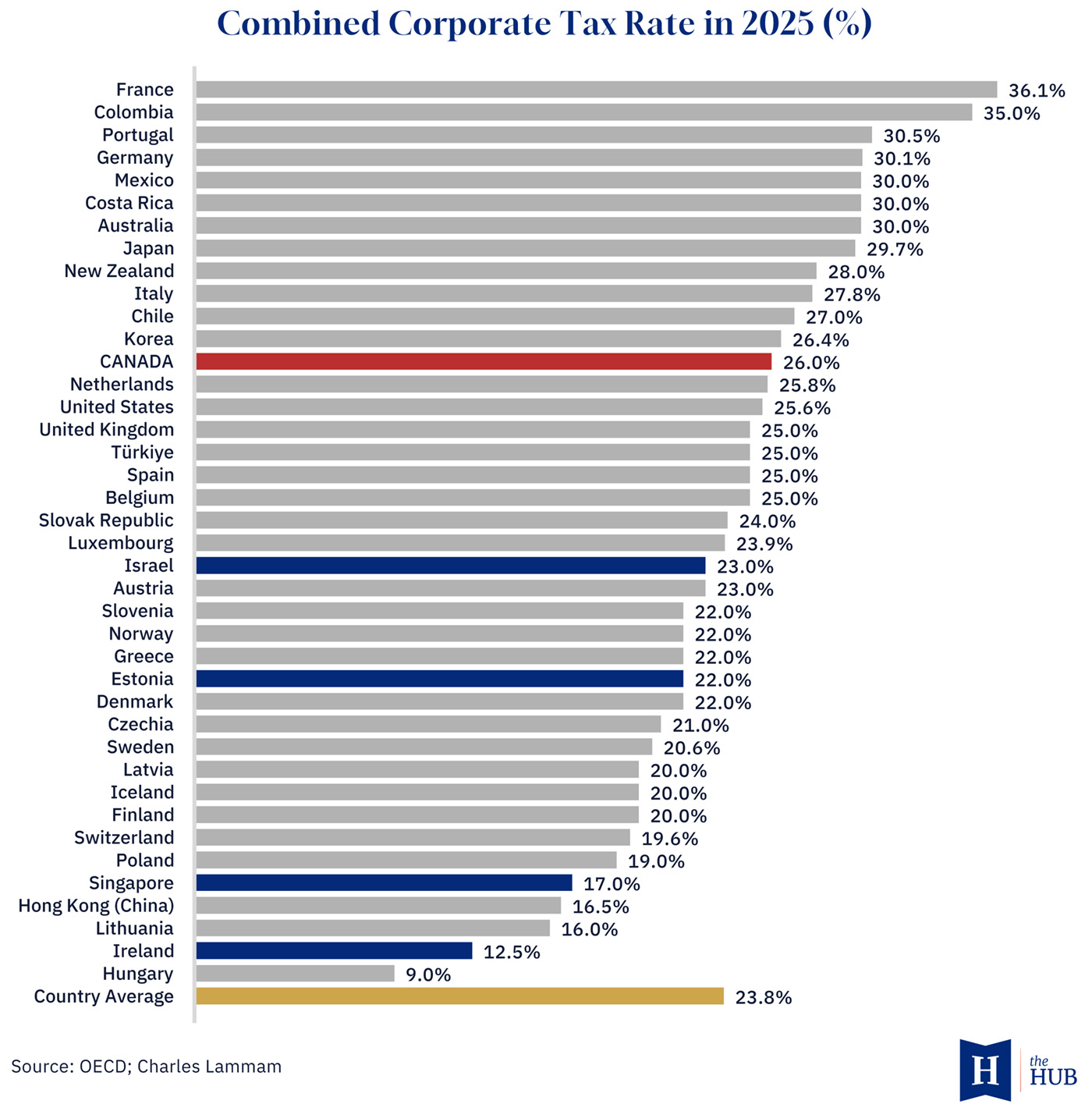
Start with the headline statutory corporate tax rate. The leaders keep them low. Ireland sits at 12.5 percent, Singapore at 17 percent, and Estonia’s 22 percent applies only to distributed profits—effectively zero for companies that reinvest their earnings. Israel is at 23 percent. Canada’s combined federal-provincial rate averages 26 percent (higher in some provinces).
Graphic Credit: Janice Nelson.
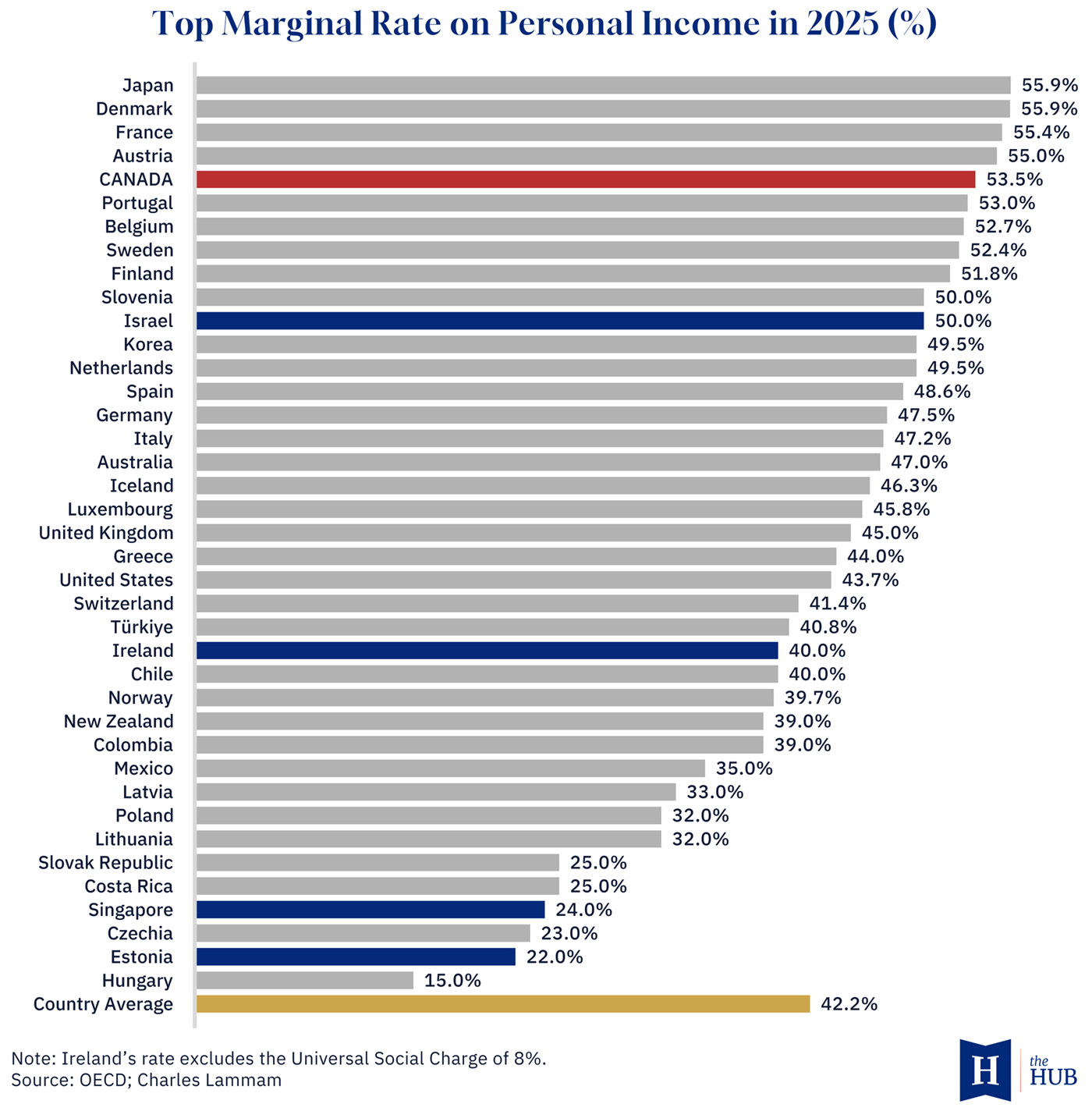
Personal income tax follows the same script. Top marginal rates among the leaders cluster between 22 percent (Estonia’s flat rate) and 24 percent (Singapore), and even the higher rates in Ireland (40 percent) and Israel (50 percent) fall well below Canada’s combined federal-provincial ceiling of nearly 54 percent.
Graphic Credit: Janice Nelson.
Rates aren’t the whole story; the structure of the tax system matters too. Estonia taxes only distributed corporate profits, rewarding reinvestment. Singapore exempts capital gains entirely. Ireland offers a 10 percent rate on qualifying entrepreneurial exits up to €1.5 million. Each of these rewards building a company over extracting income from one.
Canada’s tax system does the opposite. Ottawa taxes capital gains outright, and in 2024 it proposed raising the inclusion rate further, a move entrepreneurs saw as penalizing risk-taking before the government shelved it in 2025. Rollover provisions that exempt reinvested earnings remain narrow, and while the Lifetime Capital Gains Exemption offers relief on small business shares (totalling $1.275 million CAD), it’s a one-time allowance worth a fraction of the exemption American entrepreneurs can claim under the U.S. Qualified Small Business Stock rules ($15 million USD), and unlike the U.S. version, it can’t be claimed anew on each successive venture.
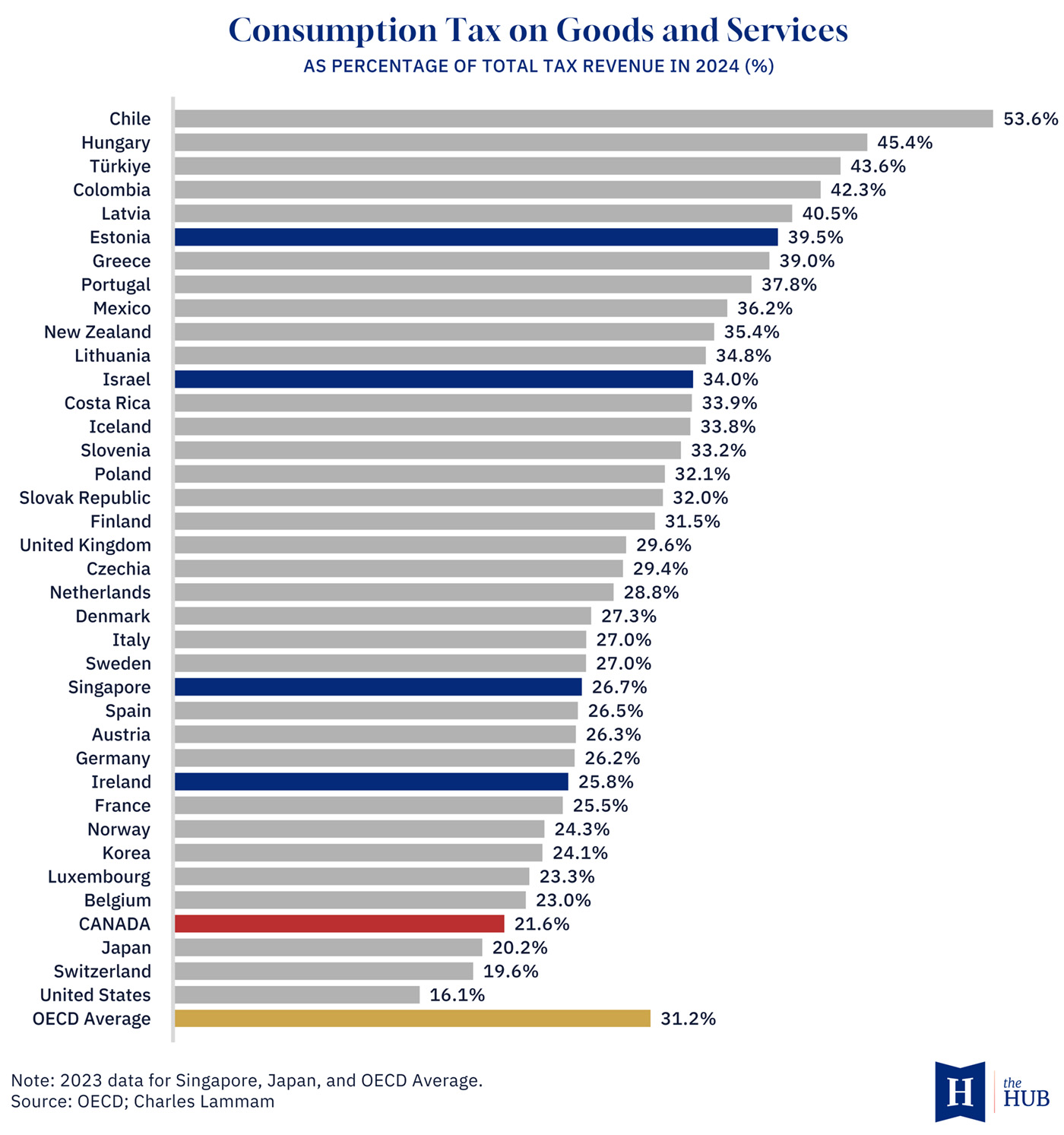
On consumption taxes, the leaders fund more of government through this broad-based, efficient source. Estonia derives 39.5 percent of tax revenue this way, Israel 34.0 percent, Singapore 26.7 percent, and Ireland 25.8 percent. Canada, at 21.6 percent, relies on them least of all.
Graphic Credit: Janice Nelson.
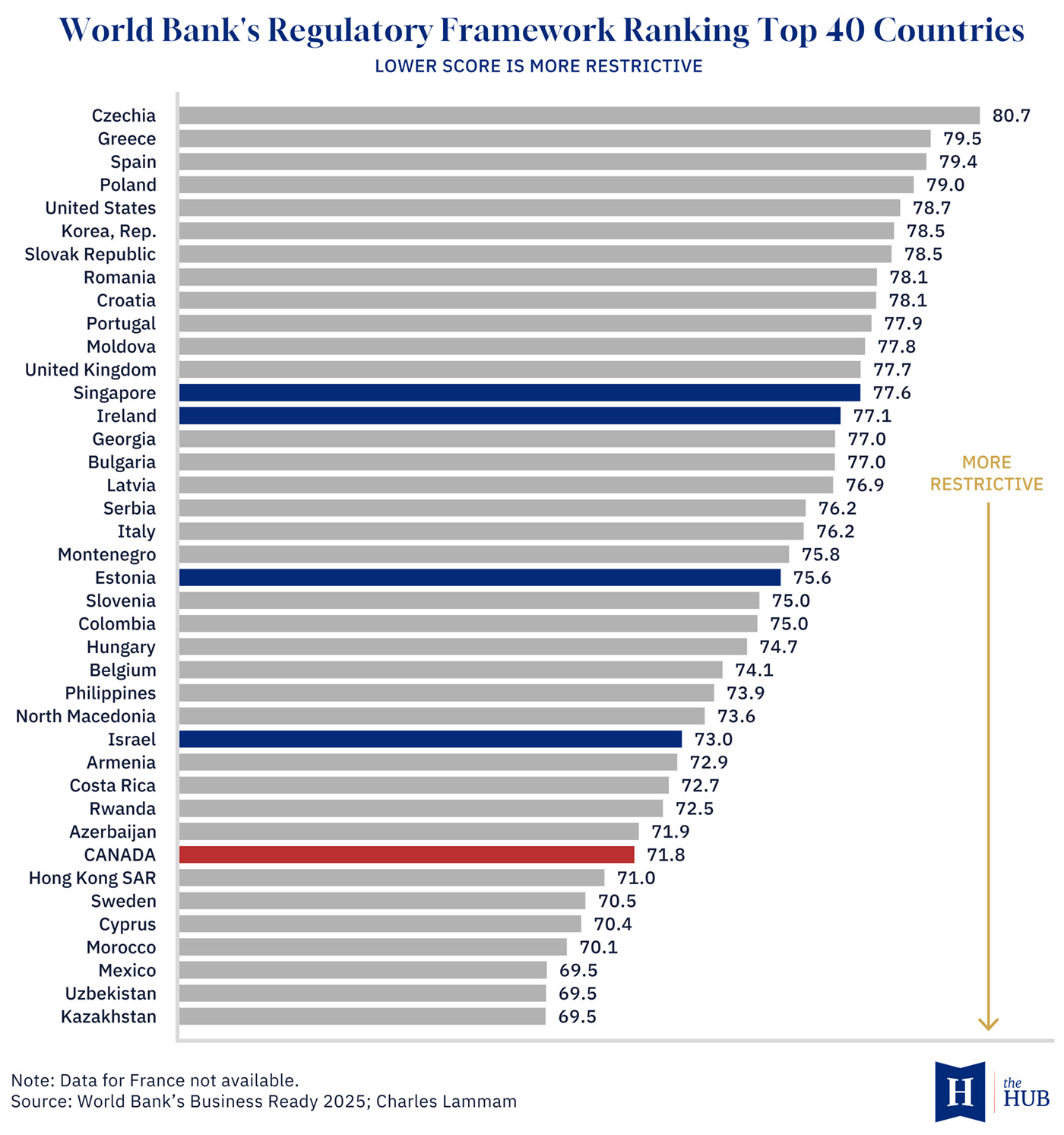
Canada is also at the bottom of the pack on regulatory burden. According to the World Bank’s regulatory framework ranking, where a higher score is better, Singapore (77.6), Ireland (77.1), Estonia (75.6), and Israel (73.0) rank among the top 30 globally. Canada trails every leader, scoring 71.8—33rd out of 101 nations. Canada has allowed the burden of regulation to grow significantly, along with compliance costs, hitting small businesses hardest.
Graphic Credit: Janice Nelson.
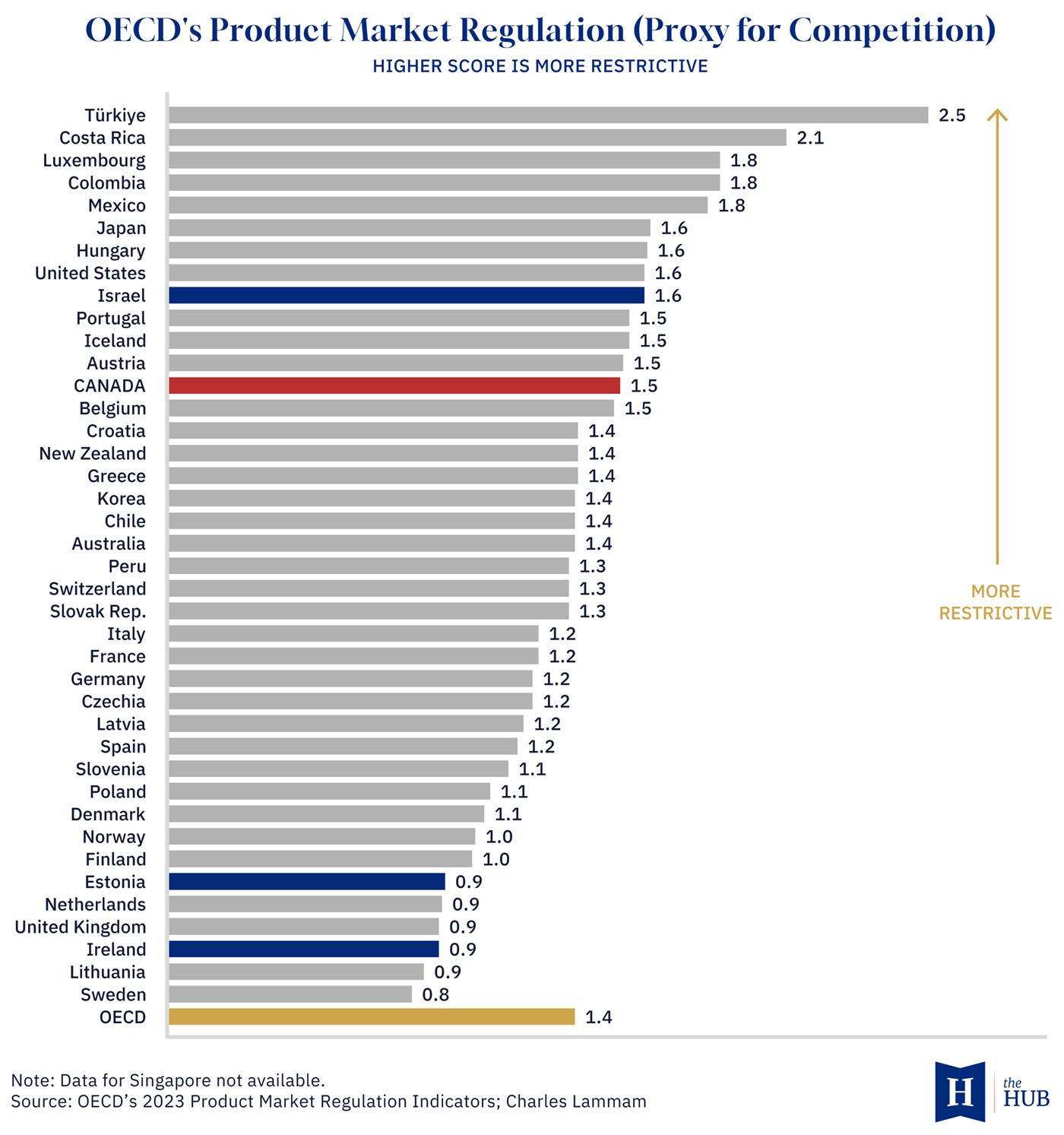
Competition in Canada also diverges from the leaders. OECD measures put Estonia and Ireland at 0.9—among the least restrictive competitive environments in the world. Israel sits at 1.6. Canada scores 1.5, worse than the OECD average of 1.4 and well behind the entrepreneurial leaders. The gap reflects regulatory barriers, interprovincial trade restrictions, and policies that often favour incumbents over new entrants.
Graphic Credit: Janice Nelson.
Canada has no shortage of government support programs for new businesses. By one count, the federal government alone runs 134 programs with innovation or business support mandates, spending billions annually through direct subsidies and tax credits. The country maintains the Business Development Bank of Canada (BDC), Export Development Canada (EDC), Farm Credit Canada (FCC), the Industrial Research Assistance Program (IRAP), and dozens of sector-specific funds. The Scientific Research and Experimental Development (SR&ED) tax credit provides among the most generous R&D support globally. Provincial governments add their own layers of grants, loans, and tax credits. Entrepreneurs must navigate overlapping programs across multiple jurisdictions, each with distinct application processes and eligibility criteria.
Programs can help individual companies access capital or subsidize specific activities, but framework conditions determine whether would-be entrepreneurs bother starting in the first place. A well-designed grant program supports some companies; competitive tax rates and light regulation help every business in the economy, without a government program deciding case by case who deserves it. Streamlining the current patchwork of programs would help, but no amount of tinkering substitutes for fundamental reform of tax rates, regulatory burden, and competitive intensity.

Canada’s unique challenge
Canada faces a structural challenge absent from the countries examined. Neither Estonia, Singapore, Ireland, Israel, nor France operates under a federal system. As unitary states, they implement tax reforms, regulatory changes, and competitive policies nationwide simultaneously. Canada’s provincial jurisdiction over taxation, business regulation, securities markets, and interprovincial trade creates fragmentation and coordination challenges that can delay and dilute reform. Effective reform in Canada requires federal-provincial coordination to have the greatest national impact.
Canada’s poor ranking on business entries reflects policy decisions that work against entrepreneurship. Other countries show that deliberate policy choices can create the conditions for entrepreneurship to flourish.
DeepDives is a bi-weekly essay series exploring key issues related to the economy. The goal is to provide Hub readers with original analysis of the economic trends and ideas that are shaping this high-stakes moment for Canadian productivity, prosperity, and economic well-being. It features the writing of leading academics, area experts, and policy practitioners. The DeepDives series is made possible thanks to the ongoing support of the Centre for Civic Engagement.

Charles Lammam is an economic and policy professional with over two decades of combined experience as a think-tank scholar and thought leader,…
Read more