
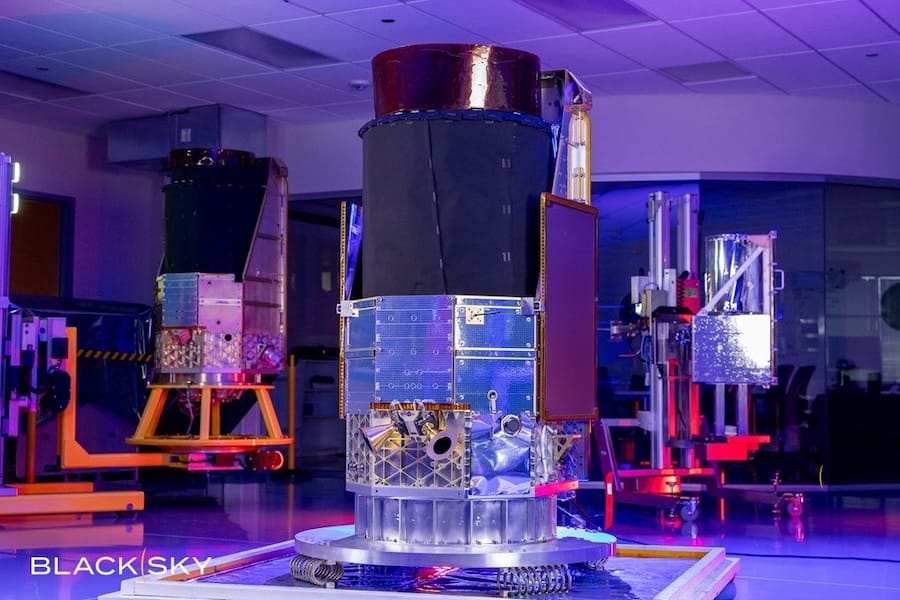
BlackSky Technology is producing more than 20 Gen-3 satellites, including unallocated spacecraft that could be assigned to future sovereign intelligence contracts. The strategy is designed to let the company begin deliveries within about a year of an order, cutting a procurement process that can otherwise take three to five years.
The production pipeline also covers satellites for BlackSky’s commercial constellation and existing Mission Solutions contracts. Chief Executive Officer Brian O’Toole did not disclose how many spacecraft were being built specifically as inventory.
“We believe that by having that inventory on hand and a scalable production environment, we can start delivering to customers within a year or so of getting those orders,” O’Toole said during the company’s second-quarter earnings call. Customers turning to suppliers that must start from scratch could wait as long as three to five years, he said.
Building satellites before contracts are signed marks an effort to compete on delivery time in a market shaped by governments seeking faster access to space-based intelligence. BlackSky said demand is strongest among international customers, although it is also pursuing opportunities with US government agencies.
The company is offering sovereign customers dedicated Gen-3 satellites alongside immediate access to imagery and artificial intelligence services from its operational commercial constellation. That structure allows governments to test the technology before committing to their own spacecraft.
O’Toole said the model lowers the risks of acquiring an unproven system and provides greater certainty over cost, schedule and performance. BlackSky can pull satellites from an established production line instead of beginning a separate development programme after each award.
Gen-3 satellites produce imagery at a resolution of 35 centimetres and are designed for low-latency operations. BlackSky combines the spacecraft with its Spectra software platform to deliver AI-supported intelligence for time-sensitive missions.
O’Toole said Gen-3 provides high-quality imagery, operational agility and scalability at about one-fifth of the cost of legacy platforms. More than a year of performance in orbit has given potential customers an opportunity to assess the satellite before starting acquisition programmes, he added.
BlackSky is on schedule to deliver its first sovereign Gen-3 satellite in 2026 and expects to reach other Mission Solutions milestones during the year. The company is seeking further sovereign orders that would add to its backlog and support growth beyond 2026.
The commercial constellation is expanding in parallel. BlackSky planned to launch two additional Gen-3 satellites in the third quarter and maintained its target of having eight in orbit by year-end despite launch-related delays.
The company ultimately intends to operate approximately 12 to 15 satellites to provide an hourly revisit service. Some of the spacecraft in production will support that target, while others will fulfil existing sovereign commitments or remain available for prospective customers.
O’Toole said the company does not need additional Gen-3 satellites to achieve its 2026 revenue targets. The broader production programme is intended to prepare BlackSky for future capacity requirements and an expected increase in Mission Solutions awards.
Prospective sovereign customers often begin by purchasing imagery subscriptions and testing Gen-3 services, according to management. Those relationships can then develop into discussions about dedicated satellites and supporting ground infrastructure.
BlackSky said this combination of recurring subscriptions and sovereign systems could generate revenue throughout a customer relationship. A government can use the commercial constellation while its dedicated satellite is being prepared and continue purchasing BlackSky services after delivery.
The approach is gaining traction amid rising international demand for independent space-based intelligence capabilities. Multi-year international subscription contracts accounted for more than 80% of BlackSky’s total funded backlog at the end of the second quarter.
International revenue from space-based intelligence and AI subscriptions increased 150% from a year earlier. Management said the performance of Gen-3 was expanding the pipeline of potential sovereign deals and prompting some customers to discuss faster acquisition schedules.
BlackSky reported second-quarter revenue of $33.3 million, up 50% from the previous year. Mission Solutions contributed to that increase as the company completed milestones under existing contracts, Chief Financial Officer Henry Dubois said.