
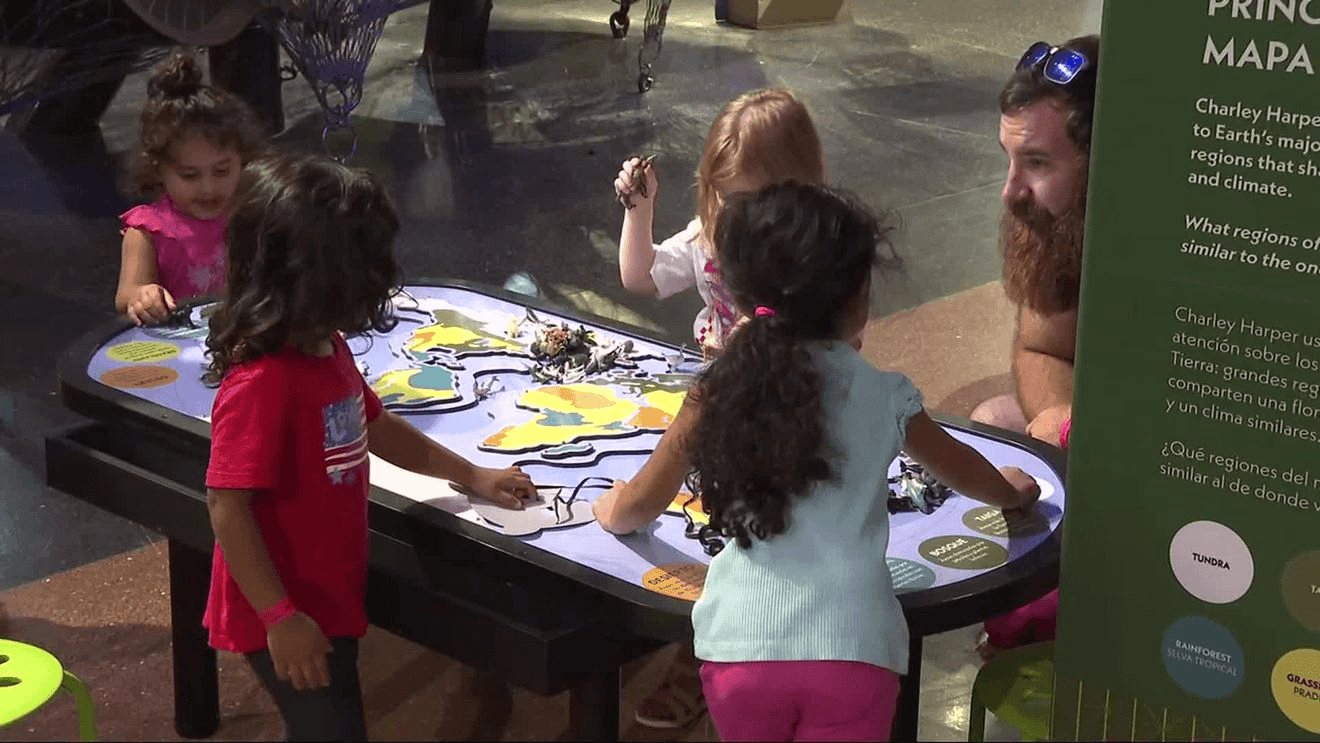
Charleston, W.Va. — A West Virginia-born artist known for his artistic take on the natural world is being celebrated back home, with an interactive exhibit designed to introduce Charley Harper’s work to a new generation.
The Clay Center in Charleston is hosting Harper’s traveling gallery more than a century after he was born in West Virginia. Clay Center Director of Communications Taylor Gue said bringing the exhibit to the state where Harper’s inspiration began was an easy decision.
“He looked out and saw the same trees, the same animal, that it keep in the West Virginia would be able to see as well. So I think there’s a certain kind of inspiration in how he was born,” Merritt said.
Born in West Virginia, Harper drew some of his earliest inspiration from the nature around him, a connection that continued throughout a career centered on art, animals and the natural world.
“West Virginia’s especially love to celebrate the fellow West Virginian. So anytime we can see that, it’s a joy and excitement. And introduce a next generation to them, it’s even better,” said Taylor Gue, the Clay Center’s communications director.
The exhibit, titled “I Am Wild,” takes Harper’s art off the walls and places children inside the world he created. Kids can explore different habitats, make art and learn about nature through play.
“Kids are naturally curious and this exhibit really lends itself to that natural curiosity so that we can develop those skills more and make a more well-rounded individuality,” Merritt said.
Part of what makes Harper’s work accessible for children is its simplicity. Harper described his style as “minimal realism,” breaking the natural world down into basic shapes.
“If you think about what a cardinal looks like, you know, West Virginia, beautiful West Virginia red birds, what, how can you take that cardinal, dilute it down into like its very pure shapes and then kind of create an artwork with that. So if you’re looking at it on the surface, you’re just going to see a red triangle with this black square on top. But if you stand back and think about it a little bit, you’re like, oh, it is a cardinal,” Merritt said.
The Clay Center is the exhibit’s first stop, with plans for it to travel to other museums across West Virginia over the next several years, including Beckley and Huntington.
“I think it’s a wonderful sign that you don’t have to leave your roots behind to survive and to thrive,” Gue said.
For now, Harper’s work will remain at the Clay Center through the beginning of January.