
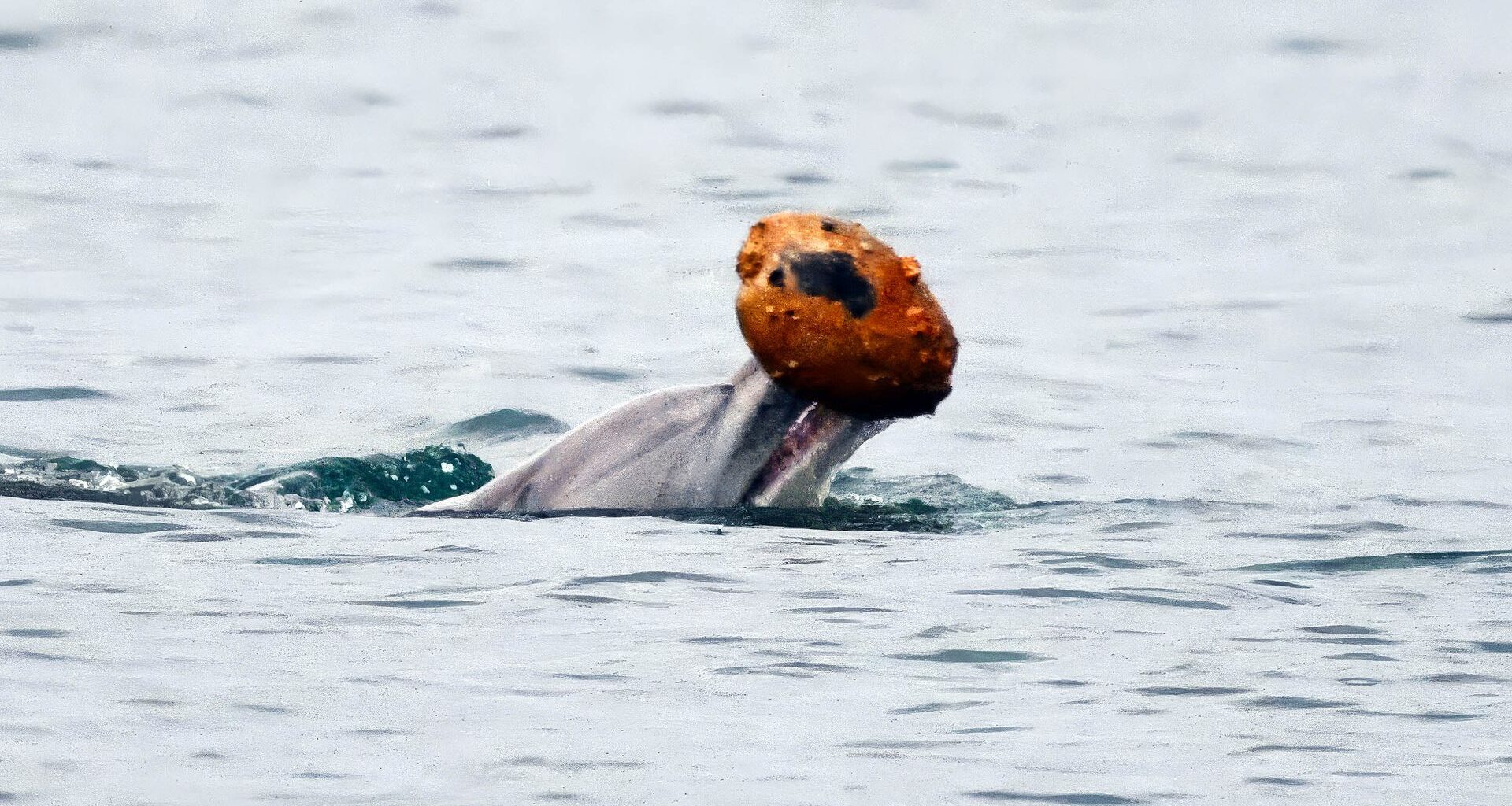
Video footage shows dolphins using empty seashells to catch fish and a calf potentially learning the hunting technique from its mother.
Dolphins do not all hunt in the same way. Some develop local feeding methods that require memory, timing, and the skillful handling of nearby objects.
New footage from Queensland shows Indo-Pacific bottlenose dolphins using large, empty shells to catch fish.
The behavior, called shelling, may offer a rare glimpse of a calf learning by watching its mother.
Dolphins use shells for hunting
Tool use occurs when an animal handles an object to achieve a goal. In shelling, a dolphin lifts an empty sea snail shell with its snout, carries it upward, and shakes out a fish.
Researchers previously documented shelling only in Shark Bay, Western Australia, where fewer than two percent of known dolphins use the technique.
The University of the Sunshine Coast (UniSC) led the new work, with Dr. Alexis Levengood serving as the lead author.
“We were on a research boat off Hervey Bay when we spotted a dolphin raising something large out of the water. I started screaming because I know what shelling looks like,” said Dr. Levengood.
Two sightings capture shell hunting
“It’s a hunting behavior in which dolphins chase fish into large, empty shells, bring the shells to the surface, and then shake them to drain the fish into their mouths,” said Dr. Levengood.
“We were able to record footage and take photographs of dolphins shelling in the Great Sandy Marine Park, which is the first published record of it on the east coast of Australia.”
The team recorded two events near Hervey Bay on July 6 and October 1, 2025. The first involved an adult female called Stevie Nicks, who lifted a bailer shell – a large shell made by a sea snail – above the surface several times.
Rain ended the observation after nine minutes. Therefore, the team could not confirm whether a fish left the shell or whether the dolphin completed a successful catch.
Calf imitates its mother’s technique
The second event involved an adult female called Maserati and her calf, Bentley.
Drone footage showed the mother raising a shell before a fish escaped. She then dropped the shell and chased the fish.
Three minutes later, the calf surfaced with the same shell in the same place. It held the opening around its snout as its mother had, slapped the shell against the water, dropped it, picked it up again, and then swam away.
“We saw the mother surface with a shell, the fish inside escaped, and the dolphin dropped the shell to chase the fish. Then, minutes afterward, the dolphin calf picked up the shell and held it the same way as its mother,” noted Dr. Levengood.
Mothers may teach shell hunting
“Our footage provides the first potential evidence of maternal social transmission – a process by which offspring learn behavior by observing the actions of their mothers,” said Dr. Levengood. “It challenges the belief that dolphins learn this tool use from their peers.”
Social learning means picking up a behavior by watching another animal.
Maternal social transmission is one form of social learning, but this single event does not prove that the mother taught the calf or that the calf had never handled a shell before.
“These findings highlight how smart, clever and innovative dolphins are,” said Dr. Levengood.
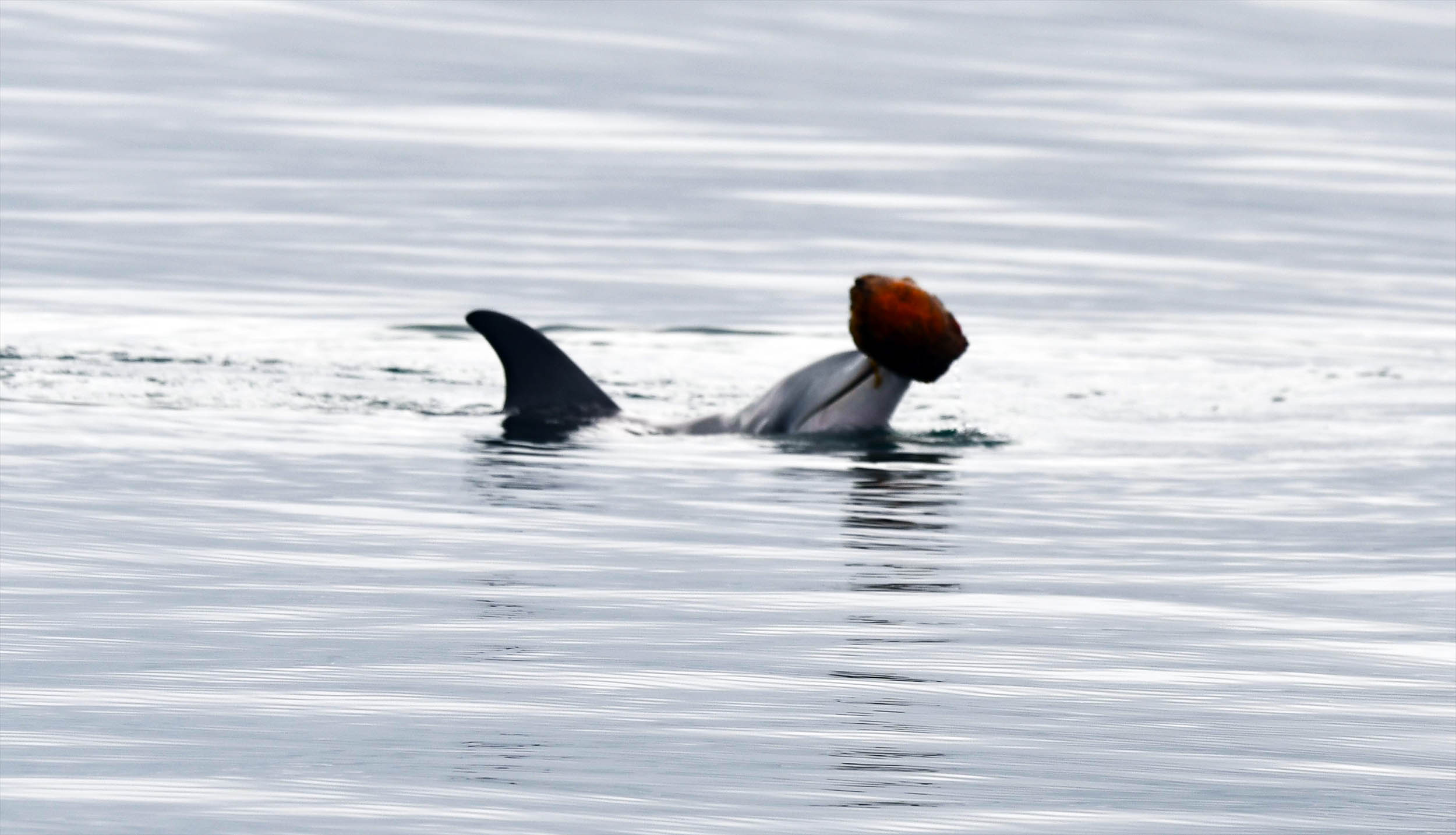 Dolphin calf captured on film by UniSC researchers while using seashells, or ‘shelling,’ to catch fish. Credit: University of the Sunshine Coast Australia (or UniSC Australia). Click image to enlarge.Dolphins have shelled for years
“We learned that shelling had been photographed during boat trips run by Blue Dolphin Marine Tours in 2013 and 2019, indicating that shelling has occurred in this population for longer than expected but went unnoticed due to limited research in the region,” said Dr. Levengood.
“Our observations in Queensland show that dolphins on opposite sides of Australia have learned to use tools in exactly the same way, independently of one another.”
Dr. Levengood said there is still much to learn about shelling. Studying this behavior and other forms of animal tool use could also help explain how some human abilities evolved.
Separate populations found solutions
The older photographs showed dolphins carrying shells in the same general area as the 2025 sightings.
Exact location records were unavailable, but the images suggest that shelling has occurred near Hervey Bay for at least 12 years.
Records from both Australian coasts support the idea that separate dolphin populations developed the same hunting solution independently. Shelling may remain underreported because each attempt can last only a few seconds.
Earlier computer simulations from Shark Bay suggested that dolphins usually learn shelling through social connections outside the mother and calf bond.
The Queensland footage suggests that mothers may pass the behavior on to their calves, although researchers need more observations to test this possibility.
Shelling requires precise skills
Shelling may be more than a chance response to a fish hiding in an empty shell. A specialized feeding method is used by only part of a population, repeated over time, and dependent on knowledge or physical control.
A dolphin must find a suitable shell, hold it without losing the fish, and use it where shells and prey occur. This method may provide access to food that other dolphins leave behind while reducing competition for the same prey.
The Queensland events involved two adult females and one calf whose sex was unknown.
Such a small group cannot show whether females use the method more often than males, even though some other specialized dolphin hunting methods are more common among females.
More dolphin sightings are needed
The team observed only two shelling events involving three dolphins.
It could not confirm that any dolphin caught a fish, and researchers could not identify with certainty the suspected lizardfish seen at the opening of the calf’s shell.
The footage records behavior rather than providing direct evidence of teaching. It shows that the calf handled the shell soon after its mother did, but it does not reveal what the calf understood or how much earlier practice it had.
The strongest conclusion is that shelling occurs on both the east and west coasts of Australia.
The mother-and-calf sequence raises a valuable possibility about how the skill spreads, but many more sightings are needed before researchers can confirm that learning path.
The study is published in the journal Marine Mammal Science.
—–
Like what you read? Subscribe to our newsletter for engaging articles, exclusive content, and the latest updates.
Check us out on EarthSnap, a free app brought to you by Eric Ralls and Earth.com.
—–