
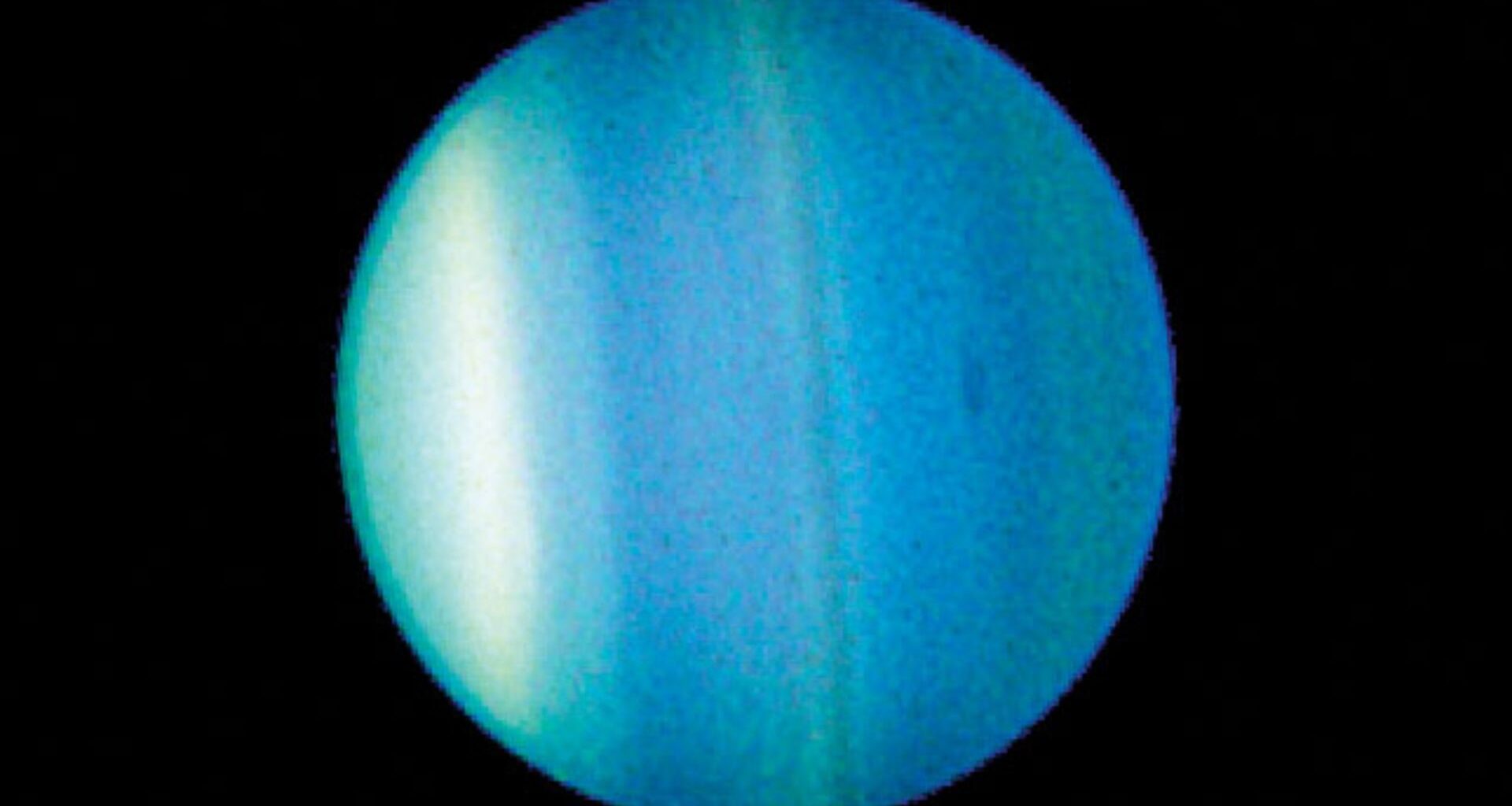
Scientists are rethinking Uranus and Neptune as new evidence suggests the so-called ice giants may contain far less ice than once believed.
For decades, Uranus and Neptune have occupied their own category in the Solar System: the ice giants.
The name suggests we know what lies beneath their blue atmospheres, but scientists are increasingly questioning whether these distant planets contain much ice at all.
New models show that Uranus and Neptune could contain hot mixtures of rock, iron, and hydrogen beneath their thick outer atmospheres while still matching what scientists observe about their size, mass, gravity, heat, and atmospheres.
Why the label may fail
Ravit Helled, a planetary scientist at the University of Zurich, said the ice giant label is “a little bit misleading.”
“We really don’t know what these planets are made of,” Helled said.
Jonathan Fortney, a planetary astrophysicist at the University of California, Santa Cruz (UC Santa Cruz), added that the evidence for deeply icy interiors is “all indirect, it’s all circumstantial.”
“This was always in the back of people’s minds: that the planets could be more complicated,” Fortney added.
Small bodies in the outer Solar System appear to contain more rock and less ice than older models assumed.
Magma oceans offer another possibility
“We have these representatives in our own Solar System, and we realize that we don’t know what they are made of,” Helled said.
The question matters beyond our planetary neighborhood because worlds smaller than Neptune are common around other stars.
Edward Young is a planetary scientist at the University of California, Los Angeles (UCLA).
“We thought, well, why should the formation of the ice giants and the sub-Neptunes be fundamentally different?” Young said.
Rock and hydrogen may mix deep inside
In the new model, intense heat and pressure allow silicate rock, made from minerals containing silicon and oxygen, to mix with iron and hydrogen into one flowing material.
The authors call it a supercritical magma ocean, meaning the mixture is so hot and compressed that ordinary boundaries between liquid and gas no longer apply.
“A rethinking of the astrophysics and the settings in which they were formed,” Young said.
This magma would not resemble lava from an Earth volcano because it would contain large amounts of hydrogen and remain trapped under a deep atmosphere.
Models match many observations
The team built computer versions of both planets as layers from the center outward.
They adjusted three features: the pressure where the magma ocean meets the atmosphere, the total hydrogen, and a layer that slows heat moving upward.
The researchers tested each version against six properties, including radius, temperature, internal heat, and small gravity variations that reveal how mass is spread inside a planet.
The best-fitting Neptune model contained about 13 percent hydrogen by mass, while the Uranus model contained about 14 percent.
In both cases, the magma ocean filled roughly the inner three quarters of the planet’s radius, with a hydrogen-rich envelope above it.
Uranus and Neptune show important differences
The Uranus model matched the observations well, though one gravity value depended strongly on uncertain corrections for deep winds.
The Neptune model matched most observations, but its modeled temperature at a standard atmospheric pressure was about 22 degrees Fahrenheit (12 degrees Celsius) too warm.
The model gave Uranus a thicker heat-blocking layer than Neptune, which can account for Uranus releasing much less internal heat.
However, the team adjusted that layer to match the heat data, so the result does not prove why Uranus is unusually faint.
Chemistry offers another clue
The model also produced an atmosphere rich in methane and hydrogen sulfide, a sulfur-bearing gas, but extremely poor in ammonia.
That pattern broadly resembles observations, and it could arise because nitrogen dissolves into the deep molten mixture while methane remains in the atmosphere.
Water can form where hydrogen reacts with hot rocky material, so a planet’s present water does not provide a simple record of where it formed.
In the cold upper atmosphere, water would condense far below the visible clouds, making it difficult to detect from afar.
The paper links Uranus and Neptune with sub-Neptune planets around other stars.
A simple formation calculation found that larger growing worlds can collect more hydrogen, placing the outer planets near the high-mass end of the same family.
Other interior structures may still fit
Roberto Tejada Arevalo, an astrophysics PhD candidate at Princeton University, has also modeled possible interiors for Uranus and Neptune.
“There are so many mysteries with these planets,” Tejada Arevalo said.
His separate models allow rock, ice, and gases to mix in ways that could also match the planets’ heat and other properties.
Different models suggest different interiors
Uri Malamud, a planetary scientist at the Technion–Israel Institute of Technology, has proposed a different picture of what may lie inside Uranus and Neptune.
“They’re just different ideas about what might be possible,” Malamud said. His work points to methane-rich material and a more layered interior, with rock remaining more separate.
Vanesa Ramírez, an astronomy Ph.D. candidate at Leiden University, has also examined what Uranus and Neptune may contain. “We are still discovering these planets,” Ramírez said.
Her modeling suggests that both worlds could be more than 60 percent rock, while recent telescope measurements still allow several internal arrangements.
The magma ocean result therefore shows that interiors without large ice layers can fit current data, not that the traditional picture has been ruled out.
Material properties remain uncertain, and the paper estimates about a two-percentage-point uncertainty in its hydrogen amounts.
A future mission could settle the question
Voyager 2 supplied the only close measurements of Uranus and Neptune, and those brief visits happened about four decades ago.
A dedicated orbiter and atmospheric probe could measure gravity, magnetic fields, winds, temperatures, and gases in greater detail.
“We really need a flagship mission to put all these pieces of the puzzle together,” Ravit Helled said.
Better measurements could separate models that now produce similar answers from limited data.
Even the name is up for debate
Edward Young prefers the name “miscible giants,” referring to materials that can mix together. Uri Malamud has suggested “subgiants,” while Vanesa Ramírez prefers “minor giants.”
Ravit Helled has proposed “outer giants,” and Roberto Tejada Arevalo favors “metal giants,” using the astronomy term for elements heavier than hydrogen and helium.
“There were 10 of us in a room for a week. We didn’t agree on any better names,” Fortney said.
For now, the familiar label remains useful, but it should not be mistaken for a confirmed description of what lies below the clouds.
Only new observations can show whether Uranus and Neptune are magma ocean worlds.
The study is published as a preprint on arXiv and is under review at The Astrophysical Journal.
—–
Like what you read? Subscribe to our newsletter for engaging articles, exclusive content, and the latest updates.
Check us out on EarthSnap, a free app brought to you by Eric Ralls and Earth.com.
—–