
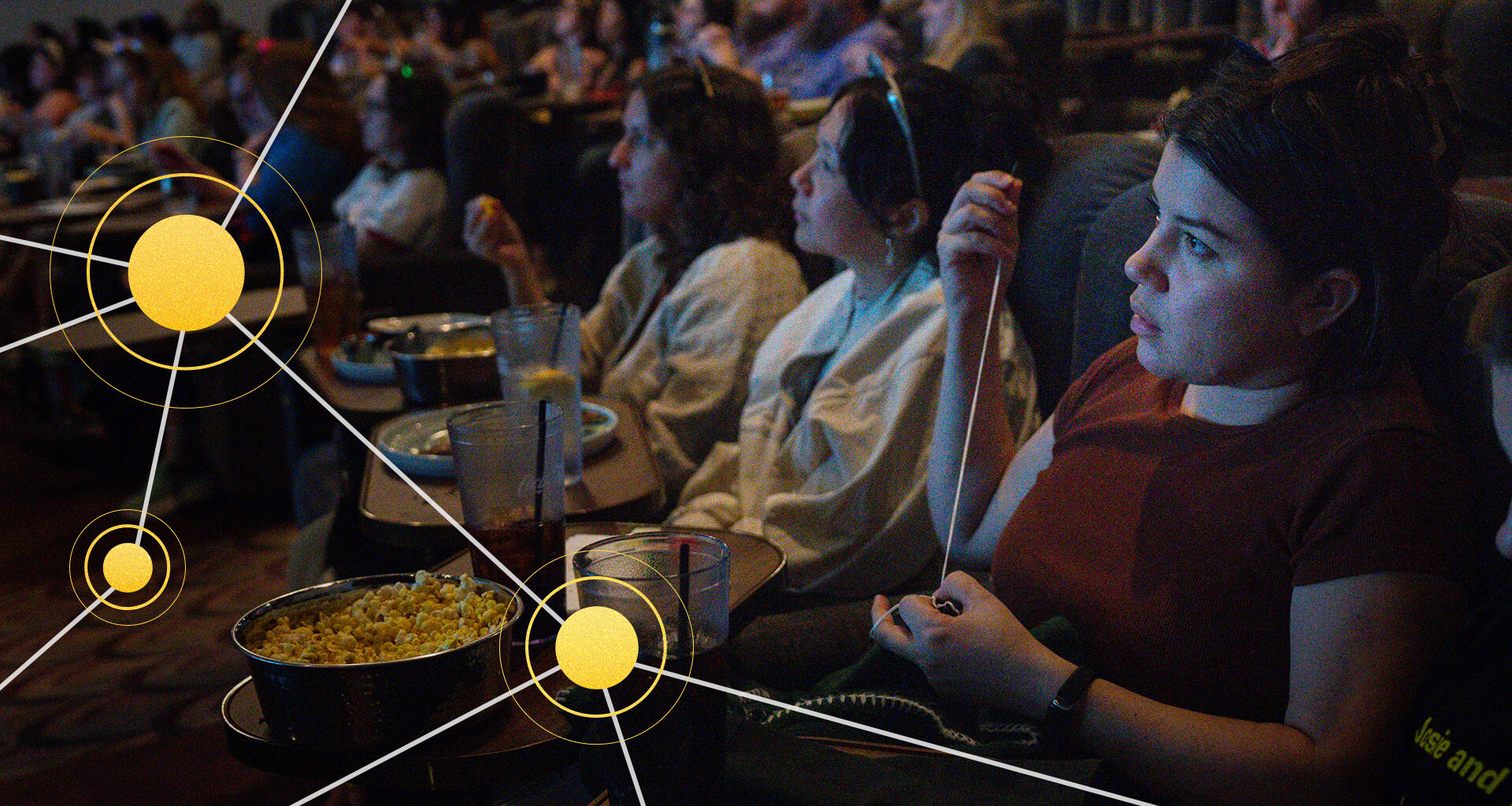
HOUSTON — Most of the movies at River Oaks Theatre in Houston’s Montrose neighborhood are swallowed by the same pitch dark that movie theaters across America have embraced for decades. But on a Tuesday night in late June, the house lights in the theater’s largest auditorium cast a glow low enough for a crowd to enjoy the ambience of a cult classic movie, yet bright enough to illuminate the room’s art deco details.
Anna Beth Charlet needed that extra light, as she pinched a needle in her right hand, preparing for her next stitch. Charlet was tucked into an oversized, ultra-comfy aisle seat as 2001’s “Josie and the Pussycats” started playing. She kept her eyes on both the screen and the fabric hoop in her left hand, where she stitched a swoopy “AB” monogram above the pocket of a pink gingham pajama top.
Hand embroidery, she says, helps her feel present and stimulated in a way that’s hers to control.
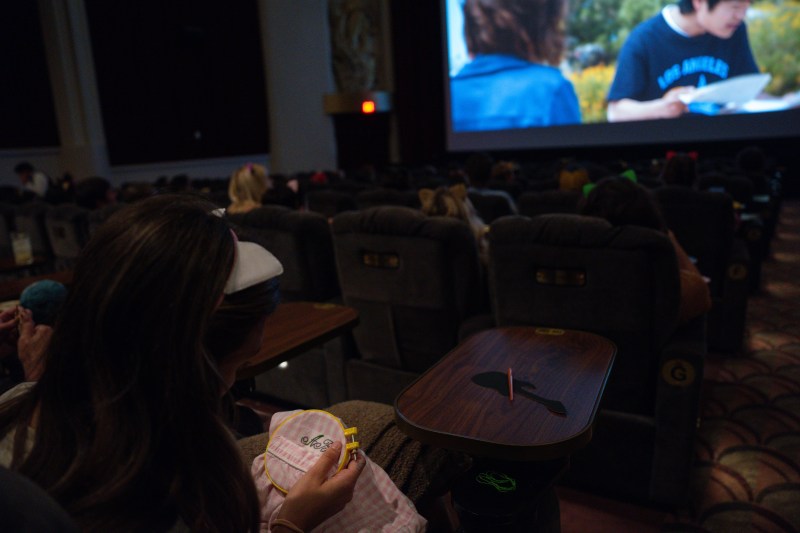 Anna Beth Charlet embroiders during previews before a screening of “Josie and the Pussycats” at River Oaks Theatre in Houston, Tuesday, June 30, 2026. Credit: Jon Shapley for Straight Arrow.
“I like the tediousness of it,” she told Straight Arrow. “And I like that it makes me not want to be on my phone.”
A dozen overstuffed chairs and one aisle to her left, Lindsey Cooper Treviño had pulled out a cardigan to hem with a thick blanket stitch during the movie’s 98-minute run time. In the seats between the two, Millennial and Gen Z women clacked knitting needles, flicked watercolor pens and split their focus between crafts and a film.

Download the Straight Arrow app today to get the stories that matter free from manipulation, bias or agenda.™
Point phone camera here
This was “Cozy Cinema” night — a once-monthly event at the historic theater, when moviegoers pack up crafts for an evening with an old favorite. The event is pitch-perfect considering how hotly “grandma hobbies” like quilting, knitting and hand embroidery are trending these days.
It sounds quaint. Retro, even.
But event organizers in Houston know that those who see a “trad wife” image are misreading this room. The rise of these grandma hobbies is a declaration of war against the attention economy designed to keep Americans’ eyes glued to pocket-sized screens. A reclamation of our brains.
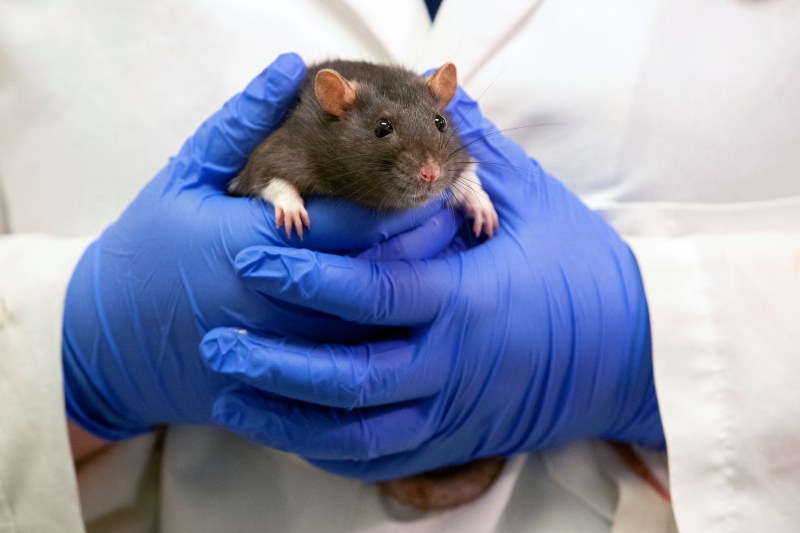 The University of Richmond’s rat drivers first dazzled the world with their ability to operate tiny cars in 2019. Now the rodents serve as ambassadors for the school’s Behavioral Neuroscience Laboratory, headed by Professor Kelly Lambert. Far from a novelty act, the animals are part of a boundary-pushing project exploring the ways in which environmental enrichment sculpts the brain, and could inhold potential for solving human mental health conditions. Credit: Ryan M. Kelly/AFP via Getty Images.
What we can learn from rats
After Kelly Lambert’s mother died from non-Hodgkin’s lymphoma, Lambert felt what she describes as “transient depression and low mood.” As one should, says Lambert, who is a professor of behavioral neuroscience at the University of Richmond.
Lambert wasn’t interested in medication. Instead, she turned to vacuuming — a mundane chore that, to be frank, she doesn’t even enjoy doing now.
“At a time where I felt like I had little control over the stress and that I couldn’t do anything that could save my mother,” she says, “seeing some effects, some outcome that was the result of my effort helped.”
She started small.
“Removing dirt from the house, cat fur and stuff, I found myself just wanting to vacuum every day or twice a day,” says Lambert. “And this made me really want to look at these activities that give us a greater sense of control over the world and predictability.”
She took her investigation to her lab, where she designed an experiment to test whether earning rewards through physical work could boost mental health in rats.
And the results explained a lot about what is drawing an over-scrolled generation to grandma hobbies.
Lambert buried Froot Loops cereal, which she calls “the currency of my lab,” under a layer of dirt. She taught one set of rats they could dig to earn a Froot Loop as a reward, while a second set — which her team dubbed the “trust fund rats” — were given Froot Loops without having to exert effort.
“We wanted to see what happens when animals work for their rewards versus when they receive them passively,” she says.
The results were striking: Rats that worked for their Froot Loops “had a robust neurochemical defense against depression,” says Lambert. Further, her working rats exhibited neuroplasticity.
“It’s this idea that we can intentionally change our neurochemistry or neuropsychology through movement,” Lambert says. “And the rats would persist longer with unsolvable tasks. They’d seem to be more flexible in their problem-solving, and we saw that their stress hormone levels were a little healthier.”
Using their paws helped the rats rewrite their brain chemistry — for the better.
 Lane Turner/The Boston Globe via Getty Images.
The business case for grandma hobbies
Nery Lucarini spent much of her childhood watching her parents’ hands. Her father was a tailor; her mother, a seamstress. Between the two, 20 fingers danced all day, stitching suits and ball gowns for their clients. Her life was built on needles, thread and thimble callouses.
Her face glows as she talks about those bygone years. Today, these happy memories serve as a foundation for a modern reincarnation of her parents’ small-business roots. When the pandemic hit in 2020, Lucarini sewed and sold roughly 6,000 masks across the globe. As demand increased, so did other requests for her sewing talents.
“During the pandemic, everybody took out their sewing machine, and realized they didn’t know what to do with it,” Lucarini tells Straight Arrow one Friday morning in June as she sits at a project table in the sewing studio she runs in Houston’s East End. “Or, they bought one and they don’t know what to do with it, because JoAnn stopped doing classes.”
So Lucarini set up a table at the front of a friend’s shop and taught a class. Then two classes. By the summer of 2022, demand was so hot that she opened her studio, Sew Great.
Starting a new business in the later waves of the pandemic was risky. But Lucarini trusted her needle-sharp instincts and bankrolled her ambition with money she’d received in a divorce settlement.
The craft industry is booming. After years of steady, post-pandemic growth, the arts and crafts market was valued at $47.4 billion in 2025. And by 2030, it is expected to hit $67.4 billion. That level of growth is about double the current inflation rate, meaning it is driven not by higher price tags but by higher demand.
That rise couldn’t save mega-retailer JoAnn filed for bankruptcy in 2025 because of massive corporate debt. But it has been a boon to scrappy shops like Sew Great and others that have opened nearby.
Lucarini’s business was slow at first, but then came January 2023.
“All of our classes sold out that January,” she says. “All my basic sewing classes sold out. Crochet sold out. Watercolor sold out. Hand embroidery sold out. People were like, ‘I love this, this is so cool.’ And from there on it’s just been an amazing, amazing journey.”
Soon, she had to lease extra space. She doubled the size of her shop, which is regularly filled with clients who — for the most part — do not appear to be “grandmas.”
“I get people from 18 to people who are in their 70s,” she says. “And I would tell you, like the 70 to 80 range is much smaller. They’re all Millennials, they’re Gen Xers and Gen Z.”
And they want something very specific: “A lot of people come to us and go, ‘I just need something to take my mind off work,’ and ‘I don’t want to binge watch all day,’” she says. “And studies have shown that you need to cut the screen time and unplug. And when you do things with your hands, it releases dopamine — you know, the happy hormones.”
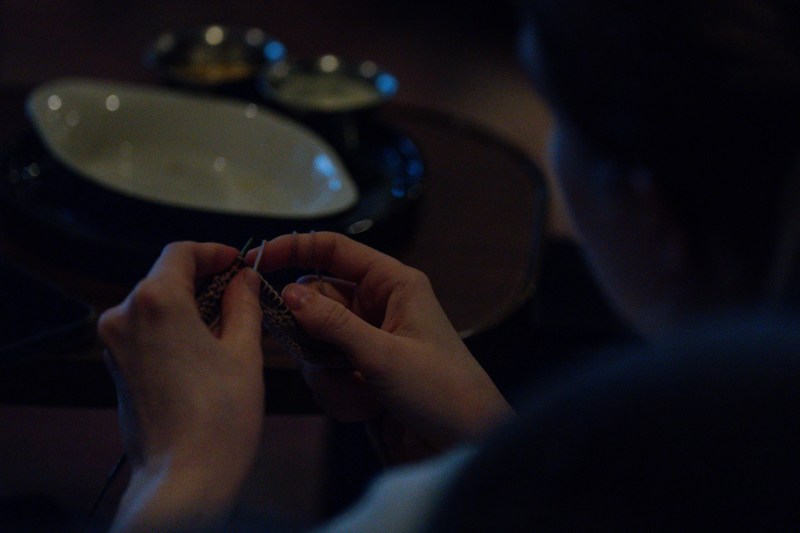 Hannah Mayhew knits an item for her daughter during a screening of “Josie and the Pussycats” at River Oaks Theatre in Houston. Credit: Jon Shapley for Straight Arrow.
The science of the ‘flow state’
Ann Collier’s Ph.D. didn’t protect her from going a little crazy while she was a stay-at-home mom.
“My sanity!” she says. “I really needed something to do.”
So she dove deeper into sewing and weaving. And when she returned to her lab, she launched an empirical study to learn how people think and feel when they craft.
“I had to turn the survey off after 11,000 responses because I didn’t want it to get any bigger,” says Collier, who is a research-based clinical psychologist and a professor at the University of Colorado. The responses came mostly from women, though even 15 years ago, she did hear from a smattering of men.
Her findings reinforced her own lived experience.
“Crafting gives you something in your world that you have control over,” she says. “Something that you can finish. In a lot of our daily lives, we don’t have things that we can finish. It’s just ongoing.”
But when you’re able to finish something, Collier says, “it really makes you feel proud of yourself.”
And the rewards don’t spring up at the final stitch. Collier continually found people describing what psychologists call “the flow state” as they crafted.
“A flow state is when you’re completely engaged in something, so much so that you lose track of time — you’re absorbed in the experience, and you forget about everything else,” she says. “My research shows that when you have activities that involve flow, you actually have the most psychological benefits and positive mood.”
Those benefits don’t only go with the flow. They keep going for several days.
“Psychologically, one of the things that happens when we all go through difficult periods is we ruminate — you’re worrying about things, and you can’t get things out of your mind,” says Collier. “And when you do one of these activities that have the flow state and the physicality, you stop that process. You have, basically, a vacation from it, and that gives you longer-term benefits.”
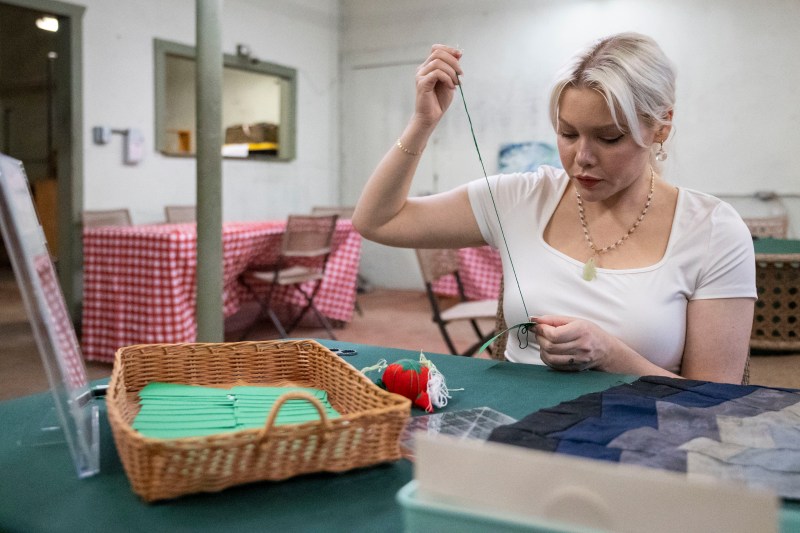 Katina Zentz/San Antonio Express-News via Getty Images.
How our hands inform our brains
Flow isn’t reserved solely for crafts. Runners hit a flow state. Writers, too. But the grounding nature of using one’s hands for grandma hobbies seems to do something extra special.
That, Lambert says, could be because humans’ hands take up outsized space in our brain wiring.
“Our hands are represented in a big way, proportionately large in an area called our motor cortex,” she says. “They have more space there than our entire back or thigh, even though there’s more physical real estate for that, because you have lots of control over our hands.”
Human brains also give way more space to signals from our hands than rat brains do. So the benefits Lambert sees in rats can be even more pronounced in people.
“If we’re doing something with our hands, especially when we know that our right side of our brain controls our left hand and vice versa, you’re activating both hemispheres using both hands,” she says. “Also, this repetitive nature has been correlated with increased serotonin, which is involved in mood regulation.”
Movement is important to the brain. Why else would the brain devote so much territory to it? Yet modern life lends itself to immobility: Most Americans report looking at a screen for at least five hours a day.
“This doesn’t produce something really tangible that our brains get excited about, and you could see how that could be contributing to some emotional dysregulation, expressed as depression symptoms and such,” says Lambert. “So doing things our ancestors did with our hands, like tool use, building, making and creating could activate those brain areas.”
Think about it this way, she says: “We’re pretty much carrying around the same brains our ancestors did before all this technology and quote-unquote advancements were here.”
Our brains crave something simpler — though the simplicity of grandma hobbies should not be confused with unseriousness.
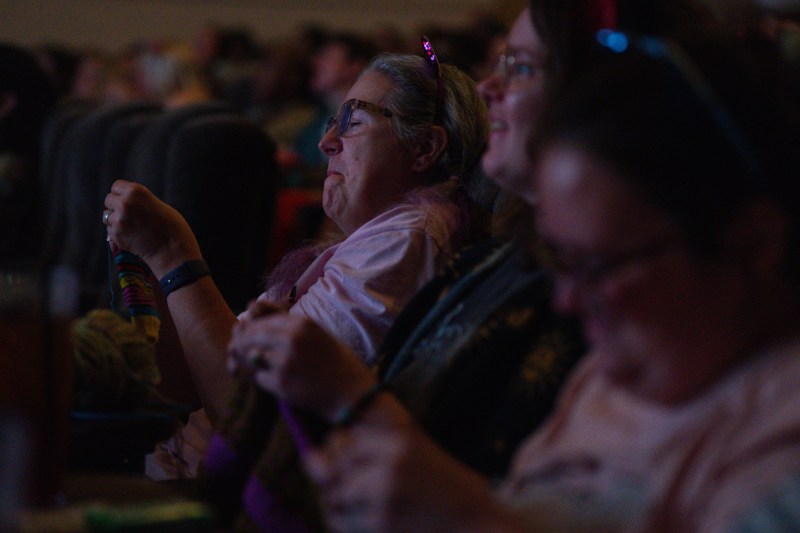 Cher Trice knits with friends during a screening of “Josie and the Pussycats” at River Oaks Theatre in Houston. Credit: Jon Shapley for Straight Arrow.
A funding fight
The sudden cultural obsession with grandma hobbies is a massive victory, researchers say. But the term — oh, the term.
“It feels really pejorative,” says Collier. That doesn’t wholly surprise her. Much of her zest for researching the topic can be traced back to a moment when she says her husband “minimized” the crafts she used to escape the mental load of parenting.
“You know, you’re going to regret this for the rest of your life,” she told him then. “I’m going to start doing research on it.”
She wanted to prove crafting was more than fluff and yarn. But for Collier and other researchers, finding the evidence was often the easy part. Securing funding in the man’s world of science was another story.
Like Collier, Betsan Corkhill conducted a research survey and had to stop accepting responses after a deluge.
“We got 3,500 respondents in 10 days,” says Corkhill. “To put it in context, a psychologist friend of mine launched an online survey at the same time and scoffed a little bit at mine. And he only got eight responses.”
She smiles.
“So I was very happy.”
Corkhill, whose books include “Knit For Health And Wellness,” found that 81% of respondents felt happier after knitting, and fewer than 1% felt sad. But despite crystal clear data, she says, “it’s really difficult to get funding into this topic because it’s seen as inconsequential.”
“We’ve had funding applications written for us by a very eminent professor,” she says, “and it was turned down without being read, because it had ‘knitting’ in the title.”
 Craft supplies sit on a table for guests before a Cozy Cinema screening of “Josie and the Pussycats” at River Oaks Theatre in Houston, Tuesday, June 30, 2026. Credit: Jon Shapley for Straight Arrow.
 Alexandra Drake stands at the stage, dressed in character, before a Cozy Cinema screening of “Josie and the Pussycats” at River Oaks Theatre in Houston, Tuesday, June 30, 2026. Credit:Jon Shapley for Straight Arrow.
 Two guests watch “Josie and the Pussycats” at River Oaks Theatre in Houston, Tuesday, June 30, 2026. Credit: Jon Shapley for Straight Arrow.
 Lindsey Cooper-Treviño, second from right, and her friend Lindsey Bodker do crafts as they watch “Josie and the Pussycats” at River Oaks Theatre in Houston, Tuesday, June 30, 2026. Credit: Jon Shapley for Straight Arrow.
 Craft supplies wait for guests before a Cozy Cinema screening of “Josie and the Pussycats” at River Oaks Theatre in Houston, Tuesday, June 30, 2026. Credit: Jon Shapley for Straight Arrow.
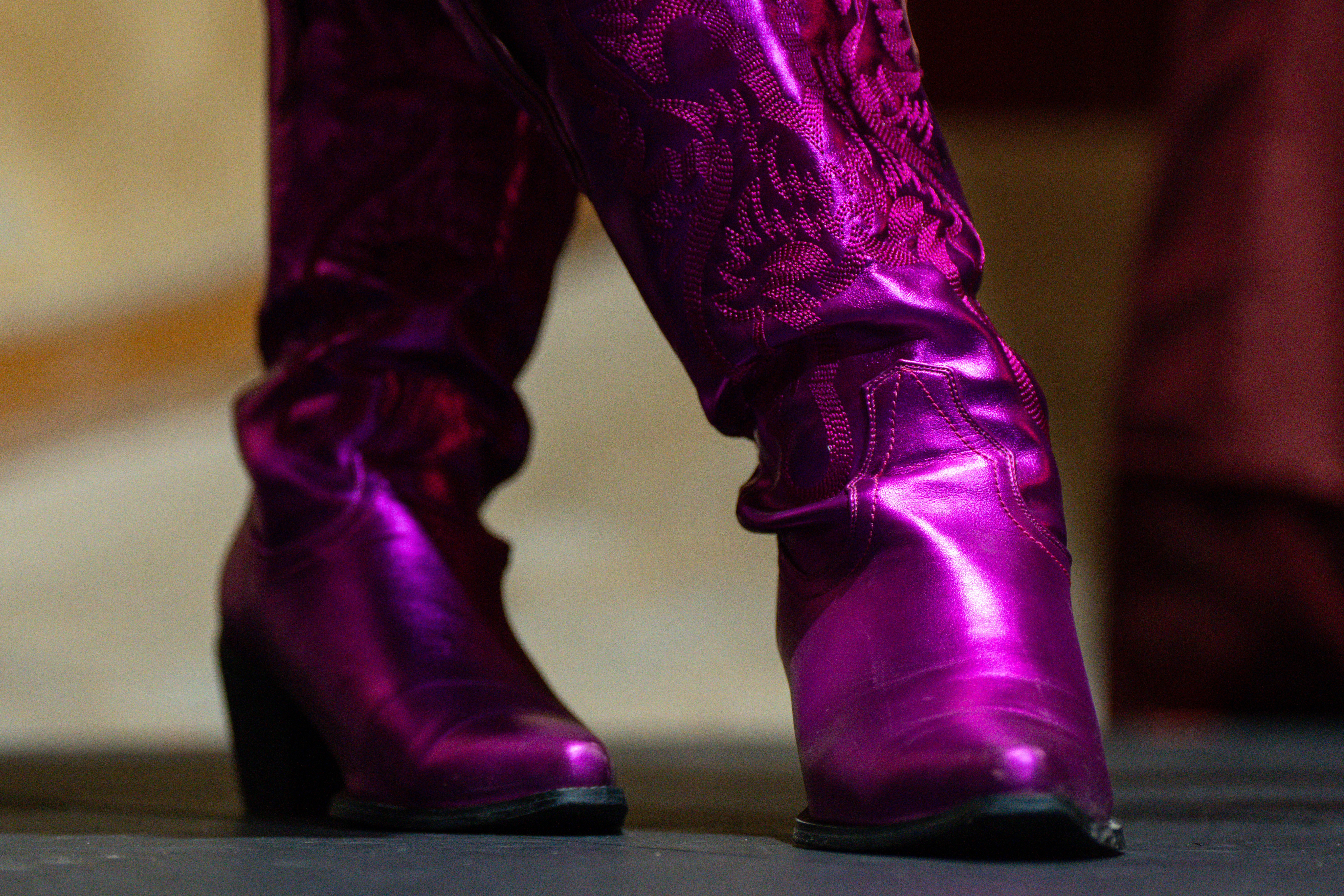 Alexandra Drake shows off her boots before a Cozy Cinema screening of “Josie and the Pussycats” at River Oaks Theatre in Houston, Tuesday, June 30, 2026. Credit: Jon Shapley for Straight Arrow.
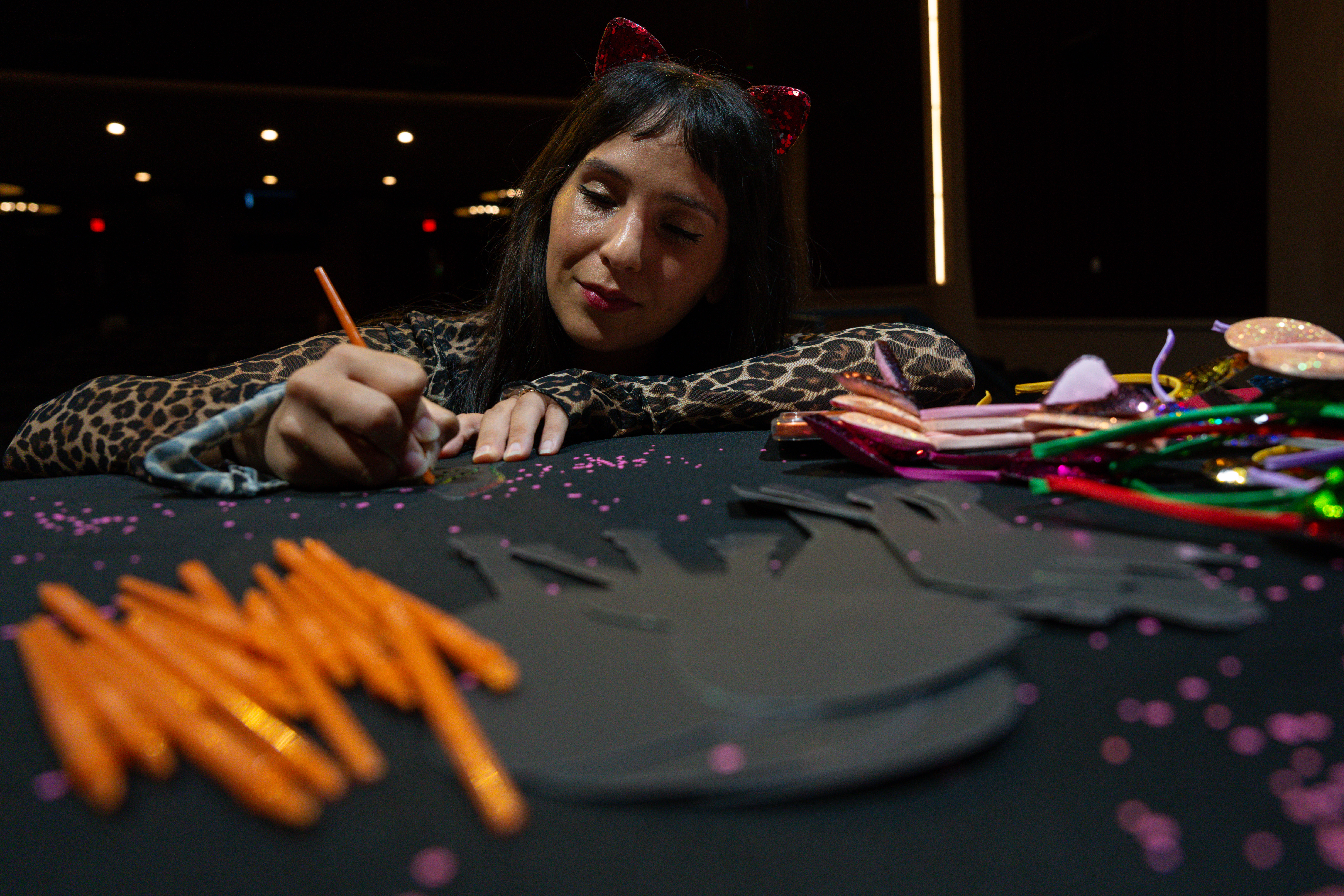 Nadia Al-Khalifah crafts a decorative item before a Cozy Cinema screening of “Josie and the Pussycats” at River Oaks Theatre in Houston, Tuesday, June 30, 2026. Credit: Jon Shapley for Straight Arrow.
How cozy
As the host of River Oaks Theatre’s Cozy Cinema nights, Alexandra Drake has seen plenty of crafts that would make a grandma blush. This spring, during a showing of “9 to 5” starring Dolly Parton, one audience member stuffed her bra with basketball-sized crocheted breasts. And yes, Drake has seen her share of cross-stitched F-bombs.
“Crafting and creating things with your hands has always been sort of an act of defiance, especially for women because of the expectations placed on us by society of how we should be using our time,” she says. “So, I think there’s an element of rebellion to creating anything, and saying, ‘OK, I’m going to go into my craft room, and I don’t want to be bothered.’”
Or, in the case of her events, “I’m going to watch a ‘cozy’ movie, and I don’t want to be bothered.”
And this new generation of crafters has shown up in force.
“It feels good to have time to do something like this,” Charlet said after the credits roll on “Josie And The Pussycats,” as she packs up her pink pajamas, now fully monogrammed in a swirling, green script.
“Time I wasn’t on my phone, and did something for me.”
Check out our three brand new premium newsletters!