
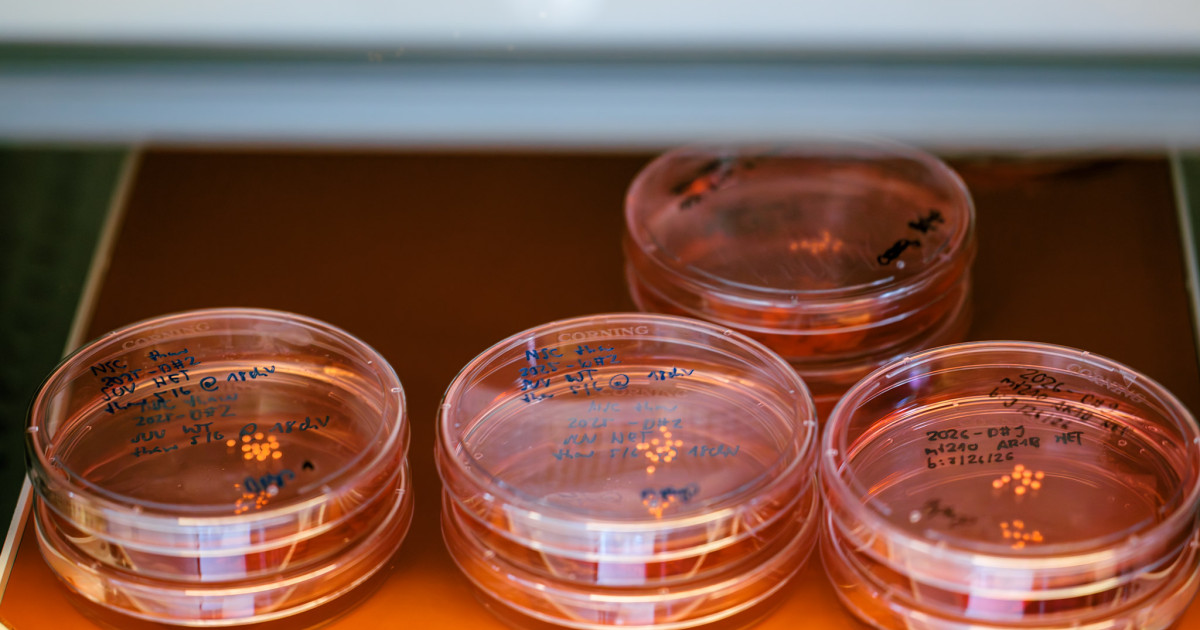
In a new milestone for stem cell research, Harvard neuroscientists have set a record for keeping alive lab-grown human brain “organoids” and proven that they mimic key developmental stages seen in living people.
In a paper published this week in Nature, the team reported that these peppercorn-sized clumps of brain cells — each containing more than 1 million cerebral cortex cells derived from human donors — were sustained in the lab for more than five years, three times longer than the previous record. These tiny “avatars” of human brains also retained memories of their own histories and could be manipulated to skip forward to more advanced stages of development — a feature that one day could be exploited to replace diseased cells, or to engineer lab-grown organs.
“We didn’t know how far the development and maturation of human brain tissue could occur outside the context of the normal brain inside the head,” said Paola Arlotta, Golub Family Professor of Stem Cell and Regenerative Biology and senior author of the new paper. “This work showed that it’s actually possible to not just have these organoids survive in culture, but also continue to change, develop, and mature over stretches of time that had never been reached before.”
Organoids offer promising models for brain research, but progress has been limited by the difficulty of keeping delicate cells alive in a lab dish — especially neurons, the fundamental units of the nervous system. The previous record for the oldest organoid was 694 days and reported in 2021 by a team of researchers at UCLA and Stanford.
Human brains continue to develop and mature for two decades — an unusually long timeline compared to other species. But most previous studies involving organoids have managed to replicate only the early phases of that brain development.
It remained unknown how well lab-grown cells would model the development of brains over longer timescales and whether all cell types could survive. To shed light on these questions, Harvard researchers sought to extend the longevity of the cell cultures.
A developmental ‘time warp’
The Arlotta lab studies the molecular mechanisms of development in the cerebral cortex, the emergence of its diverse cell types, the formation of circuits, and the pathologies that occur when those processes go awry. For more than a decade, the team has pursued organoids as promising models for research.
To make these clusters of brain cells, researchers first take a blood sample from a living donor. Because these cells all carry the DNA of that individual, they contain the instructions for making genetic duplicates of all the cells normally produced by that person.
With a series of biochemical signals, researchers reprogram these blood cells to become pluripotent stem cells that can beget many other types of cells. The team then uses more signals to guide cell differentiation and grow brain cells with the DNA of the donor — except this time in cultures outside the body.
In the new study, the Arlotta team examined 34 organoids and monitored their activity with single-cell RNA sequencing at eight timepoints between six months and five years. Combined with previous research, they gathered data on 110 organoids and nearly 425,000 individual cells.
As they watched this process unfold over several years, they discovered that organoid cells faithfully modeled the molecular developmental sequence of human brains during gestation and the first years of life.
One revealing indicator was DNA methylation, a process in which genes are turned on and off during development. Methylation follows a well-established timeline and serves as a reliable “age clock.” The lab-grown organoids, the researchers found, replicated the same steps documented in human brains.
“The methylation clock told us that these organoids were basically doing things that the endogenous brain would do,” said Arlotta, who is also a principal faculty member at the Harvard Stem Cell Institute and member at the Broad Institute of Harvard and MIT.
Next, the researchers conducted an experiment: When placed in the same environment, would older organoid cells behave differently than younger ones? They combined cells of different ages and from different donors into a single organoid.
When exposed to chemical signals to generate new neurons, the younger progenitors produced the cells normally formed at the beginning of this process. But the older ones immediately leaped ahead and made later-stage neurons normally produced two or three months later. The researchers concluded that the organoid brain cells “recorded the passage of time and retain a memory of the developmental steps already performed.”
“We were a little bit shocked by the results,” Arlotta said. “I like to call this a ‘time warp’ of development — they skip ahead.”