
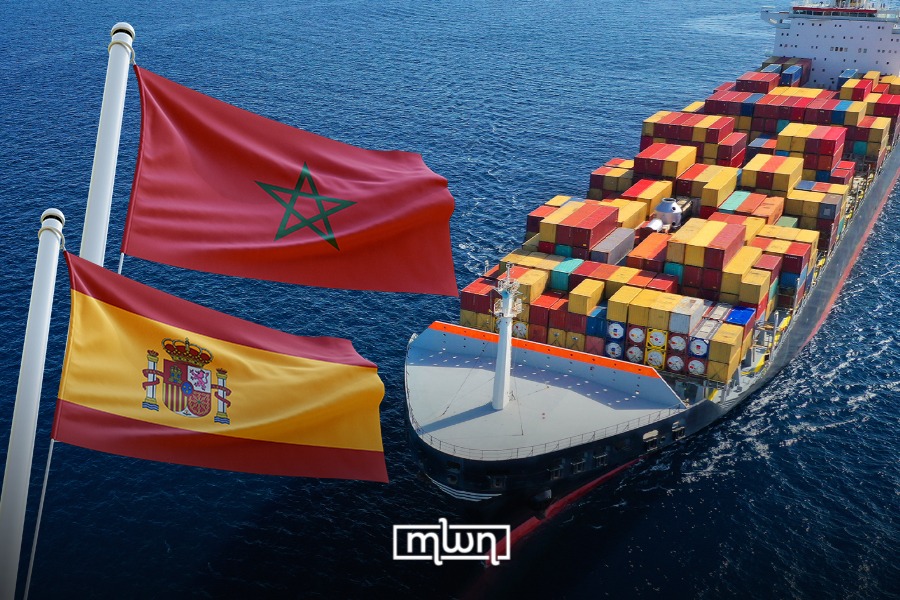
Rabat – New data from Spanish news agency EFE highlights Morocco’s importance as one of Spain’s key trading partners, with bilateral trade reaching an estimated €22.757 billion in 2025.
This comes amid the presence of major Spanish companies in different sectors, including textiles, while the relationship extends beyond trade to logistics, migration and security.
The report said trade between the two countries grew “at a very high rate” during the past decade. However, it noted that growth became more moderate from 2018 onward, while Spanish exports declined by 4.1% last year due to lower fuel sales.
Despite these challenges, Spain remains Morocco’s main trading partner, ranking first in bilateral trade for both exports and imports.
“In the first half of 2026, Spanish exports to Morocco increased by 3.5% to €6.4205 billion, accounting for 3.2% of total Spanish exports. Imports rose by 4.1% to €5.7955 billion, representing 2.5% of total imports,” the report said.
However, while the report points to the potential costs to Morocco of strained ties with Spain, it gives less attention to the North African country’s own strategic importance to Spain and Europe.
The report also comes at a critical time, particularly following the mass crossings into Ceuta, which fueled renewed anti-Moroccan rhetoric. On July 30 and 31, tens of thousands of migrants crossed into the enclave, prompting renewed debate over Morocco’s role as a key ally and security partner.
The 2021 diplomatic crisis offered a clear example of Morocco’s leverage, after Rabat reacted strongly to Spain’s decision to host Polisario leader Brahim Ghali for medical treatment, prompting Madrid to seek to restore relations and stressing Morocco’s importance as a key partner.
The importance of Rabat was also reflected in Madrid’s attention to bilateral ties, prompting Pedro Sanchez’s government to recognize Morocco’s Autonomy Plan as the most serious and credible political solution to end the dispute over Western Sahara.
The end of tensions was further marked by Sanchez’s visit to Rabat in 2022, where he met with King Mohammed VI and Moroccan officials to announce a new chapter in ties between the two countries.
Globally, Morocco has emerged as a strategic gateway between Europe and Africa and plays a central role in managing migration, security, and regional stability.
Morocco’s decision to tighten customs controls and curb informal trade with Ceuta also demonstrated its economic influence over the Spanish enclave, where businesses had long depended on cross-border commerce. The restrictions affected local retail activity and port revenues, which further reflects Ceuta’s economic dependence on access to the Moroccan market.
At the same time, Morocco’s Tanger Med port has emerged as a major Mediterranean and global logistics hub, handling growing volumes of cargo and strengthening Morocco’s position as a key link between Europe, Africa and global supply chains. The port’s rapid growth has also raised concerns among Spanish ports over increasing competition for transshipment and logistics activity.
Morocco’s industrial rise
The EFE report also portrays Morocco’s industrial growth, particularly in the automotive sector, as largely driven by its economic integration with Spain and Europe.
While the report acknowledges that the automotive sector is Morocco’s largest export sector, it emphasizes that much of the country’s industrial growth has been achieved through its integration with Europe via Spain.
However, this framing gives insufficient attention to Morocco’s own efforts to build an industrial ecosystem capable of attracting major global manufacturers and integrating them into increasingly sophisticated supply chains.
Morocco has established itself as a competitive manufacturing hub by leveraging its strategic location, infrastructure, investment incentives, industrial zones, and access to both European and African markets. Its automotive ecosystem now includes major international manufacturers alongside a growing network of local and international suppliers, strengthening the country’s position as a manufacturing gateway between the two continents.
The relationship, therefore, is not simply one in which Spain provides investment and Morocco benefits from European integration. Morocco has built an industrial ecosystem that also provides significant value to European companies, offering proximity to European markets while giving manufacturers access to African markets and competitive production conditions.
Morocco is increasingly positioning itself not only as a destination for European investment but as a strategic production and logistics platform for companies seeking access to both Europe and Africa.
European manufacturers benefit from Morocco’s infrastructure, industrial ecosystem, and proximity to European markets, while Morocco uses these partnerships to expand its own manufacturing capabilities, attract investment, and strengthen its position within global supply chains.