
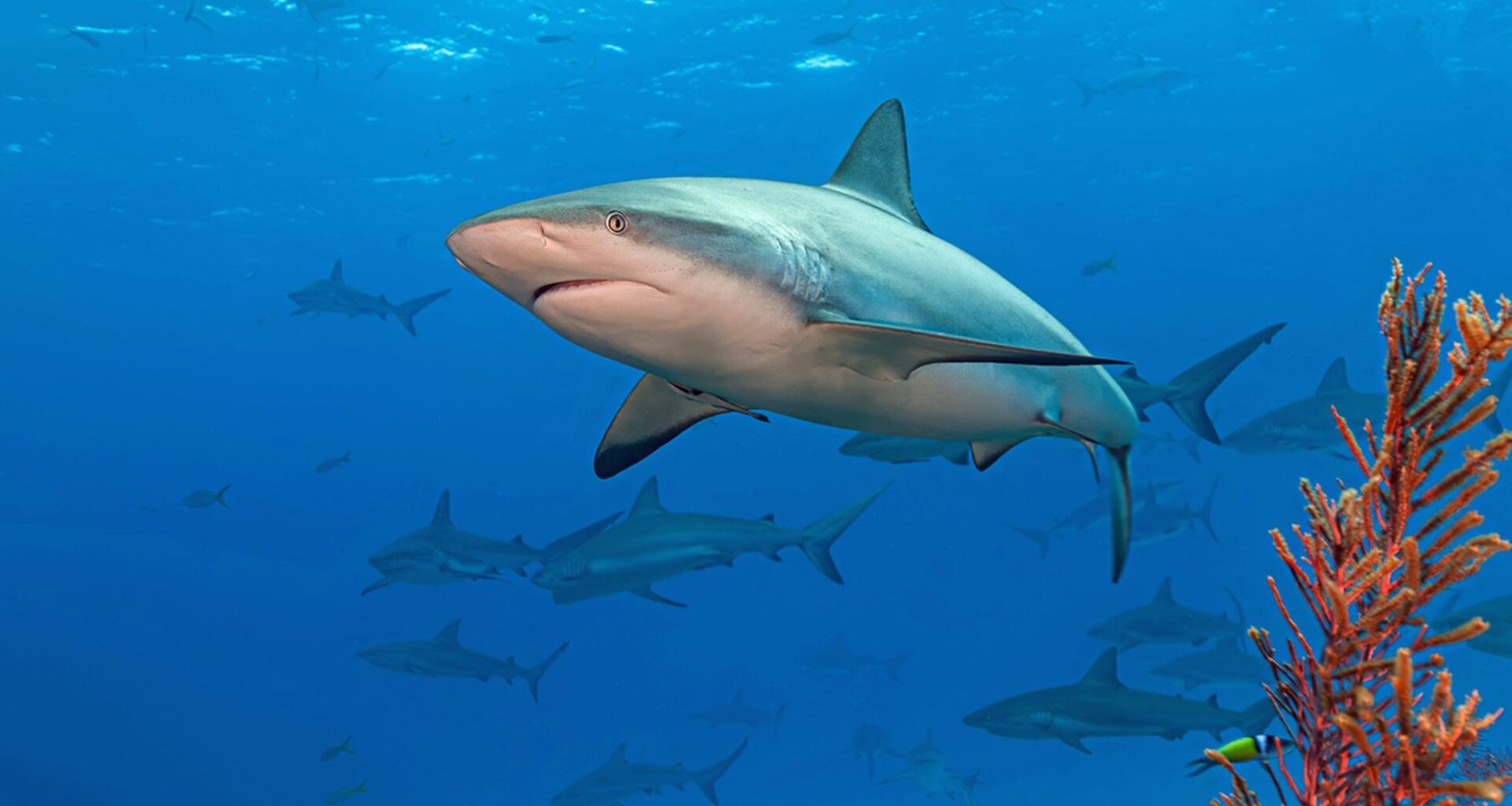
Fossil shark scales show that Panama’s Pacific once held 20 times more sharks than its Caribbean coast, changing recovery targets.
People trying to rebuild shark populations need to know what a healthy reef once looked like. But because almost no reef escaped fishing, how many sharks actually belong on a healthy reef has remained largely unknown.
Researchers counted the scales that sharks shed into Panama’s seafloor mud across 7,000 years. The surprising result was that sharks declined where fishing was lighter, not where it was heaviest.
Erin Dillon, a postdoctoral researcher at the Smithsonian Tropical Research Institute (STRI) in Panama, led the study, which began during her doctorate at the University of California, Santa Barbara. She built the comparison with STRI staff scientist Aaron O’Dea, UCSB ecologist Douglas McCauley, and colleagues, using a record that blends each era of the past into layers spanning centuries.
“Fishing is the primary threat to sharks today, but our study suggests that oceanographic conditions help set the context that shapes how fishing might impact shark populations across regions,” Dillon told Earth.com.
Shark scales preserve population history
A shark’s skin carries thousands of tiny scales shaped like teeth, and the animal sheds them steadily throughout its life. Scientists call them dermal denticles. The team jokingly calls them “shark dandruff.”
The shed scales sink into reef sediment and fossilize there. Counting the fossil scales in a dated slice of mud gives an estimate of how many sharks swam above it, and of what kind they were.
Dillon and her team collected 3,497 scales from 157 sediment samples. The samples came from two regions: Bocas del Toro on Panama’s Caribbean coast, and the Gulf of Panama on its Pacific coast.
The older samples formed 7,000 to 3,000 years ago, long before intensive fishing. The recent ones cover roughly the past century.
Dillon said the approach took years to develop and test, from working out what a single scale can show to interpreting the mix in a sample.
Asked by Earth.com what surprised her most, Dillon named the raw counts.
“The biggest surprise for me was the sheer number of shark dermal denticles in our Pacific samples,” she said. “Finding hundreds of denticles in just a few handfuls of reef sediment was striking, especially after years of working with much larger samples from the Caribbean.”
Pacific reefs supported 20 times more sharks
In the ancient sediments, fossil shark scales piled up in Pacific mud about 20 times faster than in Caribbean mud. The team estimates that the Gulf of Panama supported roughly 20 times more sharks than Bocas del Toro long before anyone fished either coast in earnest.
The two regions share many of the same shark species. What differed was how many of them each ocean could feed.
Caribbean scale buildup has fallen 75% from its ancient rate, and by the team’s estimate those reefs once held about four times more sharks than they do now. The recent Pacific rate is statistically unchanged from its ancient rate, and Pacific reef mud today yields about 100 times more scales than Caribbean mud.
One coast lost most of its sharks. On the other, the century-long average showed no significant decline.
Fishing pressure cannot explain the divide
The sharks didn’t vanish where the fishing was. Sharks and rays have declined worldwide under fishing pressure, yet more than 95% of Panama’s historical fishing has been on its Pacific side, where shark numbers held. The lightly fished Caribbean is the coast whose sharks declined.
The scales that declined most came from the kinds of sharks fisheries target. Fast open-water species such as hammerheads grow slender scales with narrow ridges that cut drag. Bottom-dwellers such as nurse sharks grow thicker scales that protect against scraping on rock and sand.
In Caribbean sediments, the fast swimmers’ share of the scales fell from 38% to 24% between the ancient and recent layers. Both groups declined in absolute numbers; the bottom-dwellers simply declined less.
Nurse sharks make up less than 5% of Panama’s shark landings because their meat has little commercial value. Yet they’re now the shark most often seen on Bocas del Toro reefs. Losing predators likely altered reef food webs, the authors wrote, and prey fish on these same reefs grew bigger and more numerous as the sharks thinned out.
Pacific waters support more shark prey
The two oceans feed their sharks differently. In the Gulf of Panama, cold water rises from the deep for part of each year, carrying nutrients to the surface – a seasonal rise called upwelling. The nutrients feed phytoplankton, the microscopic algae at the base of the ocean’s food chain, and the plankton feeds the fish that sharks eat.
The Caribbean side holds as little as half the dissolved nutrients. Its water grows less than a third as much phytoplankton and carries less than a fifth as much fish by weight. An ocean with a fifth of the fish can’t keep as many large predators fed.
The nutrients the Caribbean does have are mostly locked inside living things rather than drifting free in the water. Ecologists call that nutrients locked up in biomass.
“The result is the glassy water from postcards of Caribbean coral reefs, where energy and nutrients are locked up in biomass, rather than available in the water column,” Dillon said.
So the team proposes that the Pacific feeds enough sharks to withstand heavy fishing, while the Caribbean feeds fewer, and even light fishing removed a large share.
Shark recovery targets should vary by reef
Managers use baselines like these to estimate how many sharks a reef can carry, to set recovery targets, and to weigh protections such as marine protected areas. If the reference number is wrong, those decisions are wrong with it.
In Panama, the study found, borrowing a target across the isthmus could miss by roughly a factor of 10 – what scientists call an order of magnitude.
“Our findings from Panama suggest that recovery targets should differ substantially across the Isthmus, with Caribbean reefs historically supporting an order of magnitude fewer sharks than those in the Pacific,” Dillon said in the Earth.com interview.
Recent shark declines may be obscured
The method has a blind spot, and it’s the recent past: the mud blends everything since about 1900 into one average. O’Dea said that limitation affects how researchers should interpret the Pacific result.
“Our samples from the last 100 years may not be telling the whole story,” O’Dea said. “Targeted shark fishing in the Gulf of Panama ramped up in the 1980s, so recent declines could be diluted when averaged across a century.”
The scales also sort sharks into broad groups rather than species. If fishing removed a big top predator and a smaller shark with the same scale type replaced it, the sediment record would not show the swap.
Catch records, which do resolve single years, give reason for concern. Several Gulf of Panama shark populations have been unstable since the early 2000s, with falling catches and little rebound even after fishing effort eased.
Dillon added that climate change could slow food production in the tropics and reduce sharks’ capacity to recover.
Nobody has yet measured Pacific shark numbers against the 7,000-year baseline at the scale of decades. Through the whole 7,000-year record, the Gulf’s upwelling fed enough prey to keep its sharks abundant. Whether that holds now depends on the fleets, and on how much food the rising water keeps delivering.
The full study was published in the journal Science.
—–
Like what you read? Subscribe to our newsletter for engaging articles, exclusive content, and the latest updates.
Check us out on EarthSnap, a free app brought to you by Eric Ralls and Earth.com.
—–