
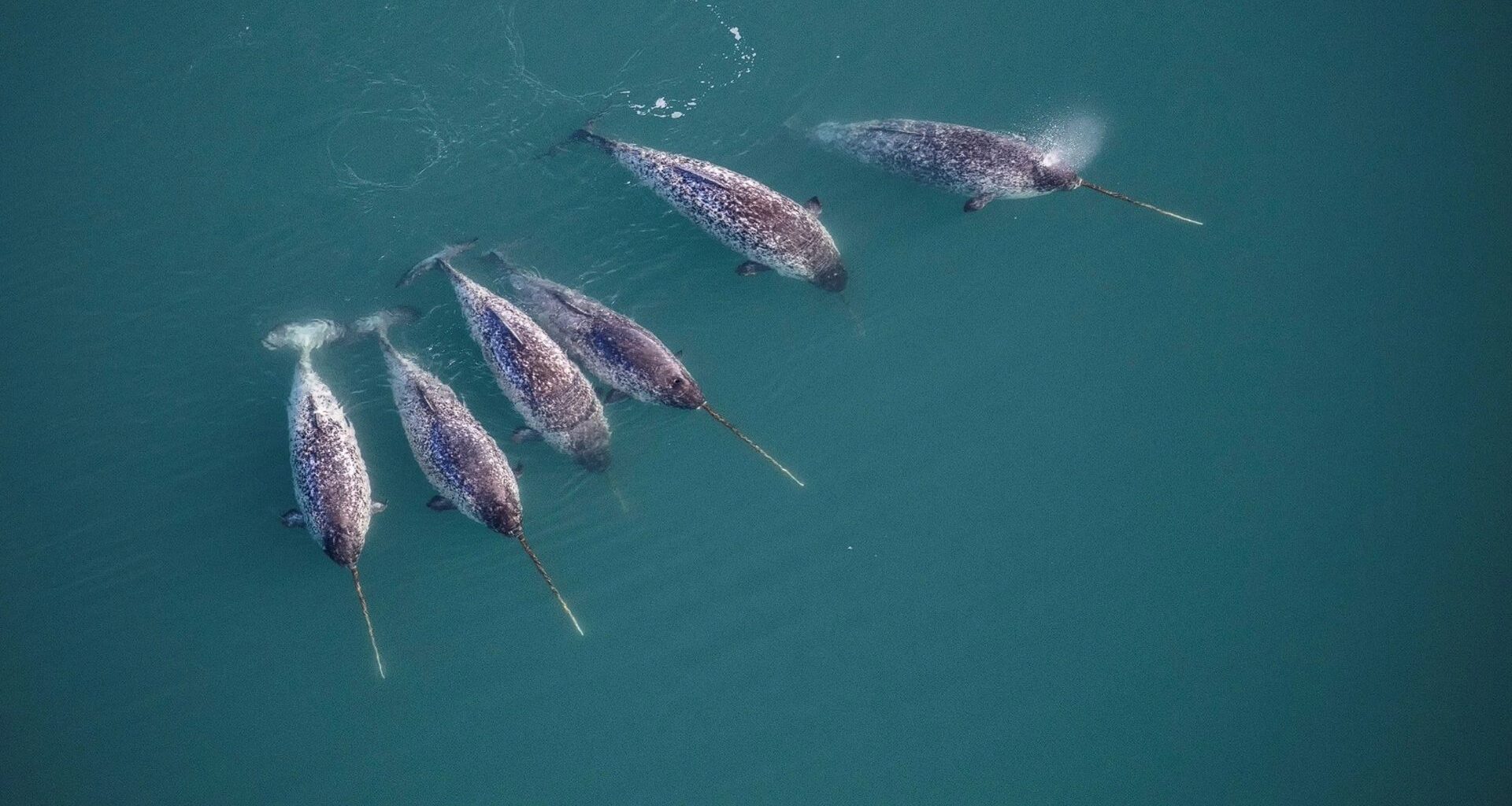
Scientists scanned narwhal tusks with X-rays and found two spirals twisting in opposite directions – a design no one expected to see.
A male narwhal grows one tooth into a corkscrew that pushes straight through its upper lip. The tooth keeps twisting in the same direction throughout the animal’s life.
Split that tooth down the middle, and the two halves spring apart on their own, untwisting by more than half a turn.
Something inside the tooth holds considerable strain. Until now, nobody knew what it was.
Henrik Birkedal, a chemist at Aarhus University in Denmark, led the team that went looking for the source of that tension.
Working with colleagues in Sweden and France, his team scanned narwhal tusks with powerful X-rays. The beams were precise enough to map how structures only a few hundred atoms across were arranged inside the tooth.
Narwhal tusks inspired unicorn myths
The tusk isn’t a horn at all. It’s a tooth: the left canine erupts through a male narwhal’s upper lip and grows to more than 6 feet (2 meters) long.
The tusk keeps corkscrewing to the left for as long as the animal lives, which can be 80 years or more.
That slow spiral growth is unlike anything else in nature. In the 1600s, twisted white tusks arriving at European trading ports convinced buyers that they had found real unicorn horns.
Denmark’s King Frederik III believed the myth strongly enough to have an entire coronation throne made from them. The throne was completed in 1671.
Narwhals do plenty with that outsized tooth besides starting rumors. They use their tusks to stun small fish before eating them.
Drone footage has also captured narwhals swatting and playing with their tusks the way another animal might use a paw.
Their long lives already come under other pressures. Narwhals have had to shift their migration patterns as Arctic sea ice forms later each year.
X-rays searched inside the tusk
Birkedal’s team suspected that whatever caused the twist would appear as a single spiral within the tooth’s building blocks.
Those building blocks consist of collagen threads embedded with tiny mineral crystals, the same basic materials that make up bone.
Mechanical tests on cut tusks had already suggested that the spiral ran deep. Splitting a tusk lengthwise allowed pent-up stress to twist the two halves apart by more than half a turn and sometimes even farther.
The team aimed X-rays at thin tusk slices at synchrotron facilities in Switzerland and Sweden, as well as the European Synchrotron Radiation Facility in France.
The researchers rotated each slice point by point, building a 3D map of how the threads inside were arranged. The first scans produced a puzzling result.
“That puzzled us quite a bit,” said Marianne Liebi, a physicist at the Paul Scherrer Institute in Switzerland and a co-author of the study. “But instead of a helix, all we saw was a regular pattern.”
Two hidden spirals emerged
The key was to stop examining each measurement point on its own. Instead, the team compared every point with its neighbors.
“When we compared how these points were oriented relative to each other, a directional trend began to appear,” said Adrian Rodriguez-Palomo, the study’s first author.
Rodriguez-Palomo worked on the project as a doctoral student at Chalmers University of Technology in Sweden. She later continued the research as a postdoctoral researcher at Aarhus University.
“All we had to do then was connect the dots – as in a children’s paint-by-numbers kit – and suddenly the structure became visible: two intertwined spirals,” she said.
The two spirals run in opposite directions. On the outside, a layer called cementum forms a left-handed spiral. Cementum is the material that usually caps a tooth’s root, and its spiral is visible on the tusk’s surface.
Beneath the cementum, within the tooth’s main bulk of dentine, the collagen-and-mineral threads spiral in the opposite direction, to the right. Dentine is the same material found beneath the enamel of a human tooth.
The two spirals meet and lock together where the cementum and dentine touch.
Collagen is a common tissue protein. It also preserves ancient dietary clues inside teeth that are thousands of years old, although it has never been found twisted into anything like this.
Double spiral makes the tusk stronger
The two intertwined spirals work like reinforcement embedded in concrete.
“Like bones or other teeth in the animal kingdom, the narwhal tusk is a complex composite material whose structure extends from tiny nanoscale building blocks to the visible form of the entire tooth,” said Liebi.
“The narwhal tusk, too, must be both hard and flexible. Only then can it withstand the strong hydrodynamic forces that swimming generates.”
The researchers tested that toughness directly. They bent rod-shaped samples cut from the tusk in two directions: lengthwise and crosswise.
The rods cut along the tusk’s length resisted bending about 63 percent more than those cut across it. They also held together much longer before failing.
Under a microscope, the crosswise rods snapped cleanly, much like a ceramic plate shattering. By contrast, the lengthwise rods tore apart slowly. Their fibers pulled loose and redirected the crack sideways as it spread.
That toughness helps the tusk survive years of drag as a narwhal repeatedly dives to feed.
The twist remains a mystery
Birkedal’s team studied tusks from only two adult male narwhals. Both animals came from a Greenland population with surprisingly low genetic diversity for its size.
A larger sample could reveal whether every tusk develops its two spirals in the same way. It could also show whether rare double-tusked narwhals found in Greenland follow the same pattern.
No one has yet explained how a growing tooth begins spiraling in one direction on the outside and the opposite direction on the inside.
The researchers suspect that the answer lies at the boundary where the two tissues meet. Confirming that idea would require watching a tusk grow from the beginning. No one has yet managed that in a wild whale that can live for 80 years.
For now, the discovery gives engineers a working design that nature has tested for millions of years.
Anyone building drill shafts or suspension cables that must resist twisting now has a natural blueprint, one old enough to have inspired a myth about unicorns.
The full study was published in the journal Nature Communications.
—–
Like what you read? Subscribe to our newsletter for engaging articles, exclusive content, and the latest updates.
Check us out on EarthSnap, a free app brought to you by Eric Ralls and Earth.com.
—–