
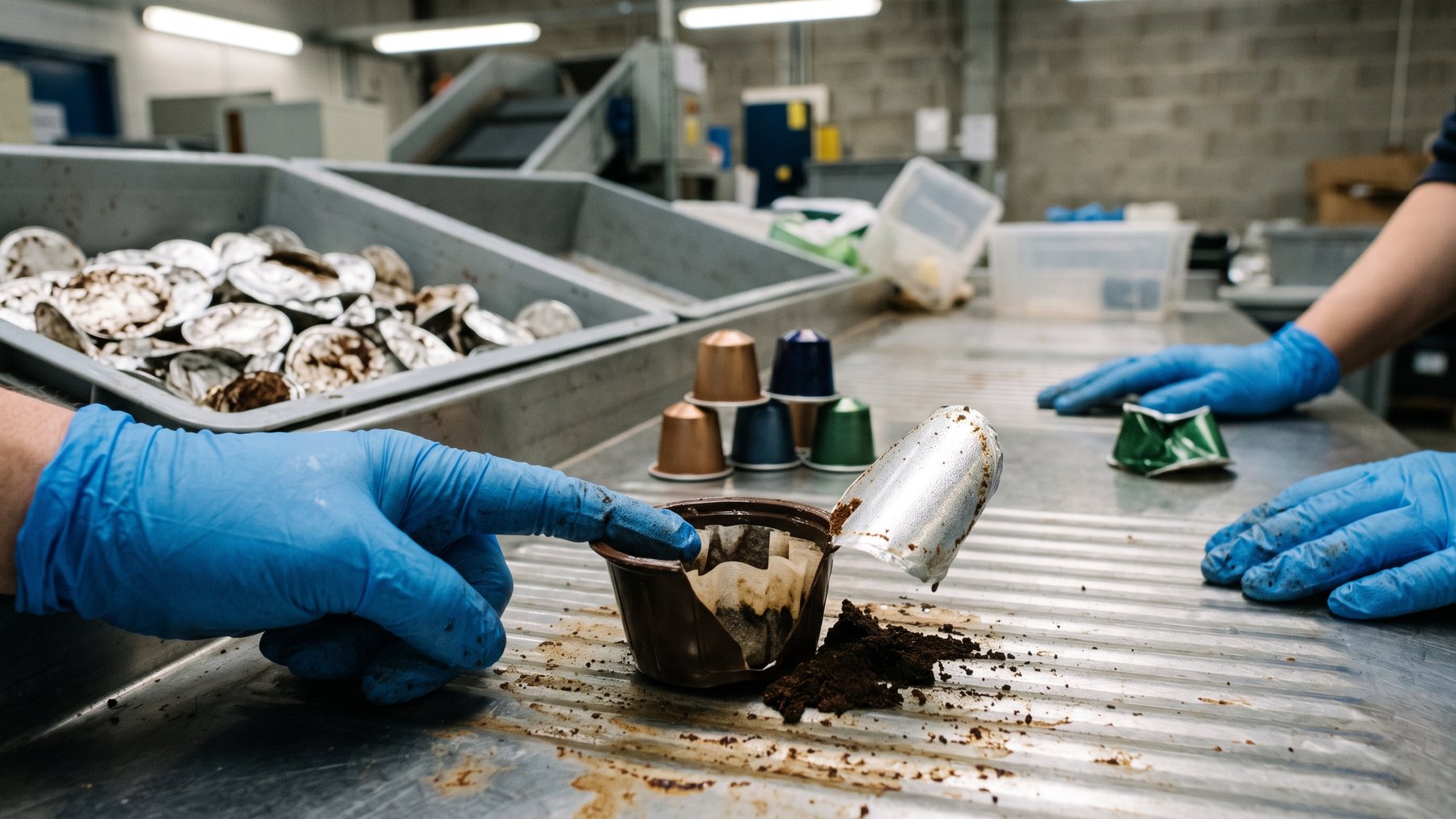
It is still warm when it goes in the bin.
A foil lid, a paper filter glued to a plastic wall, and a wet plug of grounds packed in the middle.
Four materials, one shell, under two inches tall.
Each of those four has a buyer in the recycling economy, and none of them can be sold while the other three are still attached.
The lid says recyclable. What that word means inside a building full of spinning steel discs is a different question.
Why four things fused into one shell beat the machine
A sorting line reads surfaces.
An optical sorter fires light at an object, reads what bounces back, and blows it into a bin with a puff of air.
It sees one material. The outside one.
A pod shows polypropylene on the outside and hides the rest, so the sorter routes the whole thing as plastic and the foil, the paper and the grounds ride along as contamination.
Size finishes the job.
The trade body for plastics recyclers defines small format packaging as anything under two inches in at least two dimensions, and objects that small drop through the screen decks built to pull out grit and broken glass.
They are not missed by accident. They are removed on purpose, by equipment built to remove that exact size.
Even the air jets fail, because a used pod is too light to steer.
What you find when you cut one open
Peel the foil back and the cup underneath is molded polypropylene.
That is a good resin. Food safe, heat tolerant, and reprocessors pay for a clean stream of it.
Related
Clean is the operative word.
The inside of a used cup is coated in coffee oils that have to be washed off before anybody can pelletize it, and no curbside program funds a wash step for an object this small.
The paper filter is bonded to the inner wall, and getting it off without shredding it takes water and agitation, which is a second process nobody has paid for either.
The grounds are the one part with an obvious home.
Spent coffee is high in nitrogen and composters want it, but mixed with shredded foil and wet plastic it becomes a slurry that no composter accepts.
The numbers everybody quotes, and where they came from
One figure runs through almost every article on this subject.
Global capsule production of 39,000 a minute, with up to 29,000 going to landfill, roughly forty million buried a day.
It is worth knowing who produced that estimate.
It came from a company selling compostable capsules against the plastic ones, which does not make it wrong, but it does make it a marketing figure rather than a measurement.
The firmer numbers are less quotable.
Annual capsule waste worldwide runs past 600,000 tons, and one large brand reported a global recycling rate of 32 percent at the end of 2020.
In that same period, 9 percent of all plastic in American municipal waste was recycled at all.
A study in Scientific Reports in 2020, from the University of Tennessee and Oak Ridge National Laboratory, put the sorting problem plainly. Many facilities lack the technology to detect the small components of a pod.
What the manufacturer already knew
There is a document trail, and it is worse than any estimate.
Related
In September of 2024 the maker of the best known plastic pod agreed to pay a federal penalty of 1.5 million dollars.
The charge was not about the pods. It was about the paperwork.
Two of the largest recycling companies in the country had told the manufacturer they did not plan to accept its pods, and the company filed two annual reports describing testing that supported recyclability without mentioning what the sorters had said.
A separate class action had already settled for 10 million dollars.
None of this is unique to coffee. An artificial turf field weighs 220 tons at the end of its life, and only 20 of those tons are the layer anybody has ever wanted back.
What would actually have to change
Two things are moving, and only one of them is fast.
Equipment makers are running pilots aimed at small format packaging, and one assessment found a single glass facility could divert 12,000 tons a year of material this size.
Redesign is the slower track.
A compostable cup removes the separation problem, but only in cities that run industrial composting and accept the item, still a minority of them.
An all aluminum capsule is the other route, and remelting aluminum takes about 5 percent of the energy that making it from ore does.
The same trade shows up wherever a product is built in layers, and 50,000 buried mattresses a day are the identical failure at a much larger scale.
The recycling symbol was never the false part.
Everything inside is recyclable, and almost none of it gets recycled, because no sorting line in ordinary municipal service is built to take coffee pods apart into four streams for a payload of a fraction of an ounce.
Read the whole thing?
Get the week’s signal, not the noise
Our sharpest reporting on energy, climate and nature — free, once a week.