
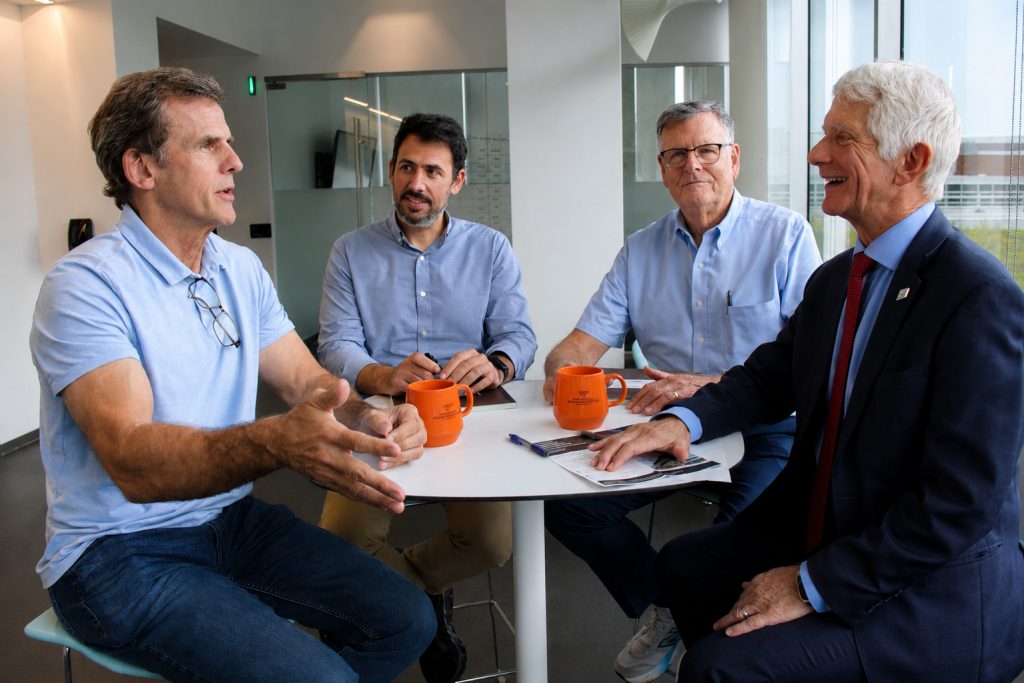
“I can say that Prozac and other SSRIs represented a true inflection point,” Brannan said.
Their impact went beyond their effectiveness against depression and anxiety disorders. SSRIs were far safer than the tricyclic antidepressants that preceded them, allowing primary care physicians to take on treatment that had largely been left to psychiatrists.
Brannan believes psychiatry may be approaching another period of significant change.
Cobenfy is one reason. For decades, schizophrenia medications have worked primarily by blocking dopamine receptors in the brain. Cobenfy takes a fundamentally different route, targeting the muscarinic class of cholinergic receptors in the brain that are involved in attention, memory, and perception.
Whether Cobenfy marks a turning point for schizophrenia treatment remains to be seen. But Brannan expects it to be followed by other drugs targeting new pathways.
“It’s the first. It won’t be the last,” he said.
The significance of the moment extends beyond a single drug and beyond schizophrenia.
Brannan points to what happened with SSRIs. Give one to a group of people with depression and some will respond, while others will not. Try another treatment and some additional patients may improve. Patients with the same diagnosis may respond to one SSRI but not another.
“We know now that these diseases are heterogeneous and not every medicine works for everybody,” Brannan said. “The hope with precision psychiatry is we’ll get smarter about this and understand which medicines work best for which person.”
Toward biological precision
The Fralin Biomedical Research Institute at VTC brings scientific depth across the spectrum needed to help advance precision psychiatry, according to Michael Friedlander, Virginia Tech’s vice president for health sciences and technology and the institute’s executive director.
That depth spans levels of inquiry at the molecular, cellular and neural circuit levels, and also includes human behavioral, neuroimaging, computation, and patient-based research.
The opportunity, Friedlander said, is to use that multi-level breadth of scientific inquiry to understand what is happening holistically in the brain and develop appropriately targeted treatments.
“There’s a lot of exciting movement in the direction to understand changes in functional brain circuitry,” Friedlander said. “That will enable our researchers to strategically suggest ways to address these issues that are more based on the emerging understanding of what’s actually wrong versus just treating symptoms.”
FBRI has been building strength in neuroscience and psychiatry for more than a decade.
Researchers, extending back to early FBRI faculty recruits Read Montague, Pearl Chiu, Brooks Casas, and Stephen LaConte, have developed a highly recognized Virginia Tech program in computational psychiatry, cognitive neuroscience, and human neuroimaging in Roanoke. From the start, they have used brain imaging, computational models, and behavioral analysis to investigate how the brain makes decisions and how those processes are altered in neuro-psychiatric illness.
Halassa builds on and expands that foundation with a focus on the brain circuitry underlying cognition and psychiatric illness and experience conducting research involving patients. As the first faculty member recruited to FBRI’s new Patient Research Center, he extends that work toward understanding individual patients and their responses to treatment, directly linking the lab to the bedside.
“The science has been advancing considerably the last few years,” Friedlander said. “There’s a tremendous unfulfilled need for these patients, and we have the right people at the right place and time here to bring together thought leaders and really develop exciting new strategies.”
Brannan will open the scientific program with the story of KarXT, the compound that became Cobenfy, followed by researchers from Bristol Myers Squibb and Ovid Therapeutics discussing other emerging approaches to schizophrenia. A biotechnology panel will bring perspectives from Alto Neuroscience and Syremis Therapeutics.
The symposium will also reach beyond drug development to the biological and computational tools that could make treatment more precise. Andrew Pines, an instructor of psychiatry at Harvard Medical School and a psychiatrist and research fellow at Mass General Brigham, will give a keynote on using human causal data to identify brain regions involved in psychosis.
From the Fralin Biomedical Research Institute, Montague will give a keynote on his group’s first-in-human direct measurement of neuromodulators in the human brain, while LaConte and Chiu will explore biomarkers, cognition, and NeuroAI.
Other sessions will examine brain mechanisms involved in psychosis, memory and planning, and whether speech and language can provide measurable clues to psychiatric illness. Industry leaders from Johnson & Johnson, AbbVie, and Rapport Therapeutics will also discuss where the field is headed.
Looking ahead
Halassa sees an opportunity to connect an established scientific foundation more directly with psychiatric care.
“We want a better framework for psychiatry,” Halassa said. “There is a great opportunity to contribute to that here in Roanoke, building on the strong programs in computational psychiatry at the FBRI and the excellent clinical care at Carilion Clinic psychiatry.”
Friedlander sees that progress as a two-way exchange between science and patient care.
“The work in the clinic can inform the research going on in the laboratory to better understand the mechanisms that cause schizophrenia, and that in turn can inform what to try in the clinic,” Friedlander said. “It’s part of this virtuous cycle back and forth between the lab and the clinic.”
For Trestman, the promise is straightforward.
“We’ve long awaited the ability to make informed decisions that can lead to the first treatment being definitive,” Trestman said.
Likewise, Brannan envisions a future in which physicians have biological information that can help guide treatment before patients cycle through multiple medications.
If they fulfill their promise, Brannan said, “We’re going to be in a new era of psychopharmacology.”