
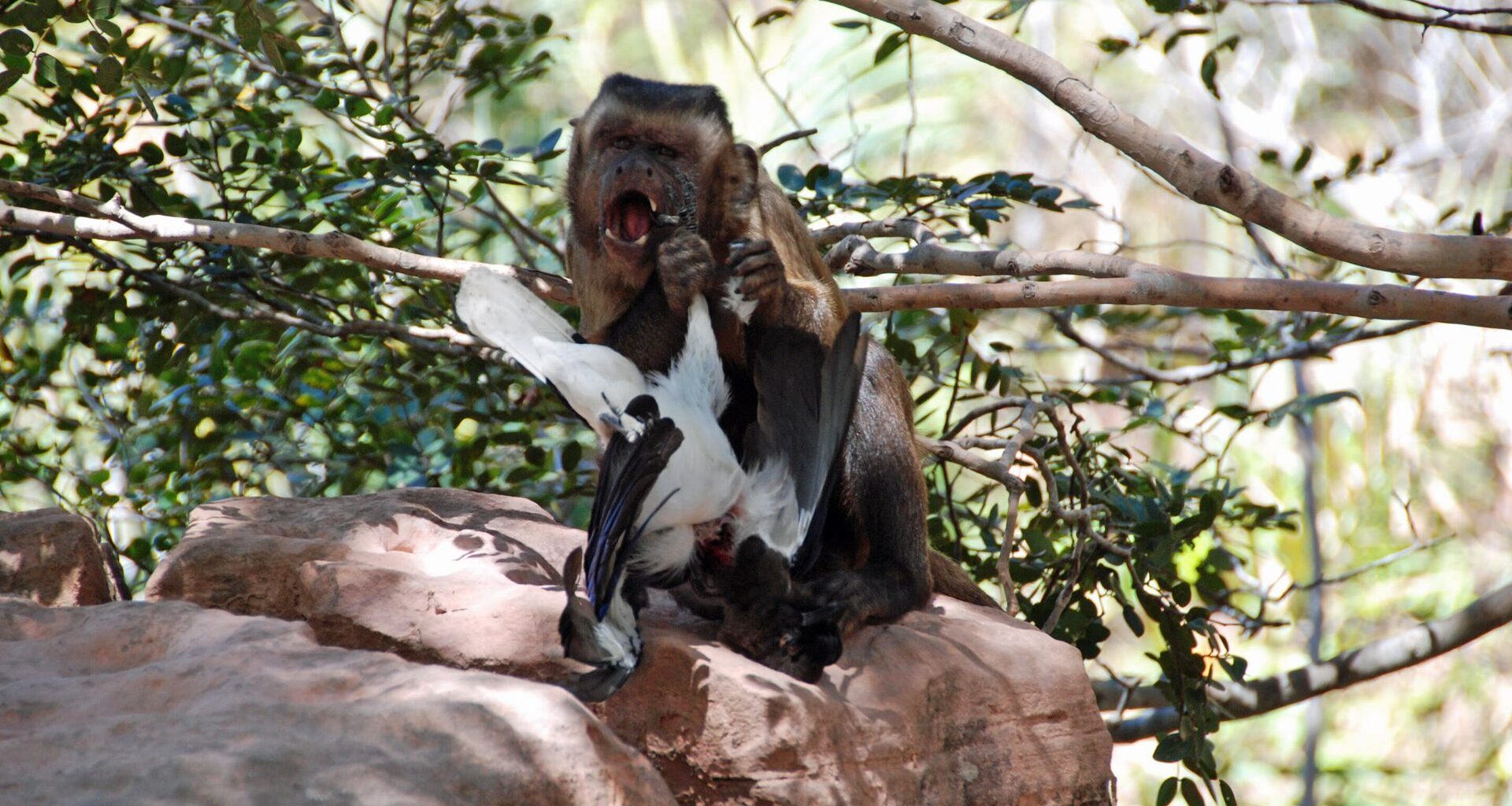
Across 45 months in Brazil, capuchin monkeys ate lizards, rodents and snakes, hinting at how our own ancestors began eating meat.
Bearded capuchin monkeys spend most of the year eating fruit, palm nuts, and insects. But when the fruit thins out, they hunt. For nearly four years, researchers followed two wild groups in northeastern Brazil and found that eating small animals is no occasional event for these monkeys.
It was a regular behavior, occurring about six times in every 100 hours of observation.
Both groups live side by side at one site, so what the team recorded describes these capuchins rather than the whole species. It’s still the longest record of the behavior anyone has: 45 months in the field, 5,093 hours of observation, and 446 meals of vertebrate prey.
Humans are the only living primate that routinely hunts animals as big as itself or bigger, and how that started is still argued over. One long-standing idea is that it began small, with prey a single animal could catch and eat alone.
Fruit shortages increase capuchin hunting
Fazenda Boa Vista, the study site, sits in Piauí state, where the Cerrado savanna meets the dry Caatinga scrub. Rain there is seasonal and lopsided. About 45 inches (1,156 mm) falls in an average year, and only about 9 inches (230 mm) of it lands in the dry season, May through September.
Fruit was scarcer in those dry months, and vertebrate eating was more common in them. The team’s model identified low fruit availability as one of the strongest predictors. Insect availability, tested the same way, made no difference.
The two groups also gave the team a second test by accident. One had been given nuts, corn, and water each day through the dry season; the other found everything itself. The unfed group ate vertebrates at 1.88 times the rate of the other.
Noemi Spagnoletti of Sapienza University of Rome shares lead authorship with Susana Carvalho, Director of Science at Gorongosa National Park in Mozambique. Patrícia Izar and Michele Verderane of the University of São Paulo are among the co-authors.
“Together with the relationship we found between lower fruit availability and higher predation, this strengthens the idea that access to other food resources can influence how worthwhile vertebrate predation is for these monkeys,” Spagnoletti told Earth.com.
Lizards and rodents were the main prey
Of the 281 events the team logged in its regular scan sampling, lizards accounted for 43.8% and rodents for 28.5 percent. Birds, mostly nestlings and eggs, made up 12.1 percent. Opossums and their relatives came to 5.3% and snakes to 4.3 percent.
Opossums, iguanas, and bird eggs and nestlings had never been recorded in the diet of the bearded capuchin before.
Capuchins here also ate vertebrates more often than the same species at Serra da Capivara National Park, where the rate is 4.6 per 100 hours. The monkeys at that site use probe tools to reach prey and are also known for using stone tools.
The monkeys usually ate alone, and observers rarely saw them make the kill. An observer saw the capture in only 51 of the 280 events logged this way.
One monkey ate the prey alone in 82% of them. Where two or more took an animal together, the carcass or parts of it got passed around in 32 of 50 cases.
Chimpanzees will coordinate hunting with calls and block a monkey’s escape routes. These capuchins mostly didn’t, and the authors suggest prey size is the reason. A lizard doesn’t feed two.
Male capuchins hunt more often
Adult males ate vertebrates at about 1.4 times the rate of adult females, and every snake taken across the study was taken by a male.
Body size is part of it. Adult males in the lower ranks here average 7.7 pounds (3.5 kg) against 4.6 pounds (2.1 kg) for females, and a bigger animal needs more calories.
Age split things differently. Infants ate vertebrates at a fifth the adult rate, while juveniles matched adults, which the authors read as experience rather than appetite.
“Evolutionarily, it makes sense that females take on less risk, because they are the ones giving birth and carrying infants during the relatively long periods of primate infant development,” Carvalho said.
She said the pattern isn’t fixed. Female chimpanzees join the hunt when the prey is safe, such as bush babies asleep inside tree holes in Senegal. And in bonobo groups, where males don’t outrank females, a female can lead the hunt and take the largest share.
Capuchins eat organs before muscle
The order the monkeys ate in barely varied. Birds were usually eaten whole, and when they weren’t, the brain and the internal organs went before anything else. With a rodent or an opossum, the monkeys started on the tail and the paws and sometimes the eyes.
Lizards and geckos lost feet, tail, eyes, brain, and skin. Snakes were handled differently again: the monkeys usually discarded the head and ate the body, starting with the organs.
Muscle and tendon were torn into small pieces and chewed repeatedly, while brain and viscera went down quickly. The authors point to fat as the reason, since both hold more of it than muscle does.
Chimpanzees at Gombe National Park do something close to this, eating the brains of young prey and the organs of adult prey before the rest. White-faced capuchins in Costa Rica do the opposite with the head, taking the viscera first and usually discarding the skull.
Palm nuts complicate the food link
One measurement makes that result harder to read. The team’s index folded palm nuts in with fruit, and palm kernels are the fat-rich, protein-rich staple these monkeys rely on here. So the animals may have been responding to a shortage of nuts.
The finding does not extend easily to other primates. The largest review of predation across the order found little evidence that primates hunt more when plant food runs short, even in species living in savannas. Chimpanzee hunting at Fongoli, in Senegal, isn’t explained by fruit scarcity at all.
The team also can’t yet separate two explanations for the seasonal swing. These monkeys may hunt more because they are short of calories. Or the prey may simply be easier to catch then, because the months when predation rose are also the months when those species breed.
Rainfall and temperature both tracked predation in the model, which is what the second explanation would predict.
Catching a lizard requires neither tools nor cooperative hunting, and the authors argue that is part of why small-vertebrate eating appears across so much of the primate order, hominins included. It shows up in chimpanzee diets in odder forms too, including hunting crabs out of forest streams.
Capuchins earn the comparison for reasons beyond diet. They’re small monkeys with unusually large brains, they live for decades, and they spend a lot of time on the ground.
“Brains being important in capuchins too presents the possibility that early hominins may have preferred the inside nutrients, and this kind of exploitation preceded large game hunting,” said Carvalho.
Whether that is what happened isn’t something watching monkeys can settle. The authors want small bones from early sites looked at again for the marks a predator leaves.
“This opens a new opportunity to revisit the fossil record and pay more attention to the smaller species that could have been prey,” she said.
The full study was published in the journal PLOS One.
—–
Like what you read? Subscribe to our newsletter for engaging articles, exclusive content, and the latest updates.
Check us out on EarthSnap, a free app brought to you by Eric Ralls and Earth.com.
—–