
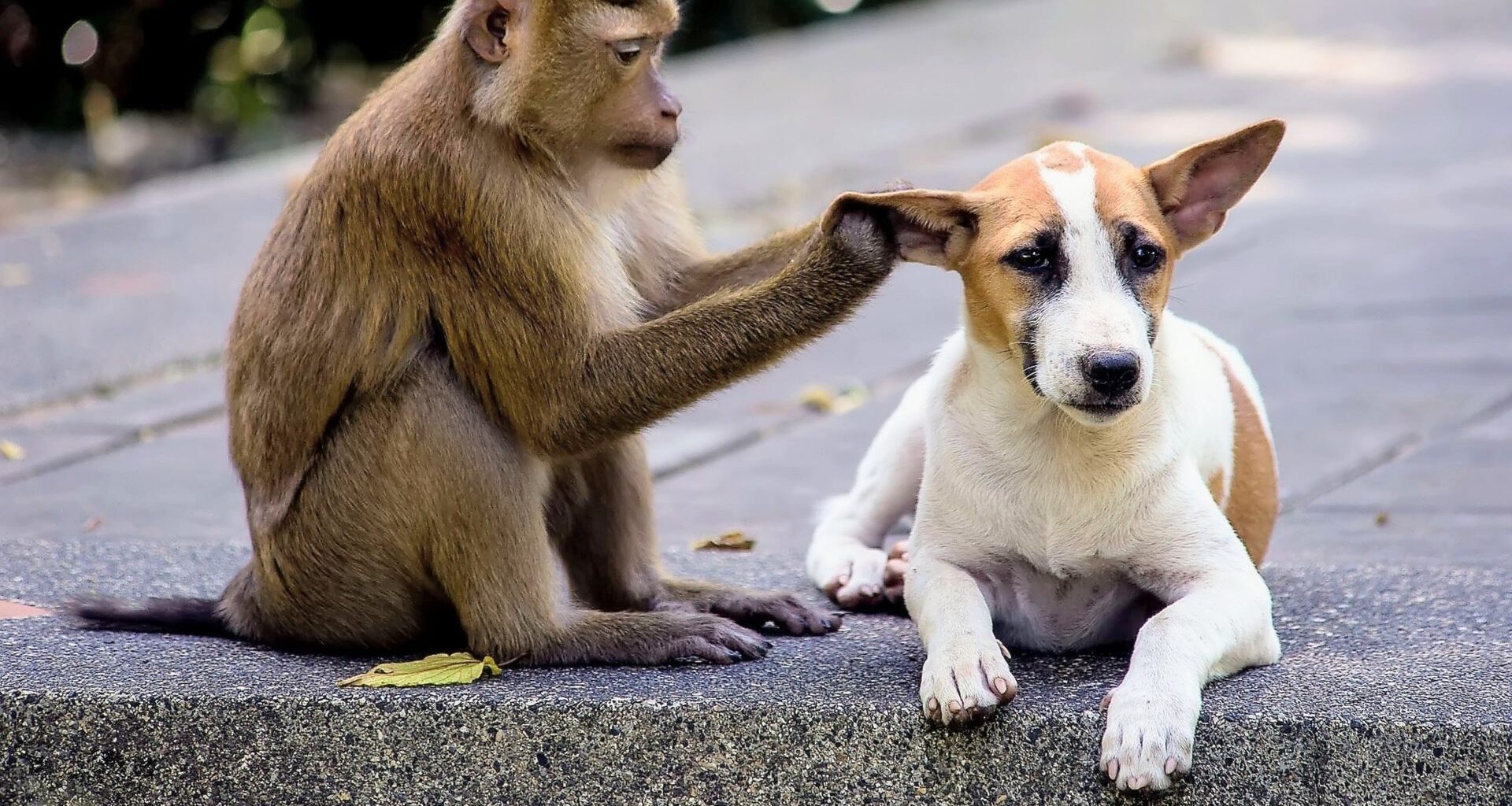
Monkeys and apes form surprising relationships with other species, offering clues about how our close bonds with animals evolved.
People keep animals as pets, feed them, brush them, and let them sleep on the bed. Scientists have long treated pet-keeping as something uniquely human.
Monkeys and apes turn out to do a smaller version of this, making friendships with individuals of other species. They have been known to groom stray dogs and sometimes care for another species’ baby for months.
Cyril Grueter, an evolutionary anthropologist at Oxford’s School of Anthropology and Museum Ethnography, led the team that pulled together 427 of these encounters.
The behaviors “don’t amount to pet-keeping as we know it,” Grueter said, “but they may represent some of the evolutionary building blocks from which human-animal companionship eventually emerged.”
Play and grooming came first
Most of the records came from studies that were already published.
The rest came from photos and videos, and from 37 researchers who filled in a questionnaire. The team threw out any clip that looked staged or edited.
Eighty-eight primate species did the approaching. The animals on the other end came from 127 species, and 55 of those were not primates. The list included dogs, deer, squirrels, pigs, birds, frogs and insects.
The team sorted everything into 17 kinds of interactions. Play came first with 139 cases and grooming second with 136. Both are also common ways people interact with cats and dogs.
At a temple in Thailand, a group of monkeys called stump-tailed macaques groomed a dog. A gray langur monkey stroked a grizzled giant squirrel in Sri Lanka.
In southwest China, a young snub-nosed monkey played on a domestic pig, and on a Japanese island a macaque climbed onto a sika deer and rode it.
The monkeys made the first move
When two different species spend time together, the reason is usually food or safety. Monkeys drop fruit and leaves, and animals on the ground eat what falls. They call out when they spot a predator, and everything nearby is alerted.
Grooming a dog is different. The monkey gets little or nothing in return for its act of friendship.
In 219 cases the researchers knew who started the interaction. The primate did in 144 of them, and in another 72 the two animals started it together.
Only three began with the other animal, and all three were cases of carrying: two started by dogs and one by a lion.
Females groomed, youngsters played
Adult females had the highest proportion of friendly encounters. Adult males had the lowest.
When an adult female approached an animal of another species, the encounter was friendly 42 times and abusive just twice.
Adult males started 30 friendly encounters and 12 abusive ones. No other group came close to that share of abuse.
Juveniles showed up more than any other group, and what they mostly did was play. It is the same pattern you see inside a troop: the young play, the adults groom.
The team also expected the primates to pick out the young of other species. Baby faces are supposed to bring out caregiving in adults, an idea that goes back to the 1940s. It did not turn out that way.
Where the partner’s age was known, grown animals and young ones came out about even, 44 to 37.
Adult females actually favored grown animals. They were friendly to adults 25 times and to young animals just 9 times.
Rough handling can turn deadly
Not all of the contact was gentle. The team logged 26 abusive encounters, and 21 of those were aimed at animals that were not primates. The targets included rodents, pigs, birds and pangolins, the scaly mammals that eat ants.
Thirteen animals died after being handled too roughly: seven birds, two pangolins, a house cat and three primates.
In an account from 1970, three female spider monkeys took turns carrying a baby howler monkey, each one pulling it away from the last by its arms and legs.
A female then rested for half an hour with the baby pinned underneath her while it called out. The baby was found on the ground soon after and died.
A male baboon in Saudi Arabia appeared to have taken a puppy and carried it around for long stretches.
On an island off Panama, young male capuchin monkeys carried off baby howler monkeys one after another. The habit spread through the group, and no one has worked out what the monkeys got from it.
One adoption lasted ten months
The closest thing to pet-keeping in the whole review happened in Brazil. Wild capuchins adopted a baby marmoset, a much smaller kind of monkey, and kept it for at least ten months.
It clung to their backs and shoulders the way a capuchin baby would. Two females took care of it in turn, and one of them nursed it.
In the 1980s, a captive gorilla named Koko did much the same with a kitten called All Ball. She cradled the kitten and groomed it, and she guarded it the way a gorilla mother guards her own baby.
Most of the encounters were nothing like either of these cases. As far as anyone could tell, they did not go on for long. People keep a pet for years, which is the biggest difference between the two.
Field studies still skip monkey friendships
Grueter’s team was upfront about the gaps. How long an encounter lasted was hardly ever recorded. Few of the records came from zoos, because the survey went mostly to researchers working in the field.
Photos and videos of monkey friendships also favor the odd and the cute over the ordinary. Grueter said better records could still help zoos and sanctuaries decide which species can share an enclosure.
Researchers rarely record how often a monkey grooms a village dog, or how long the habit lasts. Grueter’s team wants that to change.
They want long-running field projects to log these encounters as a matter of routine, and to publish the one-off sightings as a means of understanding the evolution of empathy and social flexibility.
The full study was published in the journal Primates.
—–
Like what you read? Subscribe to our newsletter for engaging articles, exclusive content, and the latest updates.
Check us out on EarthSnap, a free app brought to you by Eric Ralls and Earth.com.
—–