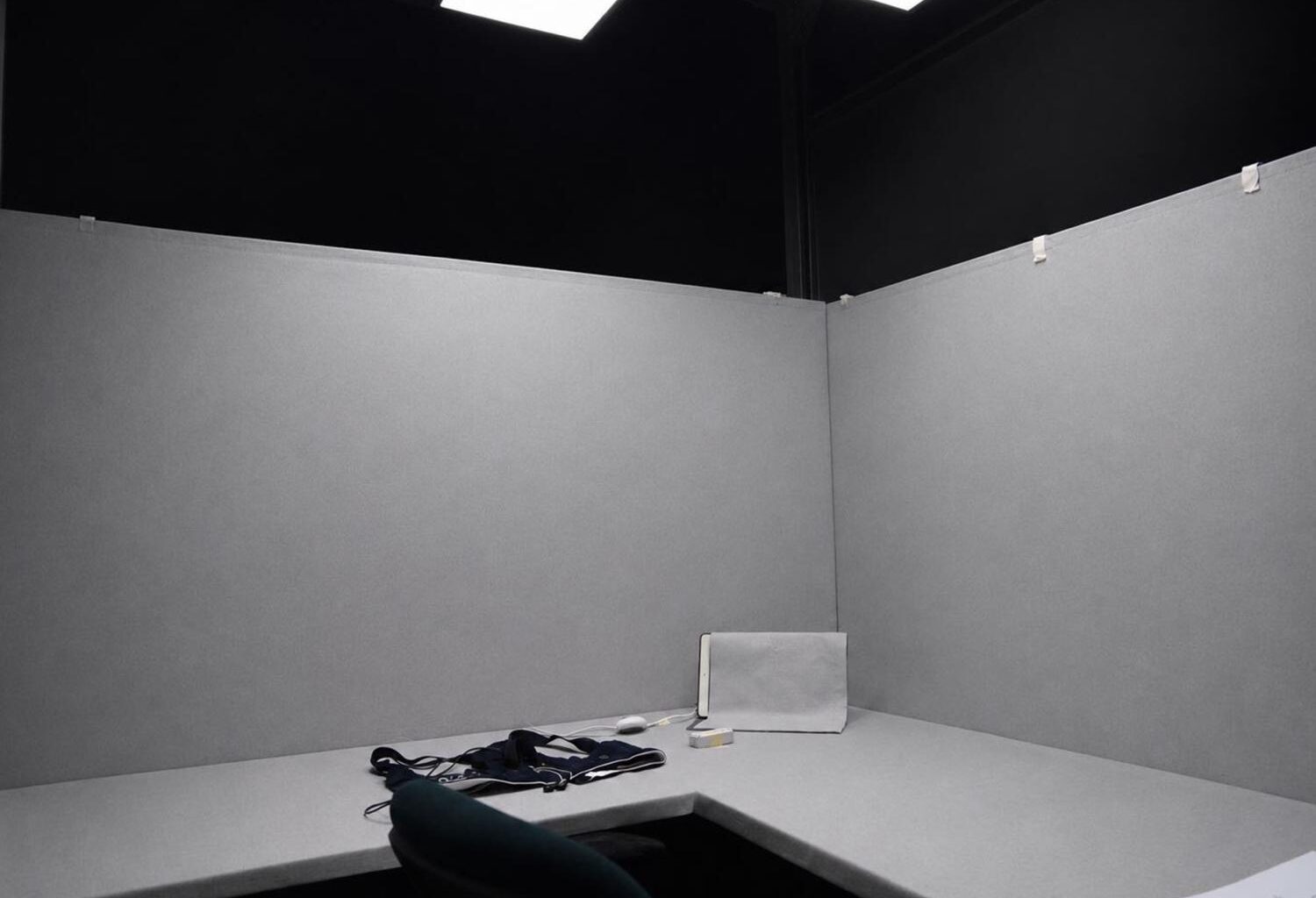
 A new study led by scientists at Penn State found that white light can impact how people experience indoor temperatures. Credit: Julian Wang / Penn State
A room can feel cooler even when the thermostat has not moved. The trick, a new study suggests, may lie in changing parts of white light that people cannot consciously see.
In a small laboratory experiment, people sitting under blue-enriched white light tolerated air about 1.3 degrees Fahrenheit (0.7 degrees Celsius) warmer before asking for relief than they did under red-enriched white light. Both lights looked the same to the human eye. It’s the first evidence that a light’s underlying spectrum — not merely its visible color — can affect how people respond to ambient temperature.
“We wanted to understand whether lighting can widen people’s thermal comfort zone,” said Julian Wang, a professor of architectural engineering at Penn State. “If it can, even a modest shift in perceived temperature can translate into substantial cumulative energy savings over time.”
Two White Lights That Looked the Same, One Hidden Difference
The researchers recruited 10 adults, five women and five men, ages 18 to 35. Each spent two days in a mock office cubicle inside a climate-controlled chamber at Penn State. They wore the same clothes and ate the same meal on both days, then sat under one of two lighting conditions presented in random order.
Both lamps produced ordinary-looking white light at the same brightness. But one concentrated more energy in short, blue wavelengths and the other in longer, red wavelengths. The ratio of blue to red radiant power was roughly four times greater in the blue-enriched setting. All 10 participants said they could not see a difference.
“The novelty of this study is that we used white light that looks identical to the human eye but has a different spectral composition,” Wang said.
After 30 minutes of adjustment at roughly 76 degrees Fahrenheit (24.5 degrees Celsius), the room slowly warmed or cooled. Every five minutes, participants rated how warm and comfortable they felt. They pressed a button when they wanted the temperature changed.
During warming, nine people pressed the button before the chamber reached its safety limit. Six participants tolerated a larger temperature increase under blue-enriched light. After accounting for body mass, core temperature and experimental day, the blue light expanded the average heat-tolerance boundary by 0.7 degrees Celsius, or 1.3 degrees Fahrenheit.
×
Thank you! One more thing…
Please check your inbox and confirm your subscription.
The reverse effect proved less easy to gauge. During cooling, red-enriched light made participants rate themselves significantly warmer, but it did not make them wait longer to request a temperature change.
A Promising Effect With Large Caveats
The idea that blue looks cool and red looks warm, known as the hue-heat hypothesis, dates back decades. A 2025 systematic review and meta-analysis found that cooler-looking light tended to shift thermal sensations in neutral or warm rooms, especially during short exposures, but results across studies varied widely. A recent controlled study likewise found that bright morning light could make people feel cooler under some conditions but not others.
The Penn State experiment is very different, though, because it removes any visible color difference from the equation. The major caveat is that it only involved 10 young adults, all tests occurred in winter, and the study had low statistical power. The experimenter also knew which light was active, and day-to-day effects appeared in the data.
Although the reported temperature effect sounds small, a computer model performed by the Penn State researchers estimated that widening thermostat settings by 0.5 degrees Celsius could cut cooling energy use by 5.2 to 11.4 percent, depending on climate. Across many buildings, the energy savings and subsequent reduction in carbon emissions can add up considerably. Earlier building simulations have also projected sizable savings from broader temperature bands, although this experiment did not measure energy use in the occupied building.
If larger field studies reproduce the effect, lights could one day work with thermostats to stretch a room’s comfort zone without bathing it in distracting colors.
The findings were published in the journal Energy and Buildings.