
Every month the Together team highlights five media stories that defined the month, and one great media idea we love. August brought major ownership changes across New Zealand media and fresh evidence of radio’s enduring scale. It also saw another step towards conversational commerce from Google and a US$2.15bn consolidation play in global measurement.
oOh!media expands its NZ footprint as ownership changes hands
August was a significant month for oOh!media. Locally, it secured Hamilton City Council’s street furniture contract and extended its Wellington partnership. It also added to its expansion in Christchurch, where more than 70 LED bus shelters are planned by the end of 2026.
At the same time, parent company oOh!media agreed to be acquired by infrastructure investor I Squared Capital. The deal underlines how outdoor increasingly behaves like an infrastructure business: long-term concessions, physical assets, digitisation and increasingly sophisticated audience data sit underneath the advertising product.
That framing could have some interesting implications for NZ marketers. First, infrastructure ownership may support a longer investment horizon for digitising the network, particularly where upgrades require significant upfront capital before advertiser revenue follows. I Squared has already said it wants to accelerate network digitisation. This could mean more digital inventory, better consistency of formats and greater flexibility across New Zealand over time.
Second, it could push oOh!media further towards being treated as a technology-enabled network rather than simply a collection of sites. I Squared itself categorises oOh!media within its digital infrastructure portfolio, alongside businesses such as data centres. That does not guarantee a particular product roadmap. It does suggest data, automation, measurement and network utilisation could become increasingly important to how value is created.
There is also a commercial watch-out. Private infrastructure owners are typically focused on improving asset utilisation and long-term returns. For advertisers, that could produce better products and more investment, but it may also bring sharper yield management, greater emphasis on premium inventory and a stronger push to monetise digital assets efficiently.
MediaWorks sold to Sports Entertainment Group
Talking of acquisitions, this month Sports Entertainment Group agreed to acquire MediaWorks for NZ$130m. This created a trans-Tasman audio, digital and entertainment business reaching more than five million listeners each week. MediaWorks brings the scale, with around 2.51 million weekly listeners and approximately 59% audience share among 25-54s. SEG brings something quite different. It’s Australia’s only “whole-of-sport” media platform, spanning premium sports rights, owned content, talent, production, events and even team ownership.
That sport focus is what makes the deal particularly interesting. SEG’s Sports Entertainment Network holds rights across the AFL, NRL, cricket, NBL and Australian Open. It also produces more than 100 sports talk programmes and connects brands with fans across radio, digital, social, podcasts, television production and live experiences. SEG has explicitly said MediaWorks gives it a ready-made platform to extend its sport, events and content offering into Aotearoa.
For NZ marketers, this could shift the shape of MediaWorks over time. Current strengths are music and entertainment, through The Rock, More FM, The Breeze, Mai FM and George FM. Under SEG, there is a clear path to layering more sport content, talent, rights, events and sponsorship around that existing reach. That could make MediaWorks a more significant player in the battle for lucrative sports audiences (about which we’ve written before), particularly outside traditional broadcast rights packages.
There are also broader implications for how brands buy sport. Rather than treating sport as a TV-led sponsorship buy, SEG’s model is built around fan ecosystems: commentary, personalities, podcasts, social content, live events and owned communities. If that approach is brought into New Zealand at scale, advertisers could get more ways to build sustained associations with sport across the week, rather than only around live match coverage. NZME have shown the way with platforms like the ACC, Mediaworks looks set to follow.
For NZ marketers, the key thing to watch is whether SEG uses MediaWorks simply as a large audio distribution business, or as the foundation for a broader sport and entertainment ecosystem. The latter would make this a much more consequential deal for the local media market.
Radio holds its ground, but the audience shifts underneath it
August’s GfK Survey 2 2026 results showed commercial radio still reaches 3.43 million Kiwis, although cumulative audience fell by 65,100. Average time spent listening was effectively flat at 14 hours 23 minutes, down just two minutes.
At a station level, Newstalk ZB remains comfortably No1 with a 14.6% share, up 0.2 points. The Breeze follows at 9.2%, down 0.3, with The Rock at 8.4%, up 0.5. More FM edged up to 7.2%, while ZM rose from 5.1% to 5.5%. The Hits also gained 0.4 points to 5.8%. George FM slipped from 2.8% to 2.5%, while Breeze Classic declined from 6.5% to 6.1%.
The demographic movement is arguably more interesting. The Rock strengthened among 45-64s, rising from 7.9% to 9.1%, while ZM grew strongly among 18-39s, from 8.2% to 9.9%. Newstalk ZB remains dominant among 55-74s at 21.5%, though that was down slightly from 22.0%. Meanwhile, The Hits posted solid gains among older audiences, moving from 5.2% to 6.9% among 45-64s and from 4.1% to 5.3% among 55-74s.
For NZ marketers, the takeaway is that radio’s overall scale is stable, but station choice matters increasingly by audience and mindset. Broad network buying will still deliver efficient reach, while the shifts underneath the topline suggest more value in matching formats to specific life stages and listening occasions.
Google is turning YouTube ads into conversations
Google announced this month that they’re testing a Demand Gen format that lets viewers move directly from a YouTube ad into a conversation with a brand through messaging apps. It’s also expanding travel personalisation and making multimodal video creation generally available in Asset Studio. Google says improvements made to Demand Gen in the second half of 2025 have driven an average 30% increase in conversions or conversion value, based on its own internal experiments. (Google Blog)
For NZ marketers, the more interesting shift is structural. Media, lead generation and customer service are moving closer together. For categories such as automotive, travel, telco or financial services, where people often want reassurance or detail before converting, that could make the messaging experience itself part of the media plan.
It also raises the bar for what happens after engagement. Fast response, good CRM integration and useful conversational design will matter just as much as targeting.
Nielsen buys DoubleVerify for US$2.15bn
In another mammoth media deal, Nielsen agreed to acquire DoubleVerify for approximately US$2.15bn in cash, paying US$13.60 per share, a 30% premium to DoubleVerify’s 60-day volume-weighted average price. The combined company is expected to generate more than US$4bn in pro-forma revenue.
Strategically, the deal combines Nielsen’s audience and outcomes measurement with DoubleVerify’s verification, fraud, viewability and brand-suitability capabilities. It’s a sign that Nielsen sees it’s future as an independent measurement and verification layer in an increasingly agentic media buying world.
For NZ marketers, this matters because media measurement is becoming more fragmented just as AI-driven buying becomes more automated. Combining audience, delivery quality and outcomes data into one independent layer could make campaign evaluation simpler and give advertisers a needed and stronger counterweight to platform-owned reporting. The key issue will be whether the combined business can maintain the independence and transparency on which both brands rely.
Media idea of the month: Jameson turns a “leaked” Kayo password into access
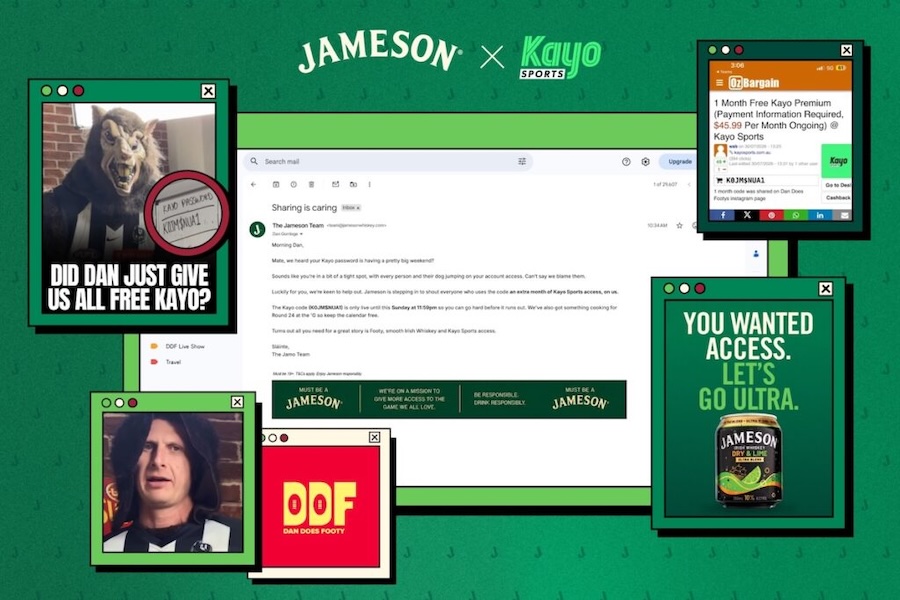
This month Jameson and Kayo staged what appeared to be the accidental leak of a working Kayo Sports login during creator content. Fans discovered the “leaked” credentials and spread them through social channels and online communities before Jameson revealed the stunt and rewarded participants with two months of Kayo access.
Why we love it:
It used internet behaviour as the media mechanic. Discovery, testing and sharing were built into the idea.The value exchange was real. People received something they genuinely wanted rather than being asked simply to engage with branded content.Paid, creator and earned media worked as one system. The spread of the idea was part of the execution, not an afterthought.
A sharp example of media thinking built around participation and utility rather than interruption.