
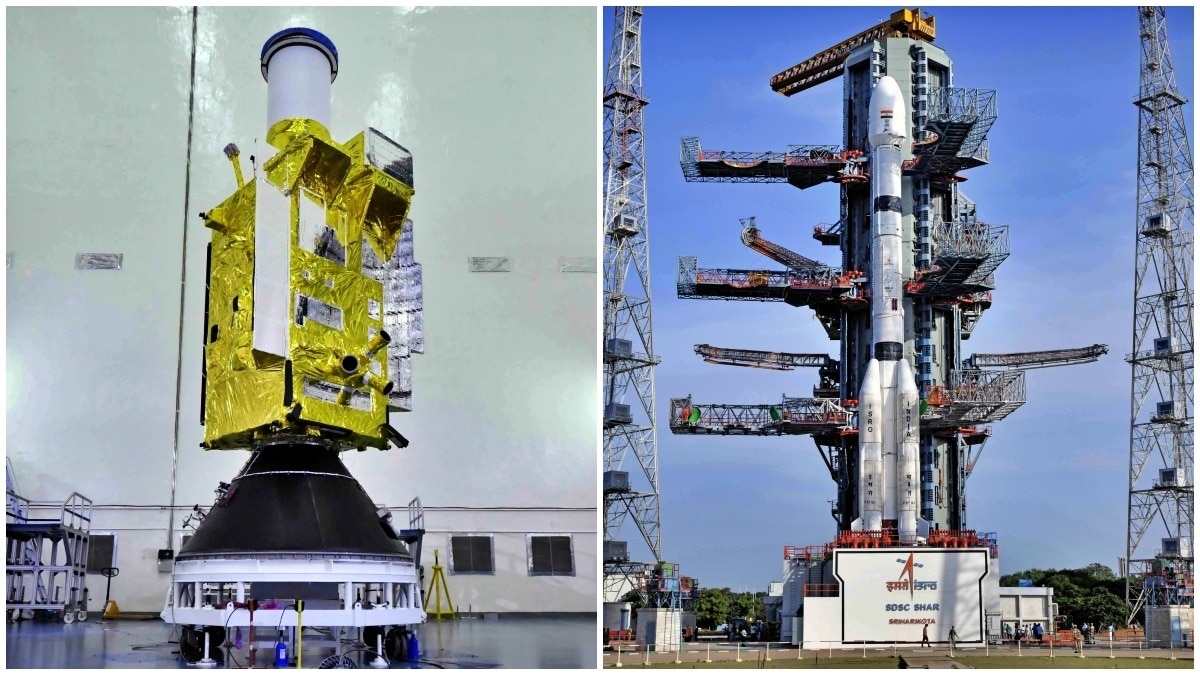
The Indian Space Research Organisation (Isro) is preparing to launch EOS-05, an advanced Earth observation satellite that represents a renewed push to establish continuous imaging capabilities from geostationary orbit.
The mission, scheduled for launch on September 4, is particularly significant because EOS-05 is the successor to Isro’s earlier GISAT-1 mission, which was lost during a launch attempt in 2021.
The satellite will launch aboard the GSLV-F17 mission from the Second Launch Pad (SLP) at Satish Dhawan Space Centre in Sriharikota.
WHAT IS INDIA’S GISAT-1?
GISAT, short for Geo Imaging Satellite, was designed to give India a unique view of the Earth.
Unlike conventional Earth observation satellites that circle the planet in low-Earth orbit and observe a location only when they pass overhead, a satellite positioned in geostationary orbit can continuously watch the same large region.
EOS-05 is designed to operate from an orbit about 36,000 kilometres above the equator.
At this altitude, the satellite orbits Earth at the same rate at which the planet rotates, allowing it to remain in a nearly fixed position relative to the Earth’s surface.
This capability is expected to allow EOS-05 to repeatedly image the Indian subcontinent and surrounding regions.
According to the planned mission profile, the satellite will be capable of providing near-real-time imagery at intervals of around 30 minutes. For priority targets, the revisit time could be as short as five minutes.
Such rapid imaging could prove valuable during fast-changing events.
WHY ARE EARTH OBSERVATION SATELLITES IMPORTANT FOR INDIA?
Earth observation satellites are used to monitor clouds and weather systems, assess agricultural conditions, track changes in land and water, and support disaster management.
Rapid and repeated observations could help agencies monitor developing cyclones, floods, forest fires and other events where conditions can change within minutes.
The satellite could also support security and strategic observation by providing persistent monitoring of areas of interest.
Geostationary satellites are commonly used for communication and weather monitoring, but imaging Earth’s surface from such a great distance presents major technological challenges.
From nearly 36,000 kilometres away, the satellite must collect detailed imagery of a vast region while maintaining precise pointing and stable operations.
That makes the EOS-05 mission an important technological step for India’s Earth observation programme.
The September 4 launch will also carry emotional and strategic significance for Isro. The original GISAT-1 mission failed to reach orbit after a problem during the GSLV-F10 launch in August 2021.
Five years later, the return of the GISAT concept in the form of EOS-05 offers Isro another opportunity to demonstrate continuous Earth imaging from geostationary orbit.
If successful, EOS-05 could give India a powerful new eye in space, one capable of watching the Indian subcontinent almost continuously.
– Ends
Published By:
Sibu Kumar Tripathi
Published On:
Sep 1, 2026 10:45 IST