
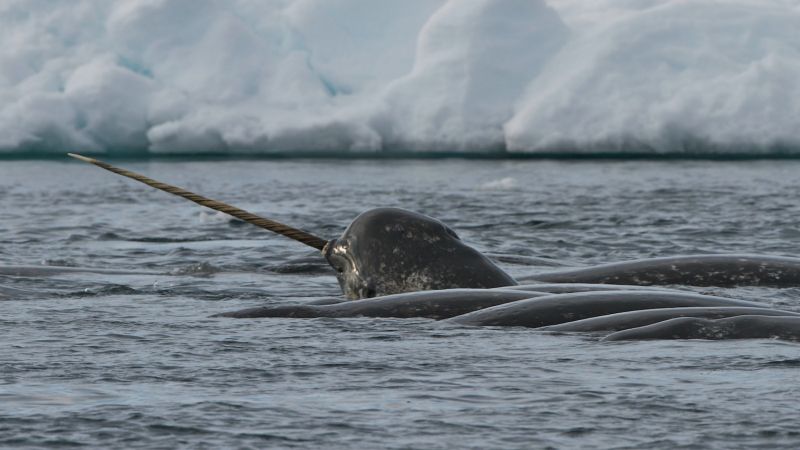
Narwhals are known as “unicorns of the sea” for their long spiral tusks — actually teeth — which lend them a mythical appearance. But a group of these otherworldly marine mammals were recently given a decidedly earthly role: Arctic scientists.
Researchers fitted six narwhals with satellite transmitters, then tracked the animals for three years as they roamed the rugged coast of East Greenland and swam deep into its labyrinthine fjord system — the largest in the world. Their job was to collect data on the state of the ocean in this remote but crucial region.
The information they brought back provides yet more concerning evidence about what’s happening in the Arctic. It reveals that relatively warm, salty water from the Atlantic Ocean is reaching far inside the region’s fjords — giant valleys filled with water and ice — where it’s able to eat into glaciers and threaten the ice sheet they protect.
“The findings are very concerning, as they indicate the rapid melting of the marine-terminating glaciers,” said Eric Achterberg, a professor at the GEOMAR Helmholtz Centre for Ocean Research Kiel in Germany, who was not involved in the study. This new data underscores an ongoing trend, he added.
☀️ Visit the CNN Weather app to learn how your world is warming.
East Greenland is home to significant glaciers, which drain parts of the ice sheet into the ocean. It’s also the location of important ocean currents, which transport cold polar water southward to the North Atlantic, redistributing freshwater and influencing marine life.
These form part of the Atlantic Meridional Overturning Circulation, a crucial system of ocean currents which has a huge impact on global weather and climate, but that scientists fear could be heading toward collapse. The effects would be catastrophic, including rapid sea level rise in the US, deep freezes in Europe and droughts in Africa.
“In many ways, East Greenland is a bellwether for the climate changes we can expect in the North Atlantic,” said Mads Peter Heide-Jørgensen, a study author and professor at the Greenland Institute of Natural Resources.
Yet there is relatively little research on ocean changes in the area due to its remoteness and harsh conditions. “It’s a very understudied region … so we needed more data,” Heide-Jørgensen said.
Sending ships is challenging and dangerous, and expensive icebreakers are needed to navigate the unpredictable ice. Narwhals, however, can reach these areas easily and do so year-round. “We can sit in front of our computers and the narwhals are swimming around in the icy waters in darkness,” Heide-Jørgensen said.
They can dive to depths of nearly 6,000 feet, meaning they “sample the entire water column,” said Heide-Jørgensen. They also visit the same areas, allowing for repeated measurements to be taken.
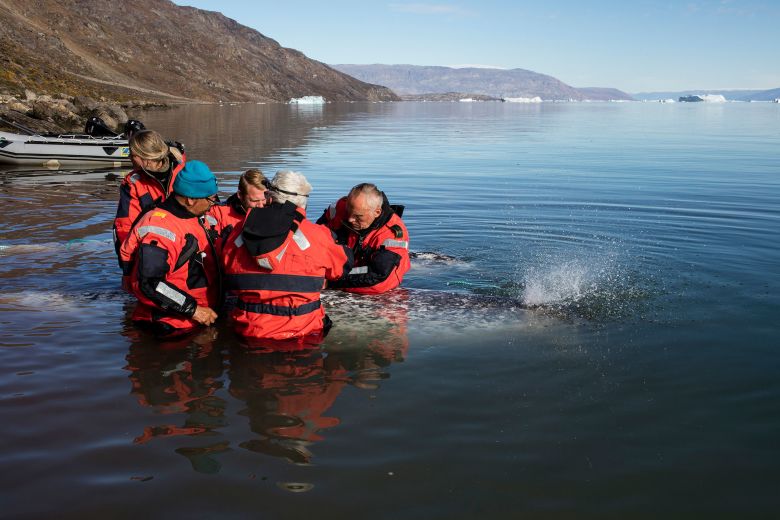
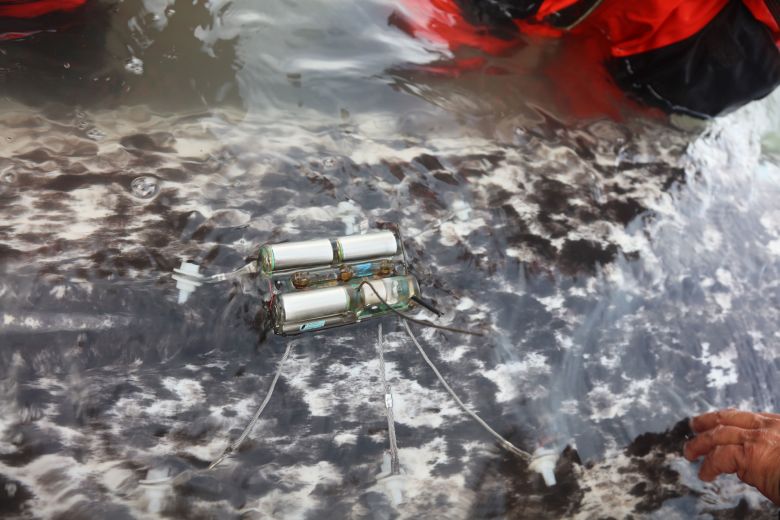
The narwhals were caught by hunters, who ushered them into nets. The scientists then fitted them with instruments weighing less than a pound, Heide-Jørgensen said. “We developed a smaller transmitter that could reliably collect temperature and salinity for a long time and transmit that through a satellite,” he said. “It doesn’t harm them in any way,” he added.
The narwhals produced more than 2,000 observations of water temperature and saltiness between 2017 and 2020. The scientists then combined this with data from the World Ocean Database, mostly collected by ships.
⛅ Get CNN Weather in your inbox
The forecast is just the beginning. We’ll send you expert coverage and the stories behind the weather — so you always know more than just the number. Sign up for the newsletter
The region is experiencing “Atlantification,” the study concludes, a process where relatively warm, salty water from the Atlantic Ocean pushes into Arctic seas.
The scientists found a long-term trend of this warmer water flowing straight to the front of glaciers, where it is able to melt their undersides and accelerate ice loss. Atlantic Ocean water reached more than 180 miles into the fjord system in some cases, the study found. It was “an eye opener,” said Heide-Jørgensen.
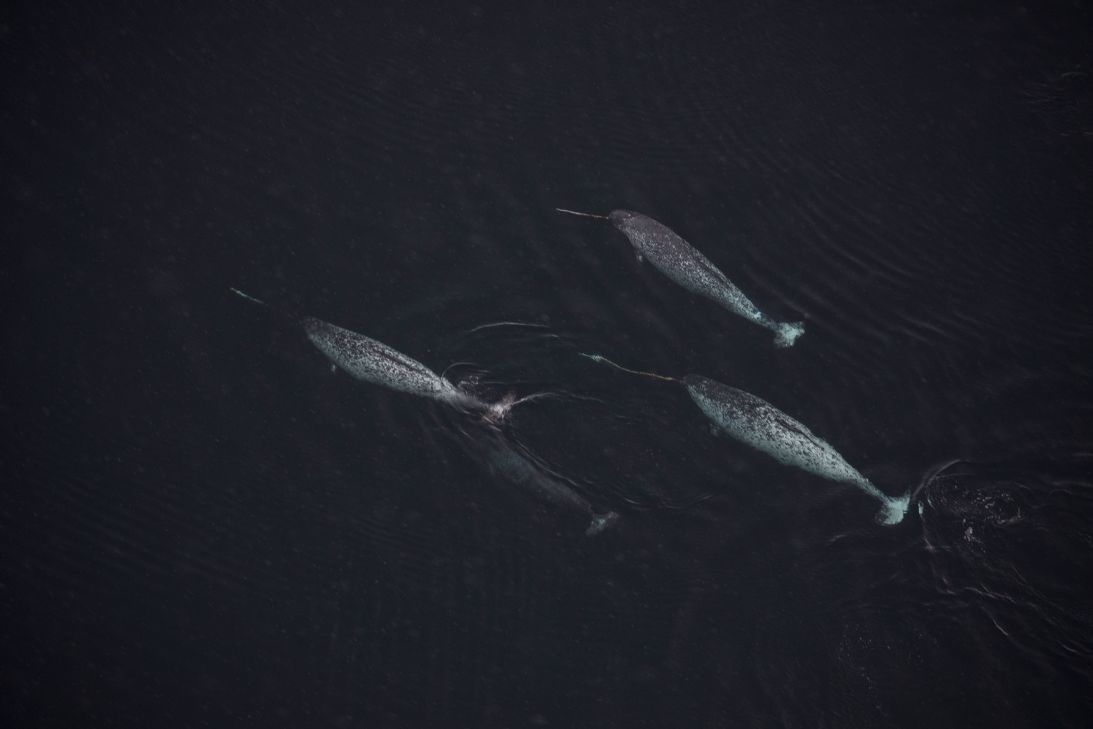
Using narwhals to gather three years of data is “unique and elegant,” GEOMAR’s Achterberg said. The study provides new insights into the melting processes in the region, he added, “in particular the winter data is unique as ships cannot operate in the region during winter.”
Helen Coxall, a professor of marine micropaleontology at Stockholm University, who was also not involved in the study, said the narwhals provided “close to the same number of analyses in three years that humans collected in the past 130 years.”
The animals were able to reveal “the scale of the ocean-melt attack on parts of the Greenland Ice sheet in this region,” she added, which is “extremely valuable.”
There is a lot more to be done to unravel the ocean processes in this inhospitable slice of the Arctic, said Heide-Jørgensen, who added that this study “is just a small piece in the big picture of what’s going on in the entire North Atlantic.”