
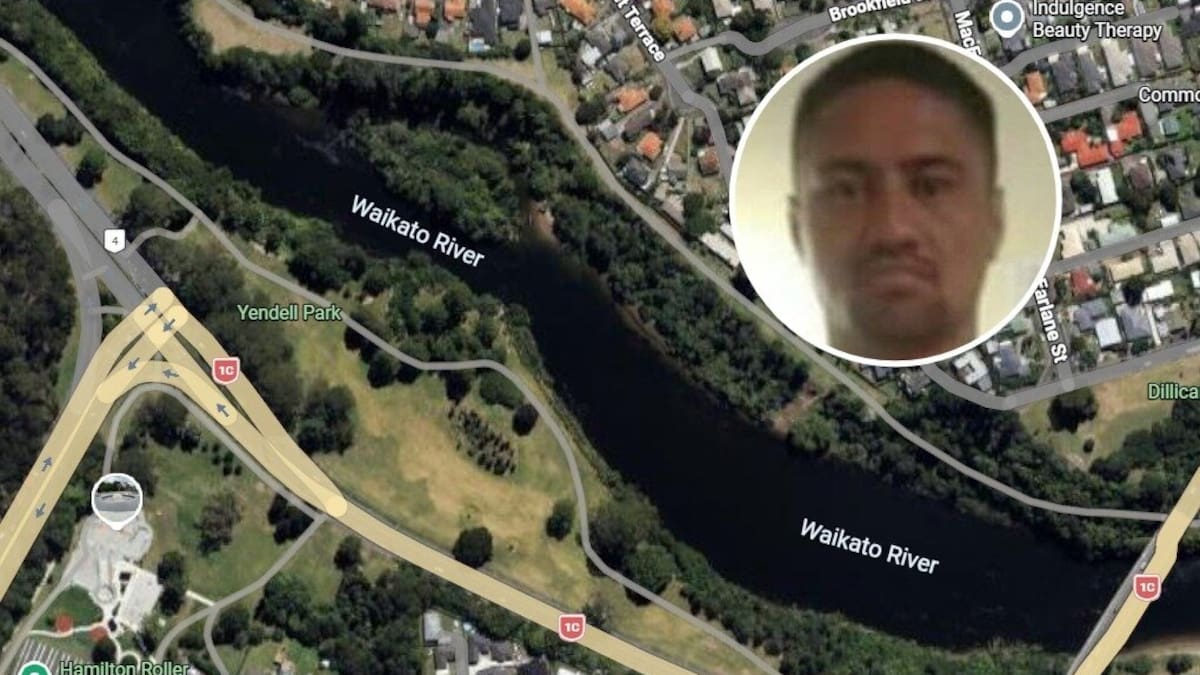
During a search, police were warned to be wary of retrieving Hale due to the possibility he could pull them into the water.
Officers were also told he had recently been in possession of a firearm.
During the second day of the inquest, before Coroner Ian Telford, communications centre audio and Eagle helicopter footage were played to the inquest.
It revealed numerous officers converged on the banks of the Waikato River and its surrounds.
A dog team began searching an area about 50m north of the bridge and a police boat was launched, carrying three officers and a firefighter with a heat detection device.
At one point, an officer announces “recent bully”, or intel, over the radio that Hale “may have been in possession of a pistol in March”.
Soon afterwards, an officer tells boat personnel to be careful if apprehending Hale as he “poses a great risk” and might try to pull them into the river.
After the search had been in progress for about an hour, the Eagle helicopter spotted Hale in the river directly opposite the intersection of Cobham Drive and Normandy Ave.
“I think we might have him on the edge of the water, north of the Cobham bridge … down below the skate bowl,” an Eagle crew member announces.
“He’s moving away from you,” he tells officers.
After about 10 minutes, an officer on the ground says, “he’s going under”.
Another asks, “Do you have him?”
“He’s gone under,” the officer states.
Several of Hale’s whānau are attending the inquest, either in person or via audio-visual link, and a few wiped away tears as details of his last moments were revealed.
‘He looked visibly tired’
The skipper of the boat, Officer C, said after being alerted by the Eagle to Hale in the water, he turned the boat around, with Hale about 100m behind them.
As he drove up the river, he noticed branches moving, before seeing a man holding on to a tree branch on the western side of the river.
They found Hale in a narrow part of the river that was renowned for being dangerous because the current was stronger.
He said he had to “fight to keep the boat in a stable position” and avoid hitting branches or trees while piloting the boat in the dark.
He noticed Hale.
“He looked visibly tired.”
He saw a couple of officers directly above him, but they couldn’t reach Hale because they were on a clifftop.
“I remember hearing [officer] telling Hale he was under arrest.
Benjamin Hale.
“I yelled out to Hale and told him to stay where he was.
“I didn’t hear him say anything back.”
He wanted him to stay there as he felt he was “fairly safe as he was holding a branch”.
By then, they were about 20m away, and he and his colleagues on the boat began talking about what to do next.
Asked by Susan Hughes KC, counsel to the officers, whether that was a feasible distance to throw a flotation device, he said no.
At that point, he was still battling to control the boat and the current.
“With the lack of lighting, I could barely see.
“The only light was a little spotlight being held, and that just remained on Hale.”
The officer said he was holding the boat steady and about 20m away from Hale when he saw him let go of the branch, “without any comms to or from him”.
Hale appeared to be swimming upstream, towards the eastern side of the river, and away from the boat.
“I have seen him take three or four strokes towards the middle of the river.
“I engaged the motor so that I was slowly moving towards him.
“I have seen him go under the water and pop back up.”
He edged the boat closer to Hale as “it was obvious he was in strife because of the free-flowing current”.
It took a few seconds to get within 5 or 10m, when he saw Hale go under the water again.
“He didn’t come back up.
“When I saw him the second time, he wasn’t close enough for a flotation device.”
Asked by Hughes how far away he was, the officer replied, “about 5m”.
“If we threw the flotation device it wouldn’t have reached him.”
He manoeuvred the boat slightly north to see if Hale popped up, but he never did.
They continued searching for about 45 minutes, by which time they were too low on fuel and went back to shore.
The inquest continues.
Belinda Feek is an Open Justice reporter based in Waikato. She has worked at NZME for 11 years and has been a journalist for 22.