
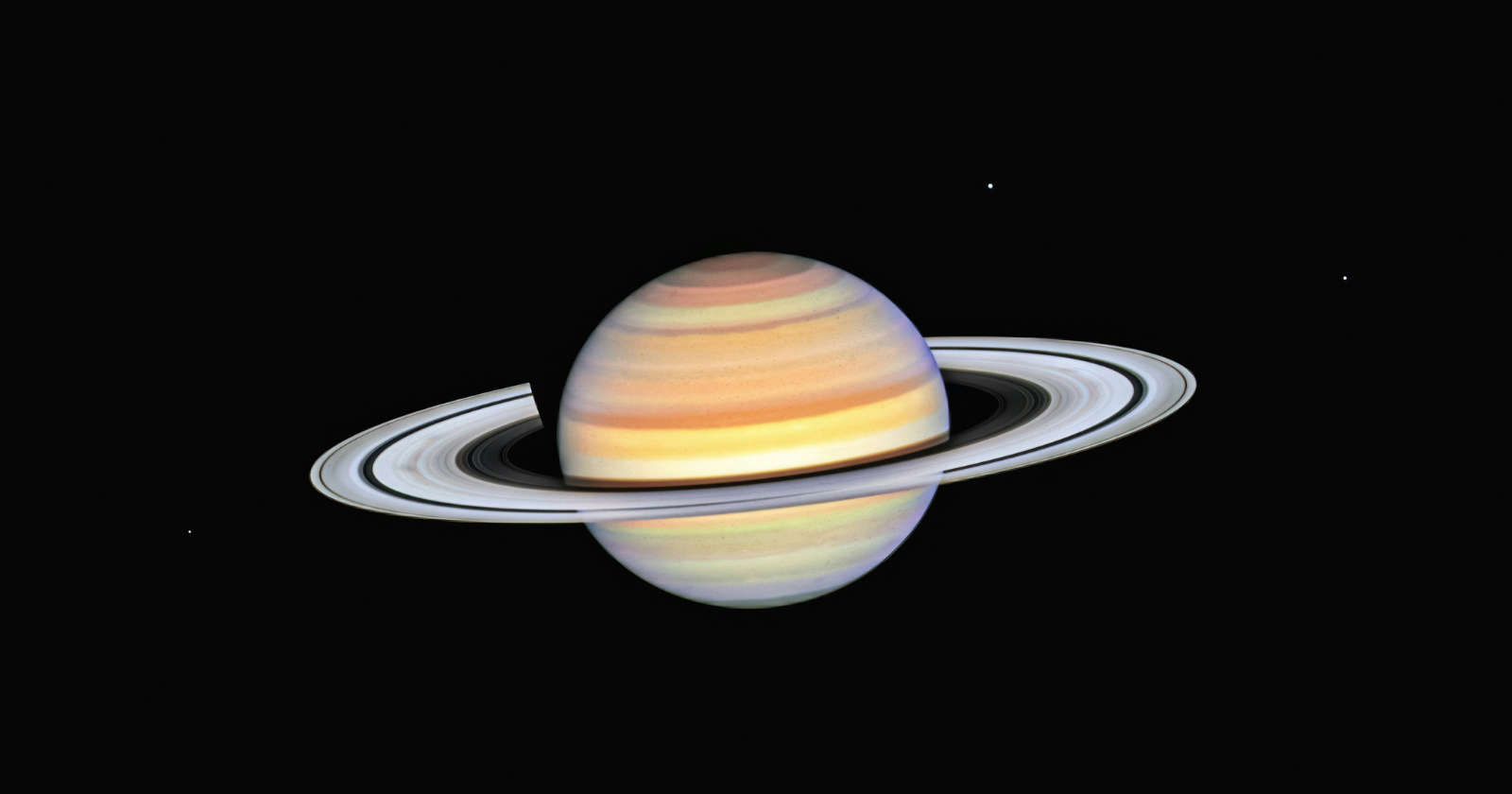
Saturn’s rings look like they have always been there. Every photo of the solar system puts them front and center, thin gold bands wrapped around a giant planet, and it is easy to assume they arrived the same week Saturn itself did, four and a half billion years ago. That assumption turns out to be wrong, and not by a small margin.
The rings have carried that assumption for a long time. Scottish physicist James Clerk Maxwell studied their structure back in 1859, and for more than a century after him, most scientists treated the rings as primordial leftovers from whatever process built Saturn itself. Every model that pictured the solar system’s birth simply included the rings as part of the original package, the same way you would not think to ask when a mountain range showed up.
NASA flew the Cassini spacecraft through Saturn’s system for thirteen years, and in its final months, before mission controllers deliberately sent it plunging into the planet in 2017, engineers steered it through gaps no probe had used before. Those close passes let scientists measure something they could not measure any other way: how much stray dust has settled onto the rings over time, and how much the rings actually weigh. Both numbers point the same direction. Saturn’s rings are young.
Cassini’s other famous cameo isn’t about the rings at all. In 2005 it released a small probe called Huygens, which fell through the orange haze of Saturn’s largest moon, Titan, and landed on a surface where rivers run on liquid methane instead of water, still the only landing humans have ever made anywhere in the outer solar system. We go deep on that one in this video, if you want the stranger-than-fiction version.
A 2023 study in Science Advances, led by planetary scientist Sascha Kempf at the University of Colorado Boulder, used that dust measurement to work backward. Micrometeorites rain onto the rings constantly, and the rings are still almost pure water ice, which means they have not been sitting out collecting grime for very long. Kempf compares it to something most people already understand from home. “Think about the rings like the carpet in your house,” he says. “If you have a clean carpet laid out, you just have to wait. Dust will settle on your carpet. The same is true for the rings.” For Kempf, the finding also closed out a much older puzzle than most headlines mentioned. “In a way, we’ve gotten closure on a question that started with James Clerk Maxwell,” he said, referring to the same physicist who first tried to explain how the rings held together.
Knowing the rings are young does not explain where they came from, and that part is still genuinely open. The leading idea is that something large and icy wandered too close to Saturn relatively recently, whether an old moon nudged out of a stable orbit or a comet that strayed too far in, and got torn apart by Saturn’s gravity once it crossed a boundary called the Roche limit. The wreckage spread out into the flat, orbiting sheet of ice we now photograph. It is a dramatic origin story for something that looks so serene from a distance, closer to a car crash than a birth.
“Our inescapable conclusion is that Saturn’s rings must be relatively young by astronomical standards, just a few hundred million years old,” says Indiana University’s Richard Durisen, a co-author on that paper. A few hundred million years sounds enormous until you set it next to the age of the planet it circles. Saturn has existed for roughly four and a half billion years. Its rings, by this math, have been around for less than a tenth of that, and possibly far less.
So which number is right? That is not entirely settled, and it is worth being upfront about that instead of picking the tidier headline. A separate 2019 study in Science, based on a different Cassini measurement entirely (how the spacecraft’s own flight path bent slightly as it passed close to Saturn, revealing the planet’s true gravity field and the real mass of its rings), arrived at a range of ten million to one hundred million years, younger still than the 2023 estimate. Cornell astronomer Phil Nicholson, who worked on that measurement, said, “Based on previous research, we suspected the rings were young, but not everyone was convinced.” Two teams, two different methods, two numbers that land in different places but on the same side of a much bigger line: not billions of years, not even close to the planet’s own age, but somewhere between tens of millions and a few hundred million.
That range overlaps with a very specific stretch of Earth’s own history. Non-avian dinosaurs lived here for roughly 165 million years, ending about 66 million years ago. If Saturn’s rings sit on the younger end of either study’s estimate, they likely did not exist for most of that stretch. If they sit on the older end, they still would not predate the earlier dinosaurs by much. Either way, dinosaurs very probably spent a long stretch of their existence looking up at a Saturn with no rings at all, had they been able to see that far. Cornell’s own writeup of the 2019 findings put it almost that bluntly, describing rings “perhaps created when dinosaurs roamed the Earth.”
I think about this kind of thing more since our second daughter arrived a few weeks ago. We are a family of four now, and somehow it already feels like this is just how things have always been, even though the actual math says otherwise. Measured against the rest of our lives together, this configuration is brand new. It took Saturn a few hundred million years, at most, to grow something that now looks like it was always part of the picture. It took us considerably less time to feel the same way about a new baby’s spot at a crowded table.
None of that makes the earlier version of things less real. Our family before this summer was real and whole on its own terms, the same way Saturn was real and whole for over four billion years with a completely bare, ringless sky. The new thing just arrives, settles in fast, and quietly edits your sense of how long it has actually been there. You stop being able to picture the version without it, even though you lived in that version yourself not long ago.
Saturn will keep spinning long after those rings wear away completely, which current models say they eventually will, dust and ice raining down into the planet the same way it once rained down onto them. Nothing about a planet looking finished means it is actually finished. It just means you arrived after the last change and before the next one.
About this article
This article is for general information and reflection. It is not professional advice. For your specific situation, consult a qualified professional.