
“Noodles can be a perfectly healthy and affordable staple, but they are generally the carbohydrate part of the meal rather than the whole meal,” Henderson says. “What they are served with and the proportion of noodles on your plate matters enormously.”
What is the healthiest type of noodle?
Supermarket noodle brands vary in terms of nutritional value.
Wholegrain noodles have an advantage because they retain more fibre and nutrients than refined varieties. Unfortunately, genuinely wholegrain noodles remain relatively uncommon in mainstream supermarkets.
Among the more familiar options, rice noodles are generally very low in fat and can be low in sodium, although they are also low in fibre and protein. Because rice is naturally gluten-free, they can suit people avoiding gluten, but those with coeliac disease should still check the label, as cross-contamination can occur during manufacturing or packing.
Udon and hokkien noodles are generally made from refined wheat and can provide a useful neutral base for soups and stir-fries. Egg noodles may offer marginally more protein, but the inclusion of egg does not turn them into a high-protein food.
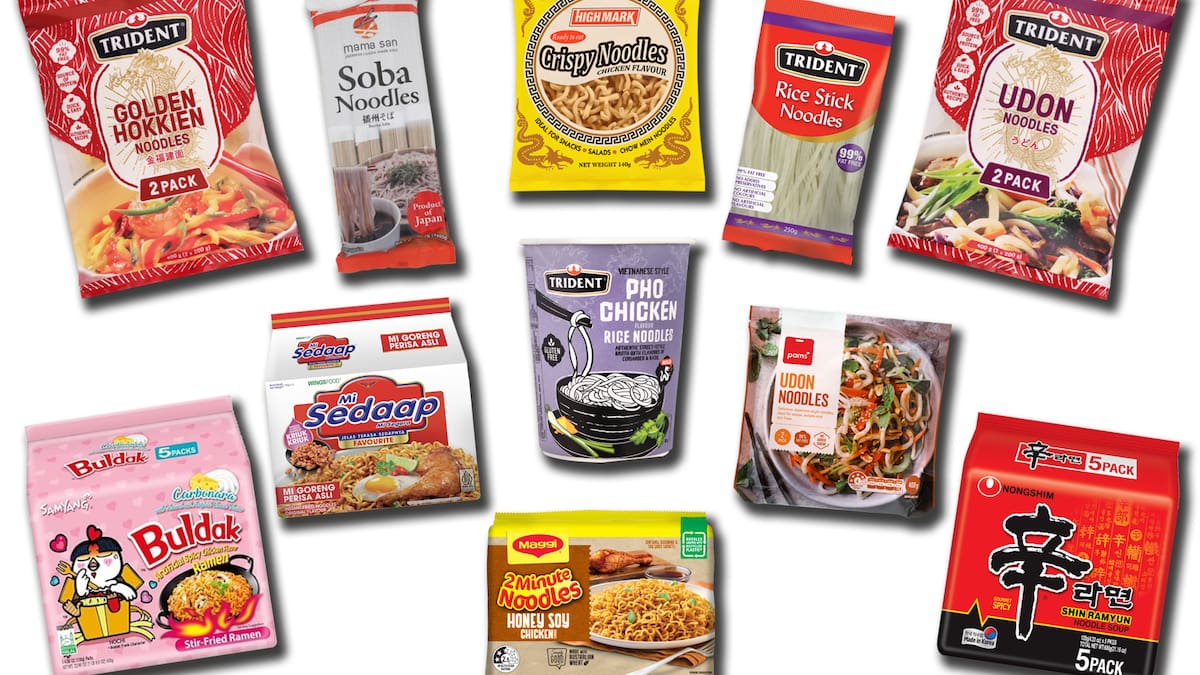
Several particularly unassuming products performed well in the product review for this story. Trident Rice Stick Noodles have a simple ingredient list and are very low in fat and sodium, while Trident Japanese Udon, Trident Golden Hokkien Noodles and Pams Udon are all relatively straightforward everyday bases.
Their limitation is not that they are “unhealthy”, but that noodles alone do not provide much fibre, protein or vegetable content. What lands in the rest of the bowl is therefore more important than choosing between these products.
Soba noodles can often contain far less buckwheat than wheat flour. Photo / Babiche Martens
The soba trap
Soba deserves closer attention because the name is commonly associated with buckwheat. While buckwheat can provide more fibre and nutrients, many supermarket soba products contain substantially more wheat.
Mama San soba noodles
Mama San Soba, for example, contains 68% wheat flour and 29% buckwheat flour. The reviewed 80g dry serving also contained 640mg of sodium – considerably more than many plain noodles.
Brown-rice, wholegrain and protein noodles may offer genuine benefits, but the description alone does not establish how substantial those benefits are. A brown-rice noodle may still be low in fibre, while a protein noodle is only notably different if it delivers appreciably more protein in an ordinary serving.
Gluten-free is similarly important for those who medically need it, but it is not a general measure of nutritional quality. “Organic” and “non-fried” describe particular features of a product rather than the complete nutritional picture.
Is fresh better than dried?
Fresh noodles may look like the less processed choice, but the format does not automatically make them more nutritious.
“Fresh doesn’t automatically mean healthier, and dried doesn’t automatically mean more processed or less nutritious,” Sekula says.
Much of the apparent difference comes down to water. Dried noodles look more energy-dense per 100g because their water has been removed, while vacuum-packed udon may contain a considerable amount of water.
Vacuum-packed products sometimes include salt, oil or additives to preserve their texture and shelf life, but they can still be perfectly reasonable choices. The pantry, chiller or vacuum pack tells shoppers more about storage and preparation than it does about whether a noodle belongs in an everyday meal.
Why instant noodles are different
The problem with instant noodles is rarely one ingredient. It is the combination of a refined noodle cake, a concentrated seasoning or sauce and, in many products, the oil used to fry the noodles.
Sodium is the most consistent concern. Many instant noodle cakes are also fried in palm oil, increasing their total and saturated fat. Eaten on their own, the are generally low in fibre and don’t provide the vegetables and protein balance needed for a complete meal.
Serving size adds another complication. Cups, bowls and packets are normally treated as one portion, but the quantity varies markedly. A large bowl can deliver substantially more sodium, saturated fat and energy simply because it contains more noodles and seasoning.
Supermarket noodle brands vary in terms of nutritional value.
For example, Nongshim Shin Ramyun contained 1840mg sodium and 7.3g saturated fat. Its sodium alone equates to 92% of the Heart Foundation’s recommended adult daily maximum of 2000mg.
Samyang Buldak Carbonara contained 1330mg sodium and 10g saturated fat per reviewed packet, while Mi Sedaap Mi Goreng supplied 1040mg sodium and 8g saturated fat. These are better treated as occasional meals than regular lunches.
Crispy noodles belong in a slightly different category again. High Mark Chicken Crispy Noodles contained 7.9g saturated fat and 699mg sodium in the reviewed 70g serving. Their nutritional profile makes more sense when they are used as a crunchy garnish rather than the main carbohydrate component of a meal.
Are any instant noodles reasonable?
Trident Vietnamese Style Pho Chicken Rice Noodles and Maggi 2 Minute Noodles in Honey Soy Chicken Flavour.
There is no nutritionally perfect instant noodle, but some make more useful starting points than others.
Trident Vietnamese Pho Chicken is lower in saturated fat, although still high in sodium and low in protein. Maggi 2-Minute Honey Soy Chicken contained less sodium than several other mainstream instant products, but still supplied a substantial amount.
“There isn’t really a nutritionally ‘perfect’ instant noodle. They are convenience foods,” Henderson says. “The key is choosing a more reasonable option and thinking about what you can add to turn it into a more balanced meal.”
Using only part of the seasoning sachet can reduce the sodium. Adding an egg, tofu, edamame, chicken or canned fish supplies protein, while frozen Asian vegetables, broccoli, cabbage, bok choy, carrots or mushrooms bring fibre and variety without requiring much additional preparation.
For plain noodles, the dietitians suggest making roughly half the meal vegetables, one-quarter protein and one-quarter noodles. Ginger, garlic, chilli, lime, vinegar, herbs and sesame can provide flavour without relying entirely on salty soy, oyster or fish sauces.
“If we’re deciding between ordinary udon, rice noodles and hokkien noodles, we’re far more interested in what the rest of the meal looks like than obsessing over small differences between the noodles,” Sekula says.
That may be the most useful way to navigate an aisle containing dozens of different choices: choose a practical base, then concentrate on building the bowl.
Herald contributor Nikki Birrell has worked in food and travel publishing for nearly 20 years.