
The findings helped inform the establishment of NorthTec’s Puawānanga Tapuhi Māori o te Kotiu programme at Ngāwhā near Kaikohe, one of four Māori nursing programmes in New Zealand and the only one based in a rural Māori community.
Seeing her doctoral research translated into the programme had been particularly rewarding.
Barton said the programme was developed in response to evidence showing Māori students often faced barriers in mainstream nursing education.
“Our programme is a response to that to try and grow the Māori workforce and particularly the rural Māori nursing workforce,” she said.
“My research identified that Māori students and nurses really struggle in mainstream Bachelor of Nursing programmes and that there is a need for more Māori nursing programmes.”
The aim of the Puawānanga Tapuhi Māori o te Kotiu programme is not only to increase the number of Māori nurses entering the profession, but also to strengthen healthcare outcomes in Māori communities by training nurses within them, Barton said.
The programme has about 50 students enrolled across its first- and second-year cohorts, with the first cohort expected to graduate in 2027.
“Place matters, particularly when we are talking about addressing rural health workforce shortages,” Barton said.
“Ultimately, if we want to strengthen the rural nursing workforce, we need to create opportunities for people from rural communities to become nurses without requiring them to leave those communities to do so.”
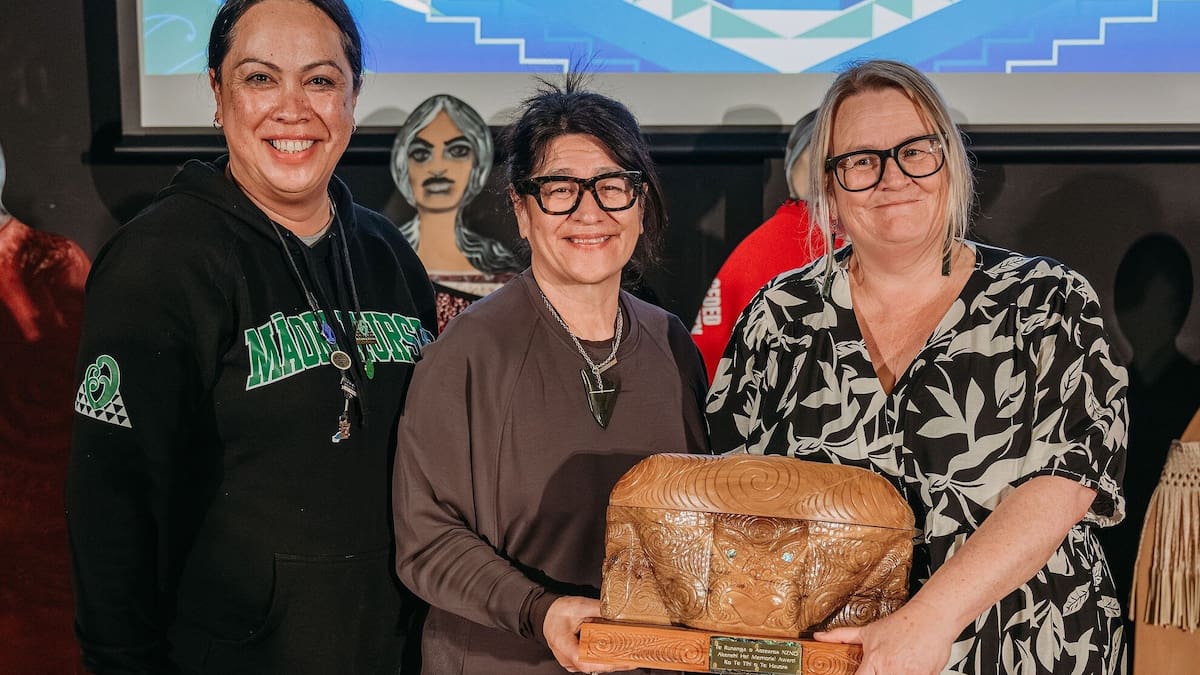
While the award recognised her professional contribution to Māori nursing, Barton said it also carried deep personal meaning.
Growing up in a family of nurses helped shape her path into the profession.
Her father, Wally Barton, served in the Navy during the 1950s, including in the Korean War, and after he left the service in 1959, his older sisters, both nurses, encouraged him to take what was then the unusual step for a man of entering the profession.
He trained as a psychiatric nurse at Porirua Hospital and went on to work there for 40 years.
During her doctoral research, Barton discovered an interview with a Māori nurse who had trained at Porirua and spoke of the support Māori nurses received from her father.
That same commitment to supporting and advocating for Māori nurses has earned Barton the profession’s highest honour.
“I see my own contribution as part of a much longer whakapapa of Māori nursing.
“So, I am keeping up the whānau tradition I suppose,” she said.
“I believe research shouldn’t sit in a thesis on a shelf collecting dust; it should contribute to meaningful change,” Barton said.
“To now see that knowledge being translated into Puawānanga Tapuhi Māori, and to see our students progressing towards becoming registered nurses, makes the years of PhD research and all the hard work worthwhile.”
She stressed the programme came about because of processes occurring at the same time, of which the findings of her doctoral research were one part.
The programme, she said, was made possible “through the leadership of Toa Faneva, former chief executive of NorthTec; the work undertaken through the development of the unified nursing programme under the former New Zealand Institute of Skills and Technology-Te Pūkenga, led nationally by our current Pathway manager, Sandra McDonald; and, importantly, the mahi already being done here on the ground in Te Tai Tokerau by people such as Whaea Moe Milne and Matua Ross Smith, who have long supported Māori nursing and our Māori communities”.
Continuing her interest, Barton is undertaking further research examining whether Māori-led nursing programmes improve student retention and completion rates.
Sarah Curtis is a news reporter for the Northern Advocate, focusing on a range of issues. She has nearly 20 years’ experience in journalism, much of which she spent court reporting in Gisborne.