
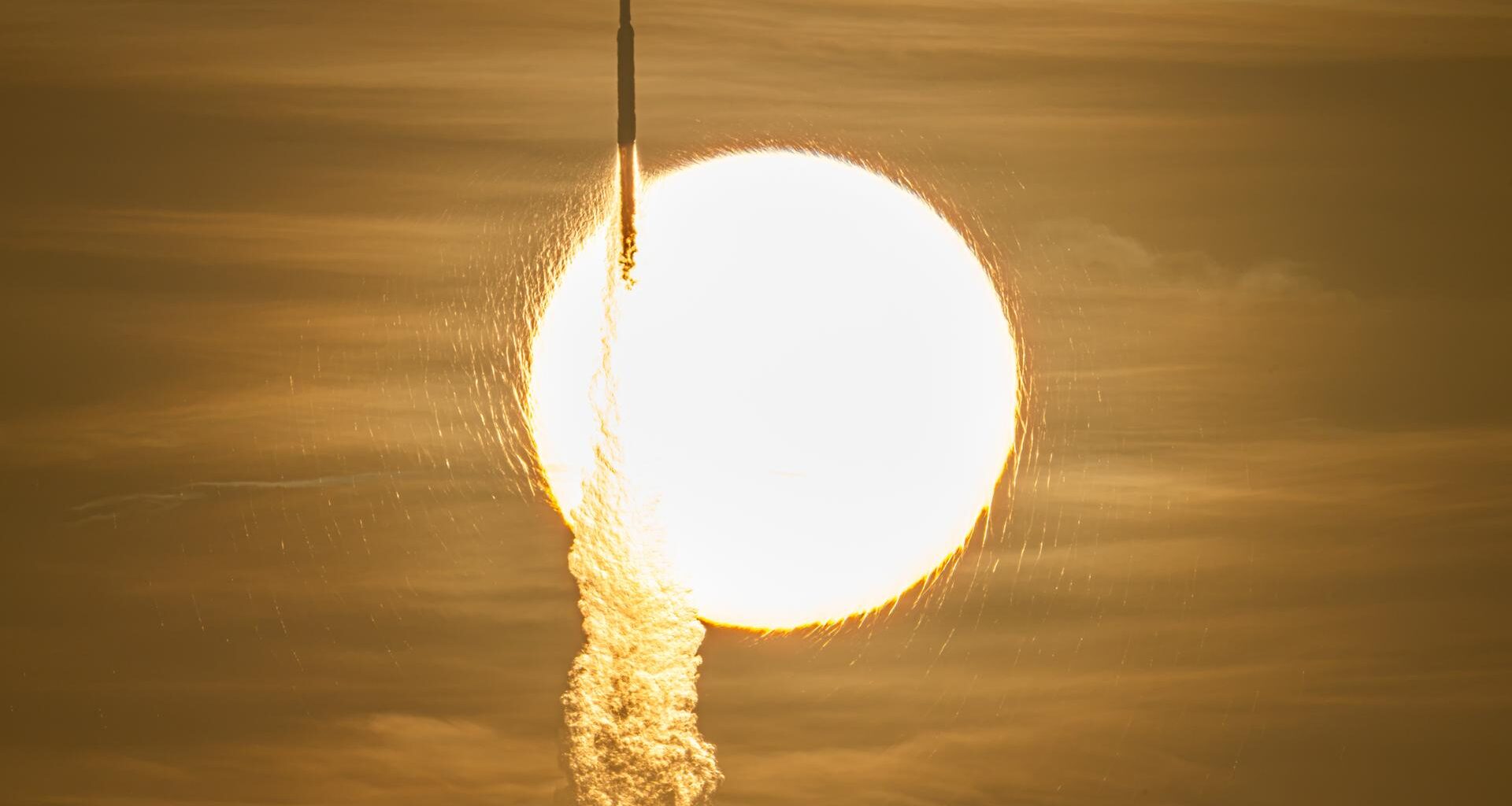
 image: ©NASA/John Kraus
NASA’s Nancy Grace Roman Space Telescope has begun its journey into space
The Nancy Grace Roman Space Telescope launched at 7:26 a.m. EDT on Sunday, August 30, aboard a SpaceX Falcon Heavy rocket from Launch Complex 39A at NASA’s Kennedy Space Center in Florida.
It is now beginning a three-month journey toward its destination, the second Sun-Earth Lagrange point, or L2, roughly one million miles from Earth.
A new view on the Universe
The Nancy Grace Roman Space Telescope is designed to survey huge areas of the sky while providing detailed infrared observations. Its mission will focus on some of modern astronomy’s most important questions, including the nature of dark matter and dark energy, as well as the search for planets beyond our solar system.
Unlike telescopes that spend significant amounts of time studying small sections of the sky, Roman is built to cover vast regions quickly. NASA estimates that it will survey the universe about 1,000 times faster than the Hubble Space Telescope.
The telescope’s main instrument, the Wide Field Instrument, features a 300-megapixel infrared camera equipped with 18 detectors. Together, they will allow Roman to capture wide, detailed views of distant galaxies and other cosmic objects.
Launch and early operations
NASA began receiving data from Roman just seven minutes after launch. The observatory separated from the Falcon Heavy approximately 31 minutes into the flight, while the rocket’s boosters successfully returned to the launch site for refurbishment.
Around 70 minutes after launch, communications with Roman were handed over to NASA’s Deep Space Network, which will guide and monitor the telescope during its journey to L2. Ground stations in Australia, Spain and California will help maintain contact with the spacecraft throughout its voyage.
About 83 minutes after launch, Roman successfully deployed its solar panels and lower instrument sunshade, an important early milestone for the mission.
In the coming days, controllers will deploy the telescope’s high-gain antenna and protective aperture cover. They will also begin the first of two planned mid-course corrections and activate the Coronagraph Instrument.
Searching for other worlds
Roman’s Coronagraph Instrument will test technology that could eventually help future space telescopes directly image Earth-like planets around other stars.
During its initial demonstrations, the instrument is expected to capture images of Jupiter-sized planets. The technology could eventually contribute to missions such as NASA’s proposed Habitable Worlds Observatory, which aims to search for signs of life on potentially habitable worlds.
Preparing for first images
A few weeks into the journey, NASA plans to activate Roman’s Wide Field Instrument. The telescope will then spend about three months undergoing commissioning, including instrument checks, calibrations and other tests.
NASA expects to release Roman’s first images in early 2027.
Once fully operational, the telescope is expected to transmit around 1.4 terabytes of data to Earth every day. Scientists will use artificial intelligence, machine learning and help from citizen scientists to process the enormous volume of information and identify potentially important discoveries.
Managed by NASA’s Goddard Space Flight Center, the Nancy Grace Roman Space Telescope brings together scientists and engineers from across NASA and international research institutions. Its development also involved major industry partners and contributions from agencies and research organisations in Europe, Japan and Germany.
With its combination of speed, wide coverage and infrared vision, the Nancy Grace Roman Space Telescope is expected to create a new map of the cosmos and provide scientists with an unprecedented look at the universe’s hidden structures.