

Listen to this article
Estimated 4 minutes
The audio version of this article is generated by AI-based technology. Mispronunciations can occur. We are working with our partners to continually review and improve the results.
The president of the Canadian Medical Association agrees with those opposed to Alberta’s new health-care legislation, saying it could lead to the end of universal health care in Canada.
“It’s pretty clear from other jurisdictions that have released similar types of legislation that what happens with the increased private financing in health care, it leads to inequitable access to care,” Dr. Bolu Ogunyemi told CBC’s Information Morning Cape Breton.
He was referring to the new law, known as Bill 11, that allows some surgeons to practise in both public and private settings.
Allowing private care also gives staff a financial incentive to leave the public system, said the dermatologist, who’s based in St. John’s.
“Bill 11 doesn’t introduce more doctors, more nurses, more technicians or other staff. These are part of a number of solutions that are known to actually increase access to care for everyone, regardless of whether you can pay for it with a credit card or with your health-care card.”
Ogunyemi said under public-private models in places such as the United Kingdom and Australia, patients in private care get faster access and those in the public system face longer wait times.
 Dr. Bolu Ogunyemi, president of the Canadian Medical Association, says two-tier health systems elsewhere have led to inequality of care. (Canadian Medical Association)
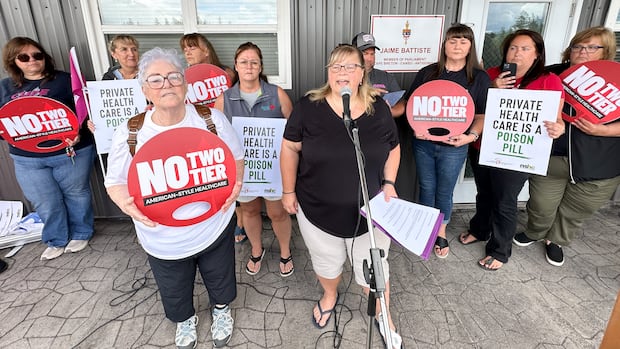
Opponents of Alberta’s plan, including the Nova Scotia Health Coalition, rallied across the country Tuesday to try to press the federal government to intervene and put an end to the new law, which went into effect Tuesday.
They say it violates the Canada Health Act, although the Alberta government says no one will pay out of pocket for a medically necessary procedure.
While federal Health Minister Marjorie Michel has said she is concerned about Alberta’s plan, she has also said both levels of government are in talks to ensure the core principles of the universal system are preserved.
“We need to stop this where it is, because all we’re doing is eroding our public system and making wait times and patient lists longer,” Jennifer Benoit, co-ordinator of the Nova Scotia Health Coalition, said Tuesday during a rally outside the constituency office of Cape Breton-Canso-Antigonish Liberal MP Jaime Battiste.
 Nova Scotia Health Coalition co-ordinator Jennifer Benoit says the Alberta legislation is the single biggest threat to Canada’s universal health-care system since its inception. (Tom Ayers/CBC)
She said the Alberta model will attract insurance companies that will target the most profitable patients, exacerbating already lengthy wait times for public health care.
“This is the single biggest threat to our universal health care since its inception,” Benoit told a crowd of union supporters.
“Because once you can pay your way to the front of the line, the line is no longer equal for any of us.”
Donna Van Kroonenburg, a health-care worker from Bible Hill, N.S., said she is worried about the effect on patients if private care becomes more attractive for workers.
“If we don’t retain our doctors and nurses and our staff, all our staff, then they’re going to go to private and then where does that leave everybody else?”
 Cape Breton-Canso-Antigonish Liberal MP Jaime Battiste says he’s not opposed to making improvements in the health-care system, but he’s not in favour of privatization. (Tom Ayers/CBC)
Battiste was not in his office during the rally, but later said he does not agree with Alberta’s new funding model.
“I would rather we preserve and work on our current health-care models that we have in Canada, but I think that there’s new ideas out there that we should be looking at,” he said.
“I’m not a fan of privatizing health care. I don’t want to go into the American system that creates disadvantage for those who are in poverty and those who don’t have the means to take care of their health care.”
MORE TOP STORIES