
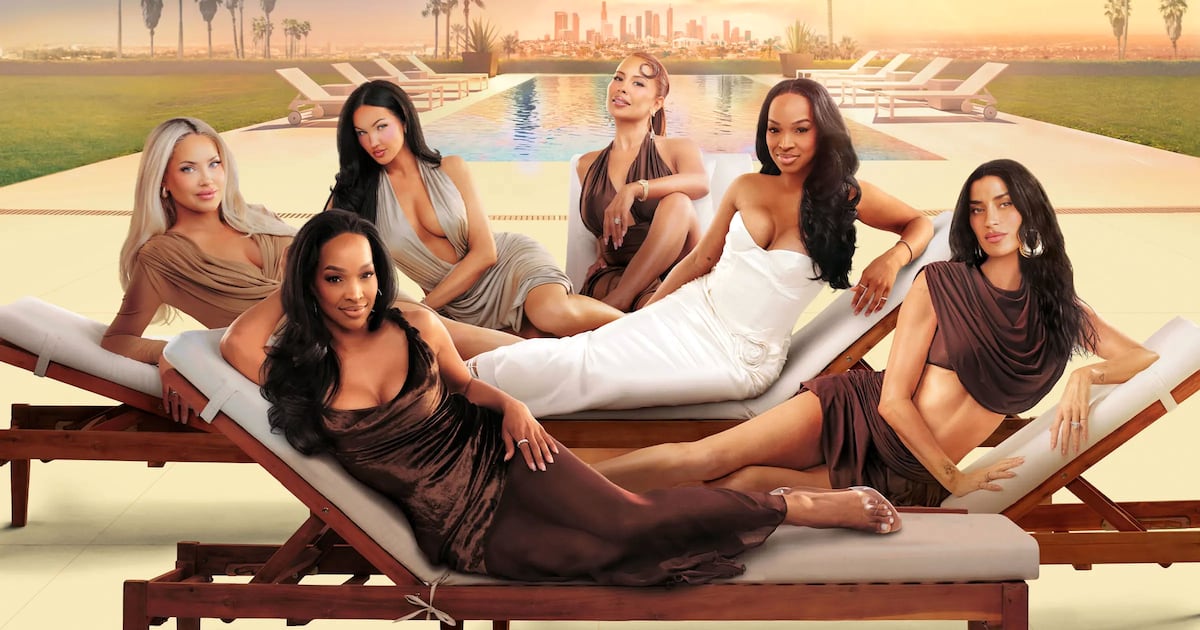
I have troubling news. The Irish Times’ investigative unit has uncovered another cell of Kardashianists in deepest California. We were alerted to their presence by their sacred music: a generic, u-go-girl, dance floor banger, with a refrain that goes “high heels, diamond rings, success” (which you will recognise, of course, from Das Kapital).
And then we witnessed for ourselves the slow-motion montages during which they like to strut in a line, get in and out of pools and ride around their city in SUVs like American oilmen in Kabul (you affect similar attitudes walking through the derelict streets of your midlands town, bathing in your flooded garden and chundering along in your Nissan Micra to Maniac 2000). Meanwhile a drone sweeps across the bland, sunny vistas of LA looking for somewhere to drop its payload of fancy shoes and/or napalm.
This is The Girls (Disney+), the eponymous selection of Kardashian “friends” assembled by their handler, an absentee Kardashian known as Khloé who contacts them remotely, much like Charlie from Charlie’s Angels or God from the Catholic Church.
The subtitle is “A Khloé Kardashian Project”, which makes it sound like an experimental art happening from the 1960s rather than a scripted reality show from the End of History, and I guess, in a sense, it is an experimental art happening. Except this is weirder. Andy Warhol would love this stuff, to be honest.
 Public transport increases; Creche overcharging; Patrick Freyne’s Kardashian analysis
Thanks to the steady work of American trickle-up economics none of these people are remotely frightened at the thought of flaunting their grotesquely boring wealth before a troubled, impoverished nation. They seem to live in what look like expensive hotel lobbies. They don’t have real jobs. It is, in a way, very kind of Khloé Kardashian to take these six unemployed rich ladies and attempt to make something of them, even if what she chooses to make of them is “a holy show”.
Also, these are not “girls” but middle-aged women; however, thanks to the steady work of the algorithm, they each resemble a cluster of balloons with the glossy mane of a horse. I’m not trying to be mean. They are very rich, so this is clearly what they’re going for. Their faces are very shiny but they’re also largely expressionless except for the very big emotions that require wide eyes and open mouths: betrayal, heartache, jealousy, rage.
Mild irritation or ennui barely registers on their pleasant, smooth faces so everything has to be bigger. “Drama” is the stuff of life to them and it is the fuel on which scripted reality television runs. The distillation of gentle inconvenience into “drama” is the core trade of reality TV auteurs such as Khloé. Arguably the people of the ’gram need drama in order to feel anything at all.
Hence, the plot of the first few episodes circles around a Girl named Nat who is even less expressive than the others and refrains from widening her eyes and opening her mouth as often as they do, thus making her suspicious and gossip-worthy. Nat wants to keep some elements of her life private, which is completely inexplicable to the others, who take this as an attack on their way of life. The situation escalates into a heated “beef” over which executive producer Khloé Kardashian tut-tuts sadly in voiceover. I mean, how could she have anticipated this? And what could she do about it? She has no power to stop this. She is but a humble multimillionaire. She cannot step in and go: “Come on, ‘Girls’, we’re all ‘friends’ here. Our ‘friendship’ is more important than brand deals and cross-platform synergies and franchise potential or whatever!” (I should make inspirational posters.)
When not beefing, they scream with delight and tell each other “I love you” even though some of them barely know one another. I have watched gradually as those three words – “I love you” – have been devalued in living memory. I remember when people wouldn’t even say “I love you” to their own children as they lay on their deathbed. They’d just give them a respectful nod or possibly write them a thank-you note or give them a firm handshake (this is how I greeted my infant nephews and niece on their births).
[ What do the President, Kim Kardashian and I have in common?Opens in new window ]
Luckily, the Girls offset the awkwardness of all this with filth. This sextet talk about sex a lot. They discuss their vibrators and their husbands’ sexual performances and they set each other up with their dentists who have a loose sense of professional boundaries and ex-husbands who look confused by why they’re still around. They worry about whether their nannies are too attractive because employment laws are different in LA and you can fire people for being too attractive there in a way that can’t happen in The Irish Times (as management found in my case).
One of them seduces her husband on camera because nothing says “love” like your wife’s camera crew getting in on the action. Other Girls get drunk and pretend to hump one another. They also have teensy French bulldogs who watch as they do this humping with the thousand-yard stare of Vietnam vets who have seen too much. If I can read the minds of these tiny dogs – and I believe I can – they’re thinking: “I am descended from the mighty wolf. I should be eating these people.” And also: “Please help me.”
Elizabeth Meriwether’s new show Furious (also on Disney+) is the most moving, exhilarating and thought-provoking crime drama I’ve seen in a long time. The faux-female anger of The Girls, in which the uberwealthy are inconvenienced into petulance, is countered here by a genuine rage about poverty, sex trafficking and institutional indifference. There are three exceptional performances at the core of this show: from Lola Petticrew as Catherine Grace, a young, trafficked woman turned avenging angel; Emmy Rossum as Alice Black, a damaged FBI agent on her trail, and Quincy Tyler Bernstine as Norah Washington, the sardonic head of the FBI sex crimes unit. There’s a dose of darkness, relatability and humour in all three characters (Scoot McNairy as Alice’s kind-hearted, rumpled colleague Danny Kelly is also very good but he’s a more uncomplicated slice of supportive, non-toxic masculinity).
Right up to the finale the show remains human, humane, unflinching and unpredictable. It’s a story about the forgotten victims of sex trafficking and sexual abuse but there’s also a recurring theme about care and care work, with three disabled characters in key roles (Steve Way as Alden is another standout cast member).
I think this is woven into the programme because it’s ultimately a story about who gets care and who is denied it. And it’s also a show about callous indifference, in which a wealthy character played by Hope Davis (it really is a great cast) is shown to lack any sense of solidarity or empathy with victimised teenagers. She is, instead, living her best life. For some reason that made me think about The Girls: A Khloé Kardashian Project and the great redistribution that is surely coming.