
Only three endemic frogs live in New Zealand. Two, the Archey and Hochstetter frogs, live in the sanctuary.
Mahakirau Forest Estate Society’s operations manager and conservation advocate Sara Smerdon said the results were “pretty confronting”.
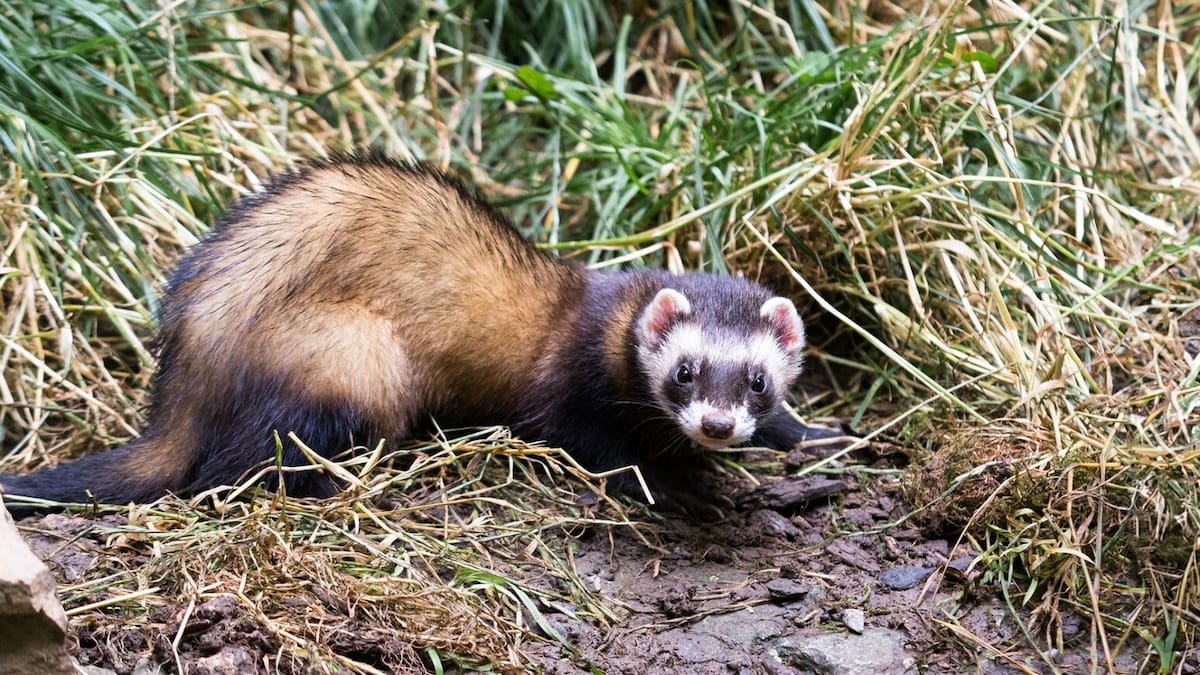
More than 90% of ferret guts tested contained frog DNA, indicating an “alarming” level of predation and raising concerns for native ecosystems.
Sara Smerdon is Conservation Advocate at the Mahakirau Sanctuary, as well as a landowner and the sanctuary’s operations manager.
Estate history
Mahakirau Estate covers about 600ha and has thousands of species, including Forest Ringlet butterflies “on the brink of extinction”, the rare Coromandel striped gecko, and kōkopu (native fish).
The land was divided into 24 properties under the QEII covenant. Landowners had responsibilities for animal and plant control.
Smerdon is one of 24 landowners at Mahakirau, living among the species she aims to preserve.
“There are Archey’s frogs and rare geckos right under our feet,” she told the Waikato Herald.
“I think that’s one of the keys to the success of our project; is that we actually live in with the creatures that we are protecting.”
More than 2000 stoats have been removed from the sanctuary since the trust started in 2001.
Stoats are just one of many predators roaming the estate. There are also mice, rats, weasels, possums, pigs, feral cats, and other “introduced threats”.
“They are just like eating everything … It’s just annihilating.”
Smerdon has been doing predator control at the sanctuary for more than 15 years, “saving species”.
She needed to know what’s in a predator’s “seasonal diet” to understand which protected animals were at risk.
Pig study
Smerdon reached out to Waikato Regional Council for eDNA testing after a Department of Conservation worker monitoring a nearby field uncovered “visual evidence” of Archey and Hochstetter frogs in pigs’ guts.
There were a “few scenarios” of people finding this before, but there had “never been solid evidence until then”.
“He was pulling out like 50 frog arms and legs [from pigs].”
With both frog species living at Mahakirau, she wanted to know if the same was happening there.
The first testing round did not show visual evidence, but she said it produced a peak sample of 53% of pigs containing Archey and Hochstetter frog DNA.
It increased to more than 75% during the frog emergence season.
Smerdon said Archey frogs were among the most commonly detected prey in pigs.
She felt frogs were a target for pigs after a hunter pulled almost 60 frogs from one pig.
“You’d have to say that pig is targeting frogs.”
Remains of multiple Archey’s and Hochstetter’s frogs recovered from the stomach of a ferret caught at Mahakirau Sanctuary. Photo / Sara Smerdon
Ferret study
Smerdon has been collecting ferrets at Mahakirau for more than five years. She uses them for genetic testing to see how the species disperse, how far they roam and where they come from.
She decided to have the guts of frozen “fresh ferrets” eDNA tested at the same time as pigs.
She described the ferrets she used as “the highlight” of her trapping career – two caught in one trap at once.
However, the results were “alarming”.
“We slit it open, and frog parts just rolled out … my heart sank,” she said.
“That one [had] four individual frogs, and I could see there was Archey, as well as a Hochstetter foot in one.”
Smerdon continued testing, leading to frog DNA being detected in 90% of ferrets’ guts.
She believed ferrets, like pigs, were targeting frogs and “fishing for eel”.
“They are definitely seeking out frogs as part of their staple diet.”
Ecosystem
The animals are moving between the forest floor, canopy and waterways, and eating across the ecosystem.
Smerdon said the impact is “generational”.
They have found eggshells in stoats from eDNA testing, showing a “clear sign” of juvenile and adult birds inside their guts.
“That’s taking the whole life cycle out.”
They’ve also found ferrets that have eaten gravid frogs carrying eggs.
“So it’s taking out the eggs of the next generation.”
Smerdon said Archey frogs live for 40 years and their habitat is about 1sq m.
“If a pig or a ferret goes into their habitats and finds a frog, they are taking out generational frogs.
“We don’t have that many [frogs around].”
She said results show “how broadly these predators exploit that biodiversity”.
A ferret and the native frog remains recovered from its stomach at Mahakirau Sanctuary. Photo / Sara Smerdon
‘New findings’
Paul Dutton, Waikato Regional Council senior scientist for terrestrial ecology, said eDNA testing complements traditional monitoring methods.
The council has used it since 2019.
“The results of eDNA testing always need to be critically examined due to the risk of contamination during any phase of testing,” Dutton said.
He said Smerdon reached out for testing between 2023 and 2025 following “observations of frog predation”.
“The results revealed native species DNA – including threatened species – in gut swab samples.”
While some predator-prey associations “were new findings”, the pattern was “not unexpected given the opportunistic feeding behaviour” of the predators.
Dutton said the results demonstrated the “remarkable breadth of native fauna”, whose predation would be “extremely difficult to detect” without it.
He said looking at a predator’s guts is an additional tool for understanding ecological interactions.
Smerdon recommends other conservationists use eDNA testing.
“Honing in on [their guts] is one of the best ways of finding out if you have a presence of these species in your environment.
“Then you can wrap your predator control and monitoring surveys around that.
“We need to be using all these tools that are available to us.”
Malisha Kumar is a multimedia journalist based in Hamilton. She joined the Waikato Herald in 2023 after working for Radio 1XX in Whakatāne.