
Warning: This story includes details and images depicting stillbirth and baby loss.
When Lauren Ensor and Matt Earle left for Nelson Hospital on the morning of February 12, 2024, they expected later that day to meet their daughter. They knew they were having a girl; they had a name,
Mackenzie, picked out and a home full of baby clothes, nursery furniture and soft toys waiting for her.
Earle, a resource management consultant turned content creator and marketing specialist, was recording the trip to the hospital; you can hear in his voice the mixture of nerves, excitement and anticipation that most first-time parents experience.
“We were really happy. We were laughing.”
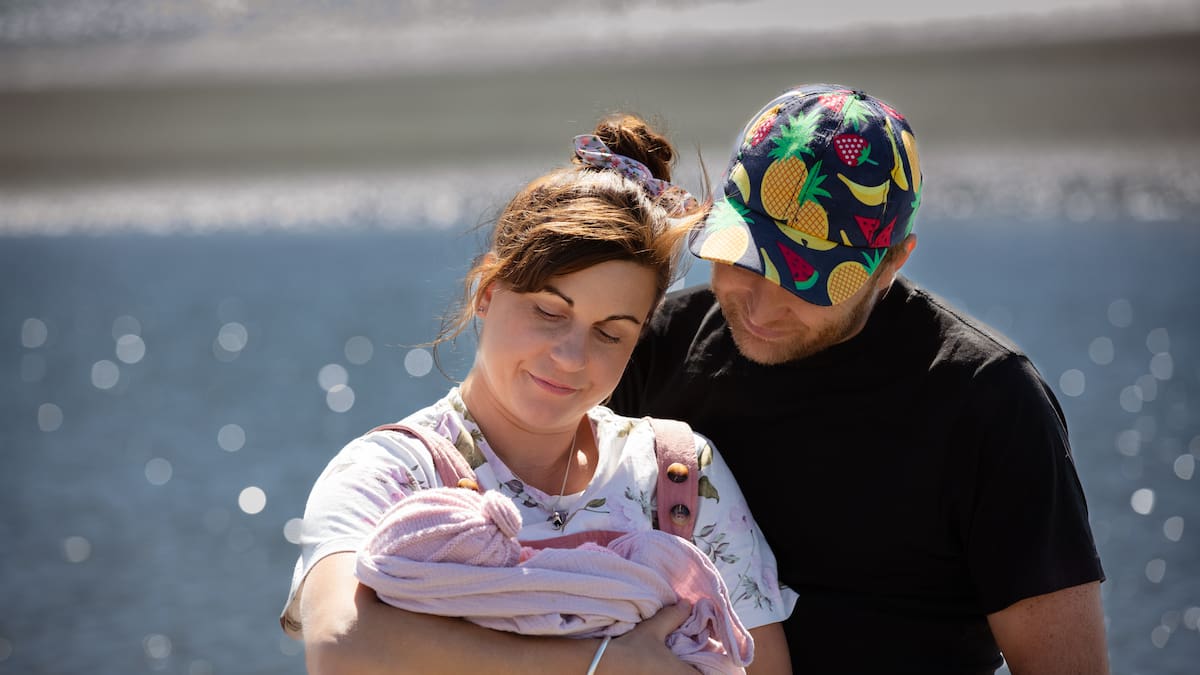
Except Earle and Ensor didn’t get the happy ending most making a trip to the delivery suite do. “Mackenzie was beautiful and perfect, she just wasn’t breathing,” he says.
That day, Earle learnt a term he’d never heard before – stillbirth. He and Ensor now know that in New Zealand, stillbirth – foetal death at or after 20 weeks of gestation – occurs at a rate of around eight per 1000 births, equating to approximately 450-500 stillborn babies each year. It’s rarer after 28 weeks, occurring in about one in 400-500 births. Ensor was full term – 40 weeks – when Mackenzie was stillborn.
“I’ve never experienced something that was so … unexpected because, I guess, I was quite naïve,” says Earle. “Throughout the whole journey I assumed everything was fine. I’ve had relatives pass away but they’ve been older and there’s been time to prepare for it. The speed at which we were thrown into this situation was quite different. We were in a club, a very specific club that nobody wants to be part of.”
And, he found, nobody really knows what to say or how to react, even the people who have found themselves unwitting members. The question of what to say and what might be helpful played on Earle’s mind as he sought to process his own grief. In the end, he came up with a solution befitting his years as a content creator who’s been recording everything from attempts to rollerblade the length of New Zealand in 2014 to surviving a motorcycle crash in Bali.
Processing the loss and grief
Why not use the real-time recordings he had – like that trip to the hospital on the day of Mackenzie’s birth – with reflections and knowledge gleaned after her death? He figured a podcast might also help others experiencing similar loss and grief.
So, Earle, with best friend and business partner Josh Hall, made Confronted. It’s an eight-part podcast shot through with laddish comedy and candid confessions; there’s some gross-out humour and a whole lot of heart. Earle, in his conversations with Hall, looks back on how he and Ensor met, what shaped the person he was before becoming a father, how grief doesn’t always look the way you and others expect it to, a trip to Europe in order to move forward and leave everything behind, and the vexed question of trying for a second child.
“I didn’t want it to be just me talking because it’s a dark story, but I wanted it to offer hope, so having my longest and dearest friend to talk with and sometimes laugh with felt right.”
Earle talks with Hall, who asks questions along the way, about his spiral into anxiety and trying to find a suitable therapist – a therapy session he tried left him feeling worse – and a drink-driving charge that stopped him in his tracks.
Earle has a tattoo of Mackenzie’s foot print. The family visit Mackenzie’s resting place often, referring to it as Mackenzie Town. Photo / Supplied
Earle is particularly keen to reach other men confronted with baby loss. Initially, he says, there was good support around him and Ensor but it tapered off and what resources there were tended to be targeted at grieving mothers.
“I think men are expected to be stoic, so we kind of get stuck and that’s massive in New Zealand to different degrees. I think it’s getting better because more people are talking about difficult subjects and emotions, but not enough in my view.”
The grief men carry after baby loss
That doesn’t surprise psychologist David Stebbing, who’s been practising for nearly two decades. He says in that time few men have come to see him to talk specifically about baby loss.
“The most common thing in respect to this that I’ve seen is couples coming, but there’s an explicit kind of undertone or stated truth that they’re there more for her than him,” says Stebbing. “That might be perceived as a more legitimate way for men – based on societal expectations – to be seen as providing care but in a way, actually receiving almost clandestine care.”
Eventually, he says, the conversation will steer toward the male partner talking about how he feels. “Unsurprisingly, they’re really similar to his female partner. It’s grief and loss. There’s an inherent expectation that our children will outlive us and when they clearly don’t, that’s not only appallingly sad but appallingly shocking and life recalibrating.”
Like Earle, Stebbing acknowledges more men are getting better at talking about feelings, emotions and the tough stuff of life but there remain stubborn societal rules that allow men few emotions.
“They’re allowed to be happy, and they’re allowed to be angry and horny and briefly sad, but more than that and [the perception is] you’re kind of not doing your job,” says Stebbing. “I also think that a lot of guys are used to not talking to friends or family about how they feel. And what they have learned to do is compartmentalise and sort of suppress or repress feelings.”
Earle says he’s so far received more responses and comments from women, but some men have come to him for advice. “I was asked for advice from someone who had a work colleague who was going through something similar. He wanted to know if he should buy them flowers and I was like, ‘I don’t know but maybe supermarket vouchers would be more useful’. It’s more practical questions coming from men.”
While therapy wasn’t right for Earle, and he and Ensor found joining a support group didn’t work for them, making Confronted turned out to be his therapy.
“I guess I’m always looking for the lesson. So the more time passed, the more I could reflect on what happened. I questioned myself about why I assumed everything was fine with Mackenzie, what’s really important to me in life, what do I value?
“But it was a process, a really gradual process of trying to find the lessons from the situation, trying to find the things to be glad to get up for in the morning. One of the biggest surprises was our family because something like this makes you drop all your barriers. We’re not a family that says, ‘I love you’, at the end of a telephone conversation, but there was much more of that and much more openness during that time.”
Confronted ends on a happy and hopeful note. Spoiler alert: You just might cry tears of joy.
“I’d like it to be for people who are going through a similar experience, but if you’ve only just gone through this it might be pretty intense, so listen to it when you’re ready, when you’re seeking answers. If it can help anyone, then I’m super grateful.”
International Pregnancy and Infant Loss Remembrance Day is observed annually on October 15.
You can find out more about stillbirth here.
SaveShare this article
Reminder, this is a Premium article and requires a subscription to read.
Copy LinkEmailFacebookTwitter/XLinkedInReddit