

Disappointment is deepening in New Zealand’s struggling arable sector over farmers continuing to opt for imported animal feeds over local grain.
New Zealand was one of the largest importers of palm kernel expeller (PKE) in the world, using the byproduct of the palm oil industry as a feed supplement for dairy cattle, largely when pasture was scarce.
Midday rural news for 4 September 2026
Arable farmers growing feed grain had long fought for greater uptake of their product domestically, but struggled to be competitive against similar imported products on price.
More new dairy farms for Canterbury: Grain growers go for milk
The issue was raised at the industry association Seed and Grain New Zealand (SGNZ) conference in Christchurch this week, where some of the country’s top arable and seed companies and government officials explored challenges and opportunities for the legacy sectors.
‘Under pressure’ seed and grain seek green shoots in challenging market
At the conference, SGNZ vice president Jo Townshend of Midlands Seed in Mid Canterbury raised concerns about the challenges for arable to compete against the usually cheaper imports.
Townshend said New Zealand’s arable domestic manufacturing sector lacked government support to help it remain viable and cost competitive.
“It’s a huge amount of importing coming into this country, possibly due to free trade agreements or other agreements, that are really putting a ceiling on the ability of arable farmers to support our own domestic economy, including process growers,” she said.
“I mean, for $2 billion worth of animal feed coming into the country, for a country that’s pretty good at producing it itself, is pretty disappointing.”
Aotearoa imported more than 2 million tonnes of the PKE feed product from countries like Indonesia and Malaysia each year, a mostly dry matter product from the fruit of the palm.
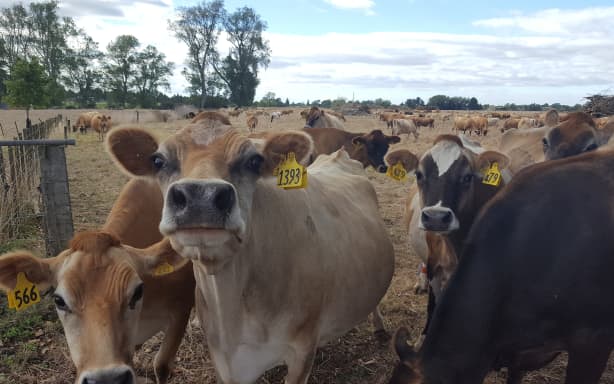
When pastures are dry, farmers have a choice of supplementary feeds for dairy herds.
Susan Murray RNZ
Environmentalists opposed importing PKE, due to its environmental effects and links to deforesting tropical rainforests.
SGNZ president Edward Luisetti of Canterbury’s Luisetti Seeds said arable farmers with irrigation were looking forward to a warmer summer, particularly on the East Coast, if El Niño arrived as forecast.
However, he also expected the drier conditions to drive up farmers’ PKE imports this year.
How will this year’s record‑breaking El Niño affect NZ and the world? Five things to knowEl Niño could bring a ‘highly unusual warm’ spring
Competitive price point
Farming leader Nathan Guy was a former Horowhenua dairy farmer and agriculture minister, and now is the country’s special agricultural trade envoy, flying the flag with government officials to grow New Zealand agriculture exports.
In response to questions from Jo Townshend at the event, Guy said he fed his cattle PKE and found it was an easy supplement to switch on and off.
“A benefit with PK is you can start the cows on it tomorrow. There’s no rumen digestion change as there is with some other feeds.”
But he said the costs for PKE had increased, and local grain was less price competitive.
“PK’s very expensive right now, very expensive with shipping costs,” he said.
“But I think right now there’s a price point.
“Is there a way of potentially the arable over time becomes more cost competitive?”
He said many farmers, including himself, would get to a point where they would look to grow maize themselves in the face of rising costs.
One farmer who contacted RNZ said PKE was $300 per tonne, versus $500 for grain, and dairy was a business not a national charity.
Fonterra said its cows were 96 percent grass-fed (including silage, hay and forage crops like legumes and brassicas).
The dairy co-op and world’s largest exporter of dairy previously told RNZ that PKE made up less than 2 percent on average of its farmer-shareholders’ cows’ overall diet
Meanwhile, Greenpeace activists staged a protest at an Agrifeeds PKE storage shed at Port Taranaki last year.
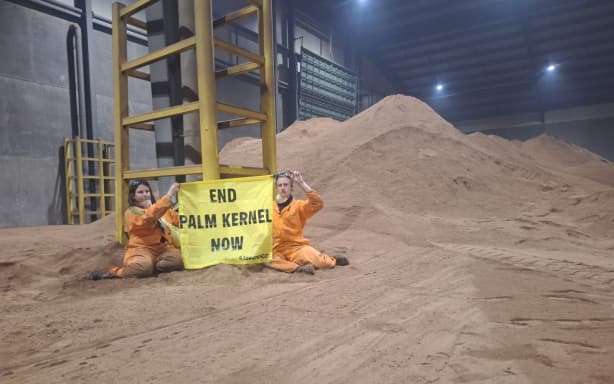
Greenpeace activists occupied part of Taranaki’s port in April last year, to protest Fonterra’s use of palm kernel.
Supplied / Greenpeace
Its global project lead for agriculture, Amanda Larsson, said the palm kernel supply chain was “incredibly murky” and made it difficult to guarantee that no rainforests were destroyed in the process.
Fonterra settles activists’ misleading packaging lawsuit for ‘100 percent NZ grass-fed’ claims
“We’re pretty aligned with the arable farmers on this one,” Larsson said.
“I think most New Zealanders would be pretty horrified to hear the dairy industry is connected to rainforest destruction, when there is a homegrown alternative that would actually support New Zealand’s own farmers.”
Larsson said farmers may need support in transitioning to more diverse and less monocultural farming systems, in the face of climate change.

Delegates at the 2024 Fonterra AGM were greeted by a Greenpeace protest about the use of palm kernel as a stock feed.
RNZ / Robin Martin
The Foundation for Arable Research (FAR) [
https://www.rnz.co.nz/news/country/575244/arable-sector-launches-new-trademark-to-champion-nz-grain-over-imports launched a landmark NZ Grown Grains certification last year], to help consumers identify products made with local grain and promote local uptake among farmers.
More than 34 producers were now certified, with more being assessed, including grain for animal feed.
FAR also released new research last month showing local feed grains had a lower carbon footprint than imported feeds, going off earlier assessments also by AgResearch.