
He also offered his opinion on New Zealand’s farming practices, suggesting that there was considerable wastage occurring in our fields.
Despite his observations, the visit concluded with the Australian taking home a little piece of New Zealand agriculture.
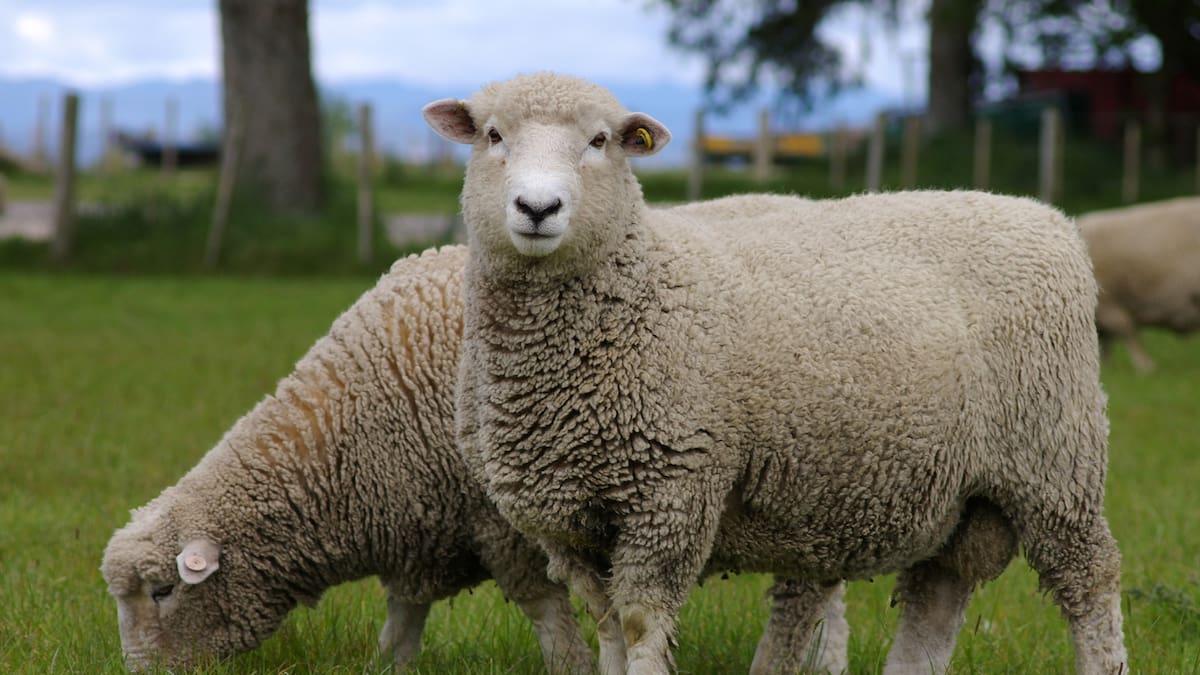
Before returning to Australia, he purchased a stud Ryeland ram from Massey Agricultural College, perhaps providing some evidence that, despite his criticism, he recognised there was plenty of value in New Zealand’s sheep-breeding industry.
Below is a historical story from the Poverty Bay Herald (1938).
Many sheep breeds
South Australian types
Fat lamb production
“To beat New Zealand”
Poverty Bay Herald, February 15, 1938
Surprise that there were very few breeds of sheep in New Zealand, compared with many different types to suit varying types of country and conditions, was expressed by Mr Ross Theim, a member of the South Australian farmers’ party, when speaking at a special meeting of the Gisborne Young Farmers’ Club last night.
Mr Theim said that fat lambs were produced mainly by the mixed farmer close to Adelaide.
Many types of sheep were used, chiefly the British breeds, while those for fat lambs were mainly the Suffolk, Southdown, Border Leicester, Ryeland, Hampshire Down and the Dorset Horn, the last mentioned now finding its way to New Zealand.
These sheep were chiefly used as sires for fat lambs, while on the other hand, the Romney Lincoln, English Leicester, Border Leicester, and Ryeland were used for crossing with Merino ewes for lambs.
Corriedales were now becoming very popular as a dual-purpose sheep.
In his area there was early and late country, where lambs were produced from April up to October.
They tried to get the fat lambs away in time to beat New Zealand on to the market.
Few British sheep
So far in the North Island he was disappointed in not being able to find many British sheep.
He had found only two Ryeland studs and many Romneys.
He had purchased a stud Ryeland ram at Massey College to take back to Australia.
It was not unusual to see from 800 to 1000 British sheep at a South Australian show, with 75 to 90 sheep of each breed.
The British breeds would outnumber other breeds.
With his rainfall of from 30 to 40in. a year, one might think he had no water problem, but the scarcity and difficulty in procuring water were surprising.
Some sheep now rugged
A number of Merino breeders were now rugging their sheep to keep the dust out, and there had been good results, a better growth of cleaner wool being obtained.
Of course it was a problem to rug thousands of sheep, but the method was becoming popular, up to as many as 2000 sheep being rugged on the one farm.
His area, which was near Adelaide, carried from three to four, and up to five sheep to the acre.
The annual ram fair held in September.
The rams were always inspected by a committee, which had the power to reject any that did not come up to the required standard.
From 600 to 700 rams were offered at the sale annually, but more were dealt with privately or through the Royal Show.
The Dorset rams usually brought the highest prices, generally from 7 to 25gns.
The lambing averaged from 80 to 90 per cent, and sometimes up to 100 per cent.
When asked by one of the listeners, Mr Theim said that what impressed him most on his tour was the greenness of the country, the number of windbreaks and the uniformity in the type of sheep being used here.
He could understand why New Zealand secured such a big uniformity in the lamb carcasses when the country stuck so rigidly to practically one type of ram.
The same applied to the Jersey cows.
The size of the paddocks also impressed him.
“There appears to be a big wastage in your fields,” he added.
“I would feel like doing some mowing in some of the paddocks.”
– Source: Papers Past