
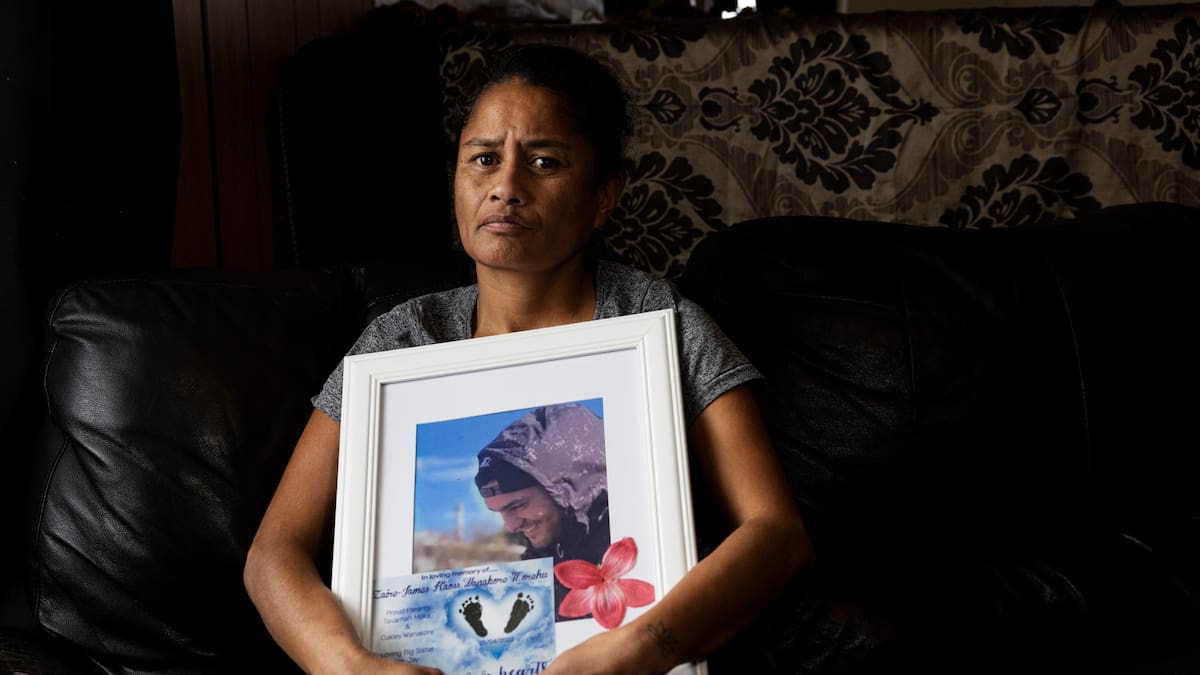
Price’s mother, Jillian Hana, is challenging the July 2023 police decision not to charge the police officers – referred to as Officer A and B – involved in her son’s shooting.
Hana, who is taking the case on behalf of the whānau, is seeking a declaration from the court that the decision not to prosecute was unlawful and wants it reconsidered.
She is also seeking $50,000 in damages under the NZ Bill of Rights Act (BORA), to vindicate her rights and mark police failings in the case.
A split-second decision
Today, lawyers representing the Attorney-General defended police actions, saying the officer who fired the fatal shot made a split-second decision and there was no opportunity for consultation.
Crown counsel Peter Gunn told the High Court at Wellington that Price was well-known to police, with a lengthy list of convictions for theft, car conversion, assault, burglary and driving offences.
Having been released from prison the month before his death, police believed he quickly resumed offending, and by April there were alerts on the police database noting a risk he was carrying knives and firearms and escaping custody.
Gunn told the court there was no suggestion the officers set out to target Price on the evening of the incident; the opposite was true.
But Hana’s lawyers took issue with that, pointing to emails the day before Price’s death from police hierarchy notifying officers of a warrant to arrest Price.
“WE JUST NEED TO GET HIM,” one email said, while a second offered pizza and drinks for those who could locate Price.
Gunn said that on the night of the shooting, the two officers were in a police vehicle parked on the side of the road, following reports of a suspected drunk driver.
A BMW passed, closely followed by a VW associated with Price. They believed the cars were travelling in convoy and began following them but weren’t pursuing them.
They watched as the VW turned its lights off, overtook the BMW, and disappeared.
Police didn’t follow the VW but pulled over the BMW.
While Officer A was speaking to the driver, they heard loud screeching tyres and an engine revving in the distance and looked up to see the VW speeding towards them.
The court heard that they felt like Price was hunting them and feared they were in immediate danger of being struck.
“I literally shut the passenger door and held my breath. I thought I was going to die; I thought my name was going to be one of the names on the memorial plaque at the Police College,” Officer B later told investigators.
The VW drove so close to the police van that it shuddered, then U-turned, sideswiping the marked police vehicle.
Officer A fired two shots through the VW window before it came to a stop. They watched as Price climbed out the window, and it looked like he was trying to conceal something, Gunn said.
Given their intelligence, they feared Price was armed, Gunn said.
As Price ran from the scene, Officer A fired several shots, none of which hit him.
Price, they estimated, was 150-200m ahead of them, and they still couldn’t see his right arm.
They watched as he tried a Mitsubishi and other cars before reaching the Hyundai, which they feared he was going to flee in, taking innocent people with him.
Yesterday, the court heard that the occupants of that vehicle didn’t feel threatened by Price, instead describing him as scared, wanting to get away, and looking “terrified”.
But Gunn said the officer, unable to see into the car, had no way of knowing that.
Gunn said when Officer A arrived at the scene, he told Price to stop and get out of the car. Price ignored the instruction, and Officer A shot him in the chest. He died at the scene.
From the time the BMW was pulled over to Price being fatally shot, three and a half minutes had elapsed.
Gunn told the court Officer A considered alternatives but discarded them as too risky or ineffective.
A Taser was ruled out as it was unlikely to incapacitate Price quickly enough and could have caused the car to surge forward.
A police dog was also ruled out because there was a risk it would bite the driver who had his foot on the brake, again causing the car to surge forward.
Opening the driver’s door risked exposing the driver to a potential weapon, given the information police had on Price, Gunn said.
Pepper spray was also discarded by the officer as it was unlikely to be effective.
The incident took place on a rural road at night, with no streetlights.
Relief
Hana is seeking $50,000 for breaches under BORA.
The third Crown counsel, Debra Harris, said for a court to award damages in a judicial review, a high threshold had to be met, and, even under public law, damages were discretionary, awarded to mark disapproval of conduct, not hurt feelings.
She said the Attorney-General opposed awarding damages in this case.
In terms of what Hana was seeking, she said the court could order no further action be taken or it could order police to provide the family with reasons not to prosecute the officers.
If the court ordered police to provide Price’s family with reasons, or the review was successful and police were asked to reconsider their decision not to prosecute, that decision could only be made by police, as the original decision maker, she said.
Earlier, one of Hana’s lawyers, Julia Spelman, suggested that if the review was successful, any reconsideration as to whether charges should be laid against the officers involved should be left to the new inspectorate of police, a body recommended following the investigation into former deputy commissioner Jevon McSkimming.
Kaoss Price was shot and killed by police in Taranaki. Photo / Mike Scott
Crown responds
Yesterday lawyers representing Hana and Price’s whānau took issue with many aspects of the case, including the police investigation and the 15 months it took to decide not to prosecute.
But Gunn defended the investigation, telling the court it was overseen by officers out of the district, with the officer who headed the investigation flying in two days after Price’s death.
Christopher Stevenson, KC, representing Hana, said: “We struggle to understand how taking 15 months for a decision, with the facts being relatively straightforward, could be explicable or justified”.
Gunn said the Crown rejected that, saying it reflected the time taken to conduct an independent investigation.
The decision not to prosecute was made by the officer in charge of the case and endorsed by an independent panel, he said.
The IPCA, which conducted its own investigation into Price’s death, also reached the conclusion not to charge Officer A.
He also said the police investigation met the requirement under the NZ Bill of Rights Act, and,even if it hadn’t, there was still a coroner’s inquest.
Yesterday the family also levelled further criticisms at police, including that the interview with Officer A wasn’t recorded on video.
Gunn said this was a voluntary interview and the officer was under no compulsion to talk to police, just as they couldn’t compel any defendant.
There were also criticisms of the interview, with the officer referred to as “mate” 14 times. But Gunn rejected the criticism, saying experienced interviewers were brought in from outside the region.
An affidavit from one suggested it was more effective to deal with people with empathy than aggression.
“There was no soft treatment here, and the treatment applied here was consistent with the interview techniques applied in other interviews,” Gunn said.
Failure to give reasons
There were also criticisms of police’s failure to give the family reasons for the decision not to prosecute Officer A, citing the letter police sent the family, which mentioned the reasons only in the last paragraph.
“Based on an assessment of the circumstances and the law relating [to] self-defence and defence of another (section 48 of the Crimes Act), police have determined there is insufficient evidence to support a criminal prosecution of the officers involved in the incident.”
The second Crown counsel, Peter Marshall, said it was unfair to characterise the letter as conclusionary. He said reasons were given.
He told the court the letter captured the gist of the findings and the Solicitor-General’s prosecutorial guidelines were applied, but he accepted it didn’t satisfy the family’s need for answers.
He referred to several cases which he said supported prosecutors’ right not to give reasons.
The Attorney-General extended sympathies to Hana and her family for Price’s death.
“The police say the actions were reasonable and defensible in law, but they understand that they grieve for him and wish to challenge the police’s actions in court,” Gunn said.
Parties will now file submissions about permanent name suppression.
Justice Victoria Heine thanked counsel for their thoughtful and helpful submissions and reserved her decision.
Catherine Hutton is an Open Justice reporter, based in Wellington. She has worked as a journalist at the Waikato Times and RNZ. Most recently, she worked as a media adviser at the Ministry of Justice.
Join the NZ Herald’s Open Justice team for Case by Case, a video and podcast series examining the disputes and decisions making headlines across New Zealand.