
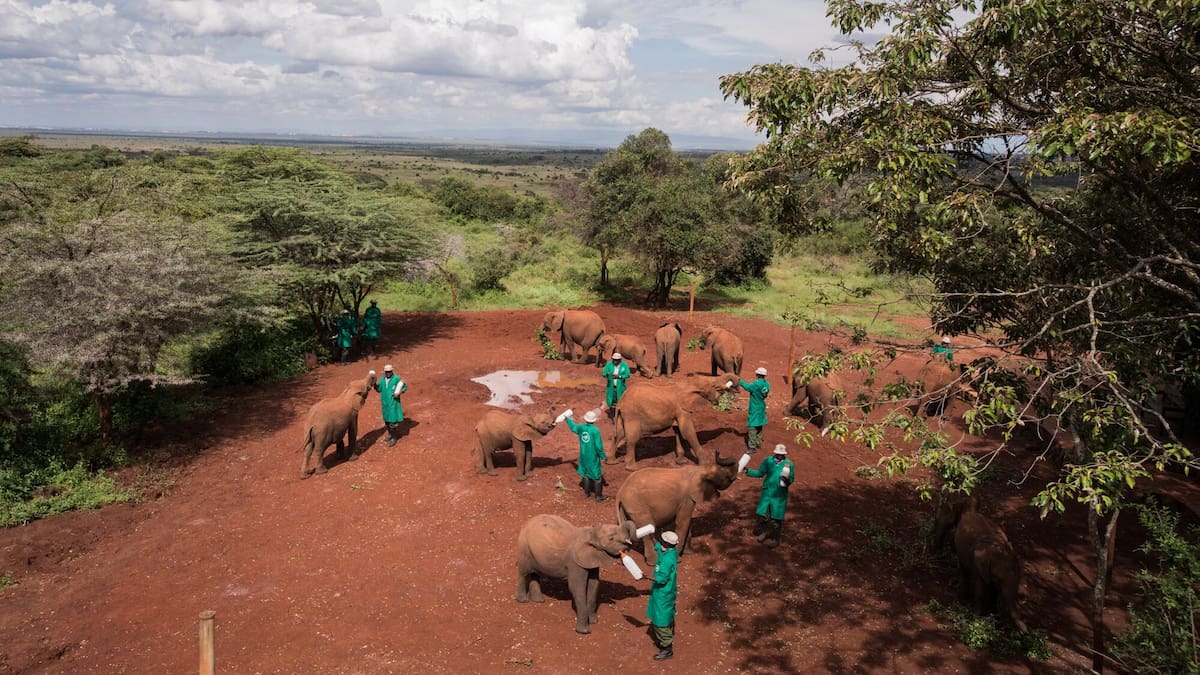
Despite Bumpy’s recent stardom, protecting elephants continues to be the trust’s main focus, and I’m soon introduced to the nursery’s current juvenile pachyderm residents. The nursery’s experienced head keeper, Edwin Lusichi, confirms there are 15 orphaned elephants in their care, but in previous decades up to 38 elephants were at the nursery at any one time. They have four other orphan units in Kenya, with nearly 100 orphaned elephants dependent or semi-dependent on their care.
A confident orphan feeds itself under watchful eyes. Photo / Carol Piper
Arriving at the public viewing point, some amble slowly, while others make a speedier dash to secure a bottle of the special milk formula developed by Dame Daphne. Today, there’s also Tytan, an orphaned black rhino, and Notty, an orphaned zebra foal. Tragically, the mothers of Tytan and Notty both died by falling down cliffs in different parts of Kenya, but since arriving at the nursery in the same week in September 2025, they’ve become good mates.
Tytan the orphaned rhino enjoys his milk bottle. Photo / Carol Piper
As baby and juvenile elephants guzzle on bottles of formula, a few of them alternating with a paddle in a shallow pool framed by the red-dirt arena, Lusichi explains the work that goes on behind the scenes. After being rescued around Kenya for a variety of reasons – including being orphaned when their mothers were killed by poachers, separated from their herds during human-wildlife conflict, or found injured and unable to survive alone – elephants are brought to Nairobi for rehabilitation.
An orphan is walked back to its stable at dusk. Photo / Sheldrick Wildlife Trust
Exploring the forests and scrubby bushland of Nairobi National Park from dawn to dusk, the orphaned elephants then return every night to sleep in individual stables at the nursery’s stockades. Overnight, they’re never left alone, with the trust’s keepers sleeping beside them in the stables. This provides the companionship and care the elephants would have received from their natural herd. Bonds inevitably form between keepers and elephants, but Lusichi explains keepers are rotated regularly to ensure these attachments do not become too strong.
Time in the nearby national park begins what is known as ‘bush school’. The orphans learn the essential skills of socialising and feeding while interacting with the other orphaned elephants, but always return to overnight in their stables. Depending on the elephant’s age, development and confidence, the nursery phase can last several years before they transition to one of the trust’s reintegration units. Lusichi confirms it will probably be around five years before Tytan and Notty make the same move. Right now they’re happiest following each other around, sleeping in adjacent stables, and being unlikely cross-species best buddies.
A keeper bonds with his young elephant charges. Photo / Sheldrick Wildlife Trust
After graduating from the Nairobi nursery, elephants are moved to one of Sheldrick’s three reintegration units, two of which, Voi and Ithumba, are in southeast Kenya’s Tsavo East National Park. Part of the sprawling 42,000sq km greater Tsavo Conservation Area, it’s the region with Kenya’s biggest elephant population. It’s also in Tsavo’s protected wilderness that the next stage of ‘bush school’ begins. New arrivals from the nursery interact with wild herds and also other ex-orphans who started at the Nairobi Nursery. During reintegration, elephants still continue to return to overnight stockades, but their confidence slowly grows, bonds form with existing herds of ex-orphans and wild elephants, and eventually they adopt a fully independent and wild life.
An orphaned calf gets its milk fix at feeding time. Photo / Carol Piper
This journey from orphaned calf to independent adult elephant can take over 10 years, with the trust never rushing this process and instead allowing each stage of the transition to happen at the elephant’s own pace. Since the trust began, nearly 330 orphaned elephants have been successfully rehabilitated, and it’s an exciting journey one very special hippopotamus is now also beginning at the Kaluku Unit near Tsavo East National Park.
Good luck, Bumpy. Go well.
Details
Public visits to the Nairobi Elephant Nursery take place from 11am to noon daily, by advance booking only. Book well ahead on the Trust’s website: sheldrickwildlifetrust.org/nursery-visit
Costs are adult/child US$20/5. National park fees of adult/child US$80/40 also apply, which include entry to Nairobi National Park beyond the nursery.
Another popular way to support the work of the trust is to adopt an orphaned elephant, rhino or hippo. From US$50 per year. See sheldrickwildlifetrust.org/orphans
The writer was a guest of the Sheldrick Wildlife Trust.