
Labour Hutt South candidate Ginny Andersen meets a constituent and his cat. Photo / Thomas Coughlan
The first question was about rate caps, although unlike at a public meeting National leader Christopher Luxon attended on the nearby Kāpiti Coast last month, this query came from a critic of the policy who argued they had not worked internationally.
Hipkins said Labour had supported the Government’s rates cap legislation at first reading so it could get to select committee, but had not committed to going further.
“We’ve supported the rates cap at first reading… I encourage everyone to make a submission on it,” Hipkins said.
“I have no problem saying we don’t want rates to increase at the rate they’ve been going up,” he said, but added the cap could mean councils imposing user charges for “the services you rely on”, which could leave people no better off.
“We haven’t committed to supporting it beyond first reading and we will let that process run its course.”
There appeared to be mixed views on councils.
A later questioner raised concerns about the Government’s move to force council amalgamations. Hipkins’ answer was interrupted by another person, who said, “we have incompetence at local councils”.
Another attendee complained about the Wellington region’s first water bills from Tiaki Wai, the new water entity.
He asked Hipkins what he would do to “stop the council from gouging us with our Tiaki Wai bills”.
Hipkins said Tiaki Wai was established under the National Government’s Local Water Done Well policy. He said the organisation needed to be held accountable, but councils “do need to spend money upgrading our water infrastructure”.
The strongest applause came after questions on pay equity, helping beneficiaries, and someone complaining that MPs spent too much time “bitching” in Parliament.
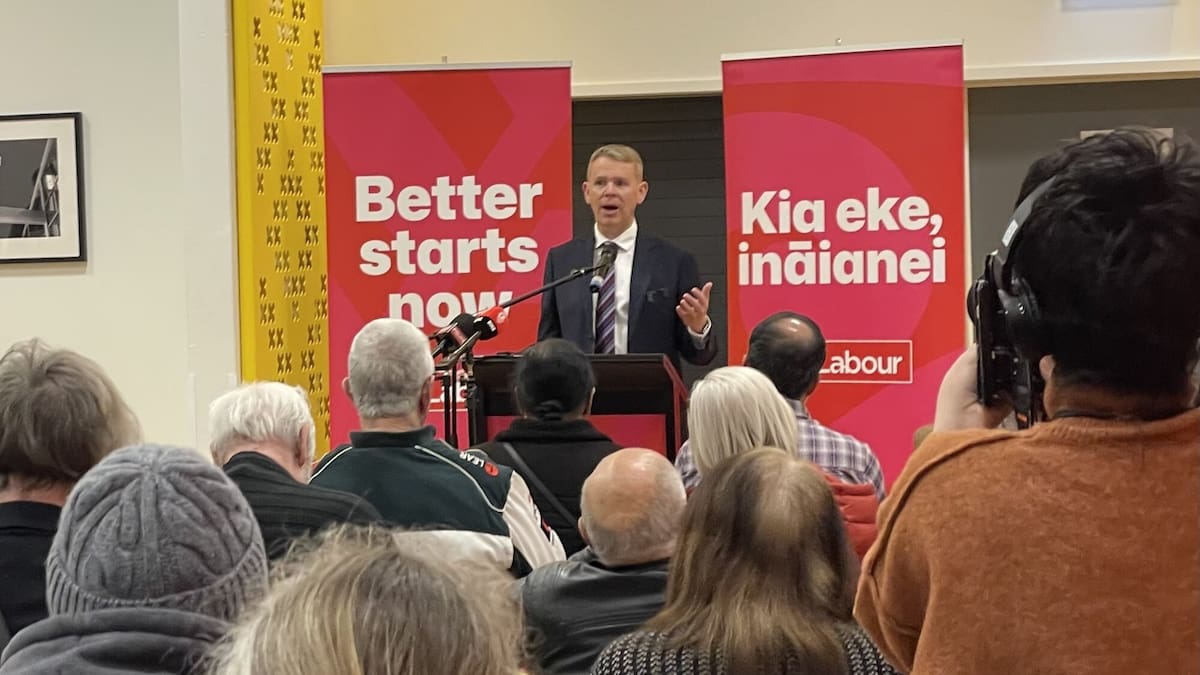
The meeting had plenty of empty seats at 6.20pm (left) but had filled up 10 minutes later once the meeting got underway. Photos / Thomas Coughlan
“Everyone is bitching and that’s no good… You don’t need to downgrade yourself bitching with all the other parties!” the person said.
There was some grumpiness from the crowd, although no major disruption during the evening. When Hipkins was answering a question about the Government’s use of urgency, someone at the back of the hall noted the Labour leader had rushed through legislation when he was in Government.
Another person came up to Hipkins after the meeting and asked whether he would apologise for the “hundreds” of people who died as a result of Covid policies. He was asked to leave by security and did so.
Other criticisms were more friendly. One critic said Labour didn’t crow sufficiently about its achievements in Government.
“Better starts now, well, better was happening then,” Amalgamated Workers Union regional secretary Robert Popata said.
However, he went on to raise concerns about Working for Families entitlements being clawed back as wages grow, which left people no better off.
Hipkins said Labour will have “announcements in due course”, and noted the party had promised to lift Working for Families abatement thresholds at the last election.
Popata later told the Herald that Working for Families thresholds were a problem for members who noticed pay rises weren’t resulting in real increases in take-home pay.
The meeting had threatened to get off to a rough start.
At 6.20pm, with 10 minutes before the meeting was scheduled to begin, a substantial number of seats were still vacant. However, the roughly 110 seats filled rapidly and about 10 more had to be added at the back.
Media reports of Luxon’s public meeting in the Hutt Valley estimated about 250 people had attended (National’s own estimate put the number at 300).
Police security were on hand at Labour leader Chris Hipkins’ public meeting. Photo / Thomas Coughlan
It was Hipkins’ first public meeting of the campaign proper, with the Labour leader slow off the blocks before the November election.
Luxon’s “Build the Future” tour wrapped up on Tuesday night with a public meeting in his own electorate of Botany. New Zealand First’s Winston Peters and Shane Jones have been touring the country for months. Act’s Paul Henry has also been touring extensively.
Former Labour MP Trevor Mallard was among those attending Labour’s campaign event. Photo / Thomas Coughlan
One consideration for Labour’s late start has been the point in the campaign when the Opposition leader can avail themselves of the Dignitary Protection Service (DPS), the police branch that provides security for the Prime Minister and is extended to their parliamentary counterpart during election campaigns.