
Lucie inside her Point Chevalier home waiting for a treat. Photo / Corey Fleming
From the hind legs down she is paralysed, a condition that happened in unknown circumstances – Greta was told by her previous owners that it was from cancer in the spine – and required a life-saving surgery at a cost of about $10,000.
After paying for the surgery, managing Lucie’s condition became too difficult for the older couple.
When Gislason saw Lucie’s profile advertised at a rescue centre in 2021 she fell in love with her good-natured looks.
“I always wanted a golden retriever and when I saw her that was it, I knew I had to have her.
“I would say the first two months were a challenge. I cried every day because I thought, what have I done? This dog is actually paralysed,” she says.
“It’s like having a newborn baby, nappy on, toilet every few hours, and that was not what I was expecting. For some reason I just didn’t think it would be as intense as it is. I think I was a little bit naive.”
Owner Greta Gislason and Lucie: the pair are inseparable. Photo / Corey Fleming
She had to adjust to tasks such as carrying Lucie up the stairs and knowing her toileting routine, as she also suffered from constant urinary-tract infections at the beginning and needed consistent vet treatment.
After five healthy years, Lucie’s cancer has returned with a tumour found in her spleen in May.
“It’s never stopped her, she’s paralysed but she’s just a normal dog apart from that.
“The reason why we haven’t put her down with the diagnosis of cancer and her getting increasingly sicker, is because she’s still so happy and normal. She’s eating, she plays with her toys, she goes on dog walks, she still goes swimming.”
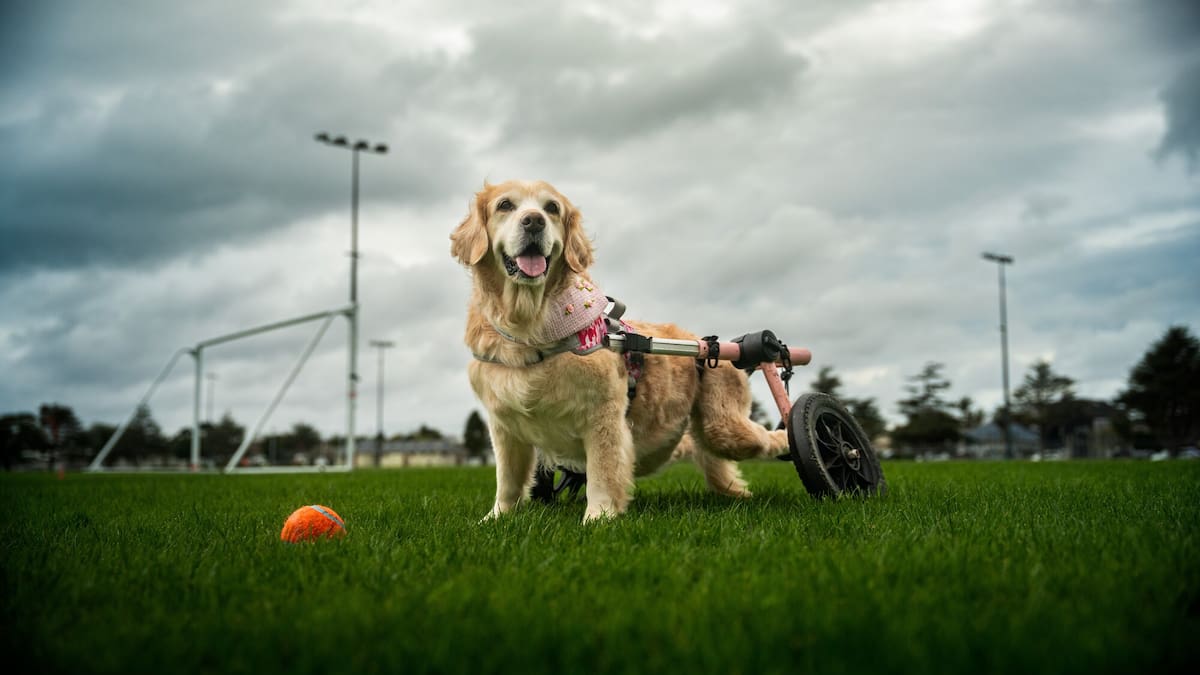
When the Herald on Sunday followed Lucie in her wheelchair to a field by their home, that becomes immediately clear – she bounds across the lawn fetching her favourite ball and races happily alongside Gislason, who always walks her without a lead.
It is phenomenal the bond the pair have; Lucie obeys Gislason’s every command and watches her attentively, as she lifts her out of her wheelchair and helps her into the house with her dangling hind legs.
Lucie has learnt to navigate smoothly in her wheelchair and easily runs to fetch balls. Photo / Corey Fleming
Lucie shows no signs of pain with her condition as she hurries to pull out a squeaky toy from a box in the lounge and then offers it in her mouth to the Herald’s cameraman.
She is always sidling up to people for a cuddle, and Gislason has noticed that children often will respond with great interest to Lucie on her walks, they always want to know what happened to make her paralysed and if she is in pain.
Gislason is finishing a postgraduate diploma in psychology and also works as a dog walker. Lucie is the pack leader on these dog walks and is often the first dog in the water and keeps the new recruits in line.
Healthy Pets New Zealand trustee Dr Cath Watson says, for vets, the timing of when to put an animal down is not a simple, straightforward decision, and often it will be based on discussions about the quality of life of the dog and also the family who are caring for the animal.
“It’s a hard question to answer because there’s no hard and fast rule for it,” Watson says.
“With some cases it’s very clear cut and you know it’s time, but some pets have a slow progression of symptoms and you have to monitor their condition.”
SPCA Hawke’s Bay centre manager Tamra Hay says their teams have a lot of success rehoming special needs pets and animals with medical requirements.
They have rehomed blind and deaf kittens and puppies, one-eyed cats, animals missing limbs, and puppies and kittens with cerebellar-hypoplasia, a condition that causes a lack of co-ordination.
Part of this is helped by social media, as the SPCA teams have found sharing the backstory and details of an animal can help to generate interest in these cases, to find a specific home or adopter that can manage the extra workload.
It’s important the new owners understand the extra responsibility, veterinary care, exercise regime and dietary requirements that animal will require, Hay says.
The expensive pink wheelchair Lucie wears was purchased through a community fundraiser. Photo / Corey Fleming
Watson says there are some people who go to amazing lengths to care for animals and show incredible commitment.
Particularly in her career as a vet, she has noticed people coping with animals with ongoing skin conditions are an incredible example of this, as intensive care regimes and maintenance are required for pets with skin diseases.
She also sees examples of people who hold on to animals for too long. Often this can be because they are living with a sick animal and the subtle decline isn’t obvious until an outsider such as a vet notices and tells them it’s not okay.
Deterioration in quality of life can happen over time or quite suddenly for animals, she says.
Gislason knows from working at dog rescue centres that it is often hard for deaf or blind dogs to get adopted because of their higher needs, and she wishes more people would be open to the idea.
From her own experience, she knows it is extremely hard at the start but just takes settling down into a rhythm with the additional care before it becomes natural and isn’t an arduous task.
Showing off her favourite ball. Gislason says Lucie’s personality is “a true diva”. Photo / Corey Fleming
Watson says pets with disabilities are a common sight for vets, such as three-legged dogs or cats missing a paw, and because dogs have such terrific other senses often they can cope a lot better than humans with loss of eyesight or hearing.
“There’s all sorts of disabilities out there from an animal perspective, but they just get on with life.”
There are also extra costs that come with these lucky pets.
Gislason had to fundraise for an expensive wheelchair early on in Lucie’s life, and because she has now become incontinent from the progression of her cancer, she wears human nappies around the house.
There are no dog nappies, so Gislason purchases human ones and cuts holes in them for Lucie’s paws.
A Givealittle page has been set up to fund the ongoing vet bills and medication associated with Lucie’s care.
As her cancer advances, Gislason is in the difficult position of weighing up when the time will come where she has to put Lucie down, as she never wants her to be in pain.
“I don’t want her to be in a position where she’s just on drugs and just staying alive for my needs.
“Every day I’m crying. I’m crying, it’s so emotional I don’t want her to pass. I know dogs have to and it’s like part of life but she is the love of my life.”
Gislason is making the most of the time she has left with Lucie.
“She’s just so tenacious, nothing stops her. She’s the greatest dog I’ve ever had,” she says.
Sign up to The Daily H, a free newsletter curated by our editors and delivered straight to your inbox every weekday.