
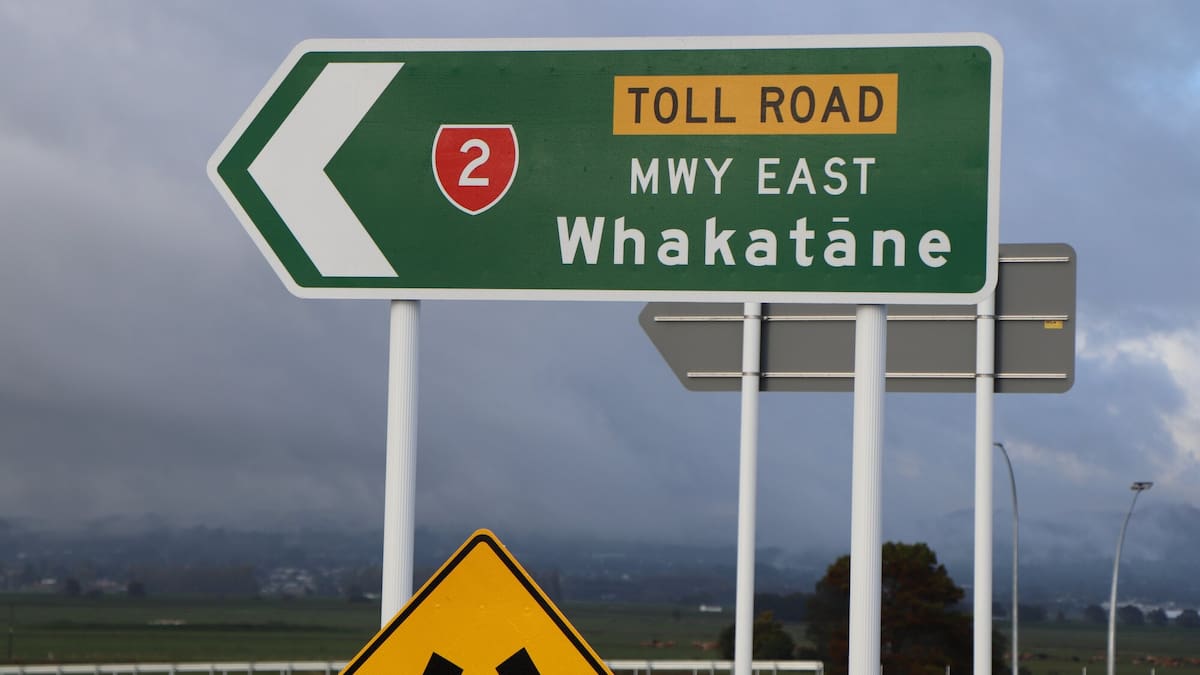
Tauranga and Western Bay of Plenty councils say motorists may choose local roads to avoid tolls, potentially increasing pressure on council-owned infrastructure.
The Bay of Plenty already has two of New Zealand’s three toll roads and is expected to gain more as major transport projects, including the Takitimu North Link, are completed.
Western Bay of Plenty District Council infrastructure general manager Brad Singh said motorists would sometimes choose local roads, but the council had not done a detailed study to isolate the effects of toll avoidance.
He said local roads potentially affected by toll avoidance included the Te Puke Highway and Pacific Coast Highway for the Tauranga Eastern Link and the soon-to-be-tolled Waiariki Interchange in Pāpāmoa East, and Minden Rd in Te Puna for the Takitimu North Link, once tolling begins.
A new flyover linking SH29 and the Takitimu Drive Toll Road opened to traffic, marking a major milestone in the Takitimu North Link Stage 1 project. Photo / NZTA
He said the council could not quantify the cost of toll avoidance because it was difficult to separate it from general traffic growth and development.
“The council is not opposed to tolling.
“We see this as a discussion about fairness rather than opposition to tolling.”
Singh said increased use of local roads would ultimately require greater maintenance and renewal spending.
He said if future work showed tolling was creating measurable costs on local roads, authorities might explore options to allow a portion of toll revenue to contribute to those network impacts.
Western Bay of Plenty infrastructure general manager Brad Singh. Photo / Mark Mitchell
Tauranga City Council transport system operations manager Shawn Geard said the council would monitor traffic patterns around the Waiariki Interchange and Takitimu North Link as tolling was introduced.
He said the council did not have enough evidence to determine the extent to which toll avoidance contributed to congestion or road wear.
Geard said the council had previously supported the Land Transport (Revenue) Amendment Bill, which would enable councils to receive a share of toll revenue.
“The council has previously supported tolling in principle as a means of funding new roads, provided this approach is applied consistently across New Zealand.”
The bill passed its second reading in June.
A NZ Transport Agency Waka Kotahi (NZTA) spokesperson said some motorists chose alternative routes rather than toll roads.
“This is a factor considered as part of tolling assessments and transport modelling.”
The agency said it monitored traffic volumes on toll roads and surrounding networks but did not hold data showing maintenance costs caused specifically by toll avoidance.
NZTA said toll revenue currently funded the purposes set out for each toll road and was not distributed to councils for local road maintenance.
Bay of Plenty MP Tom Rutherford.
Bay of Plenty MP Tom Rutherford said the Government was making greater use of tolling part of a more flexible approach to funding transport infrastructure.
“The starting point for new roads will be to look at whether tolling is appropriate.”
Rutherford said as more Roads of National Significance were completed and tolled, road users across New Zealand would contribute to the cost of major new infrastructure, creating a more balanced national toll road network.
The Takitimu North Link is a Road of National Significance and NZTA says stage one is due to be completed in 2028.
It will run from Te Puna and connect to State Highway 2 at 15th Ave, and to the already-tolled Takitimu Drive/State Highway 29 – formerly Route K – in Tauranga.
NZTA’s 2024/25 Annual Report said the Takitimu Drive made $11.4m in revenue from 5 million vehicles in 2024/25.
The Tauranga Eastern Link/SH2 had 4.1 million vehicles and $9.3 million in toll revenue.
Tolls for users of the TEL’s new Waiariki interchange are expected to begin late this year.
New Zealand’s third toll road is Auckland’s Northern Gateway, which had $21.8m in revenue from 9 million vehicles.
– LDR is local body journalism co-funded by RNZ and NZ On Air.
Ayla Yeoman is a Local Democracy Reporting journalist based in Tauranga. She holds a Bachelor of Arts majoring in communications, politics and international relations from the University of Auckland, and has been a journalist since 2023.