
Peter Townsend, independent chairman of the Te Papa Hauora Advisory Council.
Townsend, former chief executive of the Canterbury Employers Chamber of Commerce and former long-time director and chair of Pegasus Health, is independent chair of the Te Papa Hauora Advisory Council. The council is made up of representatives of the precinct’s four founding partners, Health NZ, the universities of Canterbury and Otago and the Ara Institute.
Conference delegates outside Christchurch health campus.
“Health is a big deal. People forget health is 10% of our national GDP and 11% of our workforce – it’s the biggest game in town,” Townsend says.
“And health is complicated. It’s political. There are endless demands made on the system. All of that I really relish, because of its complexity and because of its importance to the community.
“The health precinct is fundamentally driven on delivering wellbeing to our community.”
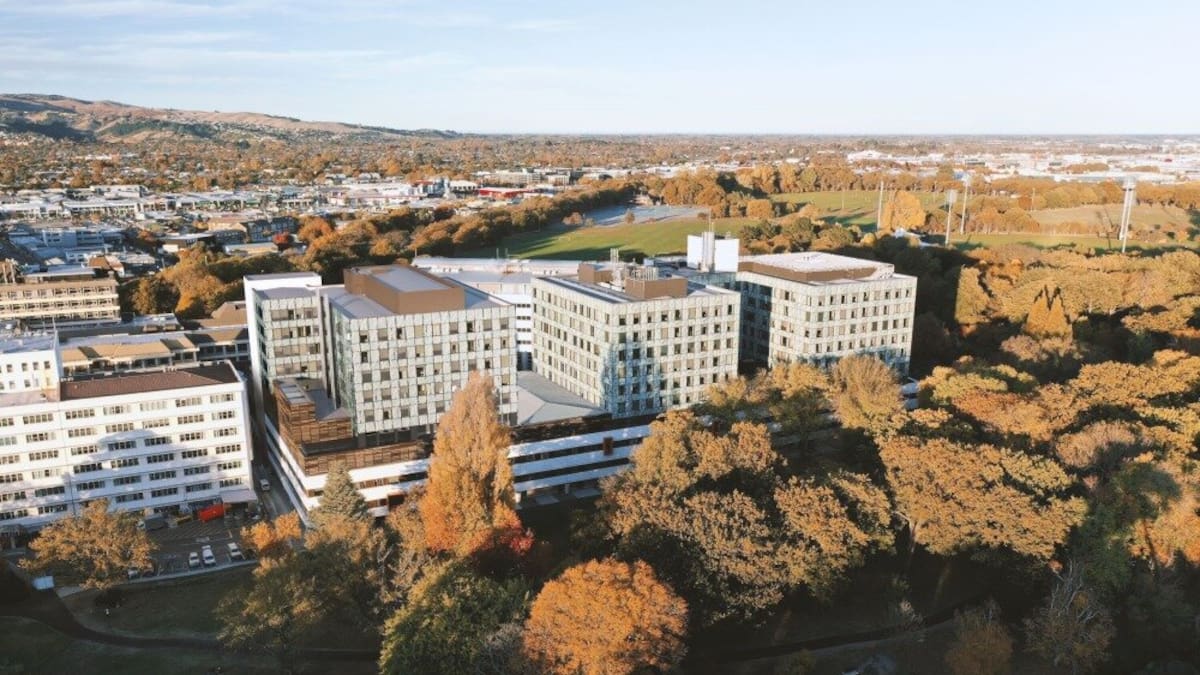
Tipped as one of New Zealand’s most important health and economic development stories, the precinct is located between Hagley Park and the central city.
It hosts more than 20 medical, education and research institutions, laboratories, public health facilities, clinics and campuses.
Emerging on the precinct’s fringes are commercial research, biotechnology, medical technology, laboratories and advanced device manufacturing enterprises.
And being drawn to this intense health ecosystem of common interest – and by Christchurch’s growing reputation as New Zealand’s city of choice – is a highly qualified workforce, along with investors with deep pockets.
Health is a big deal. People forget health is 10% of our national GDP and 11% of our workforce – it’s the biggest game in town.
Peter Townsend
Ensuring more people take notice will be the official opening on September 18 of the seven-storey Wai Ora building.
The $292 million new home for the University of Otago’s 52-year-old Christchurch campus will consolidate staff from 11 scattered buildings into one site. The campus’ teaching space will expand by 20%.
Departments and research centres that have worked separately will now be alongside each other, creating more opportunities for interdisciplinary teaching, research and innovation, says Professor Suzanne Pitama, head of the university’s faculty of medicine and project owner for Wai Ora.
“Bringing together clinicians from areas such as psychiatry, general practice and other specialities alongside our academic teams will strengthen connections between research, education and clinical practice.”
The building will host expanded research labs, an enhanced clinical trials unit and a six-bed simulation medical training centre.
Meanwhile, Health New Zealand continues to invest in the precinct’s clinical anchor, Christchurch Hospital, and the wider health precinct.
Current projects include Waipapa Tower C, adding around 16,000sq m and capacity for 160 more inpatient beds, the Christchurch Hospital endoscopy expansion, and neonatal care improvements.
Together with developments already delivered, these projects represent more than $1b invested in Christchurch’s public health infrastructure since the earthquakes, says Health New Zealand executive regional director, Pete Watson.
He says the precinct will help develop the future national health workforce.
“Its close links between healthcare, tertiary education and research provide training, placement and development opportunities for thousands of students and health professionals across a wide range of disciplines.”
Delegates at the Christchurch Health Campus.
Christchurch Health Laboratories, one of the country’s two highest-tier reference laboratories, is also part of the ecosystem, supporting specialist testing, research and education, with benefits for the whole country.
Watson says the precinct’s value extends beyond infrastructure.
“It supports the delivery of regional and national services, helps develop New Zealand’s future health workforce and creates opportunities for clinicians, researchers and educators to work together to improve patient outcomes.”
The advisory council’s Townsend says the potential is “significant” for the precinct to be a national growth engine and a spawning ground for an internationally competitive medtech export industry.
“We’ve already got many companies well-established here – some really exciting companies like MARS Bioimaging and BioOra.”
He says the city’s dedication to an integrated health industry extended to it siting the $500m new metro sports facility Parakiore next to the health precinct.
“It was deliberately positioned there so there is a continuum between health and wellness. A lot of rehabilitation and preventative health work can be done at Parakiore.”
But how have Christchurch’s rebuild planners managed to get the different bureaucracies working together? And public institutions and private technology firms wanting to hold hands?
“Post-earthquake, we learned very quickly to pick up each other’s books and bricks to rebuild our city,” Townsend says.
“The common purpose was to recreate Christchurch, to create a modern city that would become New Zealand’s city of choice.
“And I think we’ve arrived. We have our differences, we still play our politics and we still protect patches but we have a common purpose to deliver a city that has the best offerings in New Zealand.”
Precinct participants say investment will be key to the precinct’s future success.
Townsend says that investment will have to come from the Government, local government and private investors.
“There’s a whole matrix of investment possibilities,” he says. “I’m very positive about the future because the more we can demonstrate we are making a difference here, the easier it gets to move forward.
“We’re right at the stage now where people are starting to take notice. They realise there’s something real happening here.”
Townsend doesn’t expect the bricks-and-mortar core of the precinct to expand.
“What it will do is act as a beating heart for health-related activity, health tech and health innovation to expand around it.
“The wider precinct will continue to develop. It’s already happening.”
Another cheerleader for the wider precinct’s powerhouse potential is economic development agency ChristchurchNZ.
Health tech growth sector lead Shawn Melley says the agency works with health and technology industry companies to help support their needs, whether they’re at start-up, early growth or established stage.
Some Christchurch-developed technologies require very specialised manufacturing processes and technical skills, he says.
Some of those skills aren’t available even within New Zealand, so the agency’s business growth teams will work with local universities to identify and help establish programmes to train graduates who can support these highly specialised companies.
“At the heart of all economic development are the obvious metrics of job growth and GDP growth, which really come from companies performing well, increasing their revenue to hire more people, doing more R&D, making more products, selling more products and exporting.
“So investor attraction is very important, helping these companies with capital. My job as a growth sector leader is to try to help bring it all together.”
Melley says when he talks to people about what makes Christchurch and Canterbury special he consistently hears about its history of bringing in innovation and integrating it into the health system to achieve better outcomes for patients.
“There’s also a willingness of leadership, wherever that leadership exists, to want to integrate technology.
“It is a close-knit community who wants to see this technology come in and help improve the lives of patients – and equally, not just patients, but the healthcare workforce.”
The precinct’s success as an economic engine and a future rich export hub will require health tech companies to grow at scale, rapidly, Melley says.
He cites cancer treatment cell therapy tech company BioOra as an example of what could be possible.
“BioOra sets up a manufacturing facility here. If they grow at scale quickly, that will bring in patients who will come to Christchurch for cellular therapy. Right now they’re travelling to China and the United States. They can instead come to New Zealand.
“So there’s potential medical tourism. Jobs will be created, not just from BioOra manufacturing but all the health requirements around it, at the treatment centre itself.
“Then if you get companies tangential to cellular therapy also coming here to support, they bring in more jobs and more revenue for the city.
“What we need to see happen within the health precinct is companies like BioOra establishing themselves and growing quickly.
“If they can do that it will have a huge impact on Christchurch and those revenue numbers will have an impact on the national economy as well.”
But does proximity always produce collaboration and productivity?
Melley says proximity to other sector participants is helpful.
“When you look at innovation generally, generational leaps in technologies often happen at the edges of multiple disciplines.
“I lived in Boston. Christchurch reminds me of Boston on a much smaller scale in that it has multiple universities. It has the University of Canterbury, which is very strong in engineering. The University of Otago medical school is here. You have Lincoln University.
“You have multiple universities in a very small area and an industry with areas of specialisation. That collaboration should generate significant innovation.”
Melley says to be successful, a health precinct requires a good health system with clinicians and healthcare workers solving problems and treating patients, using the latest technology.
It also requires universities to provide some of those technologies and industry to commercialise them, bring in the people and resources to expand and export them and raise international awareness.
“For this to be more than a good regional or national health precinct, you need all that working together. And you really need companies able to commercialise and scale to make it international.”
Venture capital investor Paul Muckleston says only time will tell over the next 10 years if Christchurch is building an internationally competitive health innovation cluster.
He’s a venture capital partner in MARS Bioimaging through Pacific Channel, which holds nearly 16% of the medtech firm on the edge of the precinct.
A director of several US west coast tech companies, Muckleston also leads the technology practice for a Denver-based mergers and acquisitions firm.
He likes that the precinct formalises movement of participants between academia, hospitals and commercial tech start-ups such as MARS.
“Some of the key people employed by MARS have come out of the universities of Canterbury or Otago. You see in some of the successful clusters in the US market, which I’m familiar with, these almost interchangeable roles people have between innovation and research at the university.
“Then, when they commercialise that, they often work with angel investors and other co-founders in a kind of community.
“Then that research or medical institution provides a great local concentration of really skilled professionals who you can tap on a part-time or full-time basis to come and do work with you.”
Muckleston also cites Christchurch’s advanced manufacturing resources as being attractive from an investment perspective once a med device is commercialised.
An ecosystem such as the precinct is a proven model, he says.
“By formalising it a bit more and making more people aware of what it is, it’s easier for future investment. You can see the same thing happening in Melbourne.”
An interesting start-up or pre-seed stage company near a precinct is more likely to be looked at by venture capital funds because it has supporting mechanisms like access to talent, employees, advisers and customers.
“If you’re able to put Christchurch on the map, you’re more likely to be able to tap into investors in Australia, for example, who are looking at Melbourne when they’re wanting to do more health tech investment. Why wouldn’t they then also look at what’s coming out of Canterbury?”
How internationally competitive the Christchurch model will be depends on time, execution, “a bit of good luck” and having the right quality founders and start-ups, Muckleston says.
“There’s no doubt that Christchurch and Canterbury are on fire right now in a good way.
“There’s high growth. People want to be there. The universities are attracting lots of students that previously went somewhere else. Now they want to be in Christchurch.”
Collaboration vital
Canterbury has been ahead of the game in recognising teamwork can offset a funding abyss when tackling massive health problems like cancer and degenerative joint disease, says a leading research professor.
Tim Woodfield, professor of regenerative medicine at the University of Otago’s Christchurch campus, says the rise of the city’s health precinct and the opening of the flagship building confirms the region’s legacy of taking a collaborative, multi-discipline approach to health problems.
Tim Woodfield, professor of regenerative medicine at the University of Otago’s Christchurch campus.
“A lot of the major problems in the world need to be addressed in a very multi-disciplinary or inter-disciplinary way. And to solve some of the new problems we’re going to come across.
“Research now isn’t where you see the biggest breakthroughs globally so much as when you have clinicians working with engineers working with social scientists who are then working with industry,” says Woodfield, who leads the Christchurch Regenerative Medicine and Tissue Engineering (CReaTE) Group and is director of the university’s centre for bioengineering and commercialisation of health technologies.
He says New Zealand’s small size means sometimes it can’t properly fund research into “massive” problems like cancer, degenerative joint disease, osteoarthritis and joint replacement.
But because it’s small, it’s agile and easier for researchers, for example, to access people in other disciplines, such as surgeons.
“I think this is the sort of legacy of Canterbury and this health precinct. We seem to have hit upon this idea of collaboration across lots of different disciplines,” says Woodfield.
“When I work overseas or in other hospitals or other centres, they say, ‘We never get to see a surgeon’ or interact with others. But in Canterbury we seem to have been doing that really, really well.”
Woodfield says the long-planned new university building and the health precinct are going to strengthen and accelerate “some quite groundbreaking stuff that’s happening”.
He predicts an increase in the scale and impact of work from within the building and the precinct, particularly in the clinical and commercialisation areas, with more medtech companies collaborating; and with more rapid trialling and testing of research results, involving clinicians and bioengineers.
The new seven-storey, fit-for-purpose building will have state-of-the-art laboratories for multidisciplinary research, from complex chemistry to pilot-scale manufacturing and the latest tools for molecular discovery, Woodfield says.
It has the latest pre-clinical facilities for analysis, testing and imaging to help develop technologies, and a six-bed ward simulation suite – “a really important research space” mirroring a ward in the new hospital across the road.
Woodfield says an example of the benefit of having multiple components of the health ecosystem interconnected is the free-flow discussion possible between a cancer researcher, a cancer clinician, an orthopedic surgeon involved in a tumour removal, and a bioengineer with an idea for a minimally invasive surgical approach to treating cancer.
Importantly, the work in the university and the precinct will attract more industry – companies commercialising research results.
“That’s the really big thing for New Zealand. We need to be doing inter-disciplinary research that’s then transitional. Transitional means getting it to patients.”
People may imagine a new drug or medical technology can just be administered by a surgeon, he says.
“But there’s lots of regulatory stuff and you need investment to make it happen. It’s a complex process and a university doesn’t fund it or develop something that goes into a patient necessarily.
“It’s often a company that comes and does it. So the opportunity of the building and the precinct is being able to take all of the innovation and accelerate or catalyse it.”
-On the other hand, Woodfield notes that often medtech and biotech companies don’t have the funding or pilot-scale manufacturing or access to medical device regulatory expertise.
“It’s very costly for them to build their own lab when they’re not sure if the technology will work. This is where the Wai Ora building and the precinct is vital.”
However it’s not a case of “building this and they will come”, he says.
In other countries, including Australia, the model of thinking that putting all the right people together will bring industry into an innovation centre has failed.
“There are lots of examples where that doesn’t work because it’s built around what people think industry and the market is looking for, or what they think health technologies will be – rather than having a space tuned or tailored around enabling what industry is looking for.”
Woodfield says the approach in Christchurch is to harness the capability in Canterbury for all of New Zealand and focus strongly on a major opportunity for international investment.
A big year for bioimagery
It’s been a very big year for MARS Bioimaging, a rising star of Christchurch’s vibrant emerging health precinct Te Papa Hauora.
The private medtech company, founded by two bluebloods of the city’s science and medical communities, closed an oversubscribed $15 million capital raising, became the first CT scanner-maker out of New Zealand to gain US Food and Drug Administration (FDA) clearance, made its first major sale to a New Zealand clinical practice and is preparing to launch a subsidiary in the US, its primary focus market.
MARS scanner in use.
Co-founded by Phil Butler, a former physics professor and leading researcher at the University of Canterbury, and his son Anthony Butler, a professor of radiology at Otago University and a consultant to Christchurch Hospital, MARS has developed the world’s first commercially available portable spectral photon-counting CT (computed tomography) scanner for point-of-care use and clinical research.
Point-of-care use means hospital-grade imaging delivered directly in patient clinics, research labs and community healthcare sites. Unlike traditional CT scanners, which produce low-resolution black and white images, MARS’ technology measures in colour every individual X-ray photon as it passes through the body.
With international capital now backing its expansion and commercial adoption accelerating, the company is emerging as one of Christchurch’s most globally significant health tech success stories, says economic development agency ChristchurchNZ.
Its colour X-ray technology is exclusively licensed to MARS from CERN, the world’s largest particle physics laboratory and operator of the Large Hadron Collider.
MARS group chief executive Dr Ojas Mahapatra says FDA clearance was a big milestone.
“Now the company has a strong commercial footing in the clinical marketplace, you will see us pop up a lot more in the US clinical market setting.”
MARS Bioimaging group CEO, Dr Ojas Mahapatra
Revenue-earning but yet to make a profit, MARS is merely “weeks” away from launching a US subsidiary, he says.
“We just want to get our beautiful technology out into the clinics where it’s actually making a difference to patient care.”
For medtech, the health precinct is a “very vibrant ecosystem”, Mahapatra says.
While participants are diverse and immersed in their own work, proximity offers the opportunity for helpful discussions on markets.
But does the health-focused cluster have the potential to be a regional, or even national, economic growth generator?
“The potential is definitely there. If a company, or a group of companies, do well, we are bringing in a lot of investment capital to Christchurch. There are a lot of companies doing capital raises and it brings a lot of capital into the ecosystem,“ Mahapatra says.
“Investor interest becomes concentrated. Also, we are feeding off each other’s publicity. A sports team becomes successful when there are individual performances. If MARS Bioimaging becomes successful, the health precinct becomes popular.”
Being in the precinct helps attract and retain skills.
“There is a lot of dissemination of engineering information – there is that inter-disciplinary knowledge exchange. For people who understand the medtech ecosystem it is extremely helpful having that concentration in a small area.”
MARS isn’t Christchurch-based just because it’s home to the founders.
“Christchurch has a very rich manufacturing heritage. We are able to build our devices here for the next generation of devices, we’re able to prototype really fast,” Mahapatra says.
Hand and Wrist bone and soft tissue. MARS imaging.
“We have seen a lot of American and European talent wanting to come here. There’s a new city centre. Bringing that talent in improves your team and investors invest in a team, always.
“Christchurch as a city is extremely vibrant. I’d be bold enough to say it’s the place to be in New Zealand right now.”
Medical tourism
Christchurch won the prestigious job of hosting manufacturing for next-generation cancer cell treatment pioneer BioOra because it was the only city able to satisfy a very long, very demanding list of requirements.
Opening on the edge of Christchurch’s Te Papa Hauora health precinct next month, BioOra’s high-tech CAR-T cell immunotherapy manufacturing facility will put the city on the map as a serious support player in the biotech world.
The facility will manufacture personalised CAR-T cell treatments for blood cancers.
CAR-T cell therapy is a one-off cancer treatment that works by redirecting a patient’s own immune cells (T-cells) to directly identify and attack cancer cells.
BioOra will use automated manufacturing platforms to scale production safely. Its work builds on research from the Malaghan Institute, an independent biomedical research institute based in Wellington.
BioOra chief executive John Robson.
BioOra chief executive John Robson says the company needed a high clinical-grade facility and was running out of options when Christchurch delivered.
“We needed to be near a major hospital. We needed the infrastructure to support the medical and clinical complex manufacturing for our business. We needed a public treatment hospital. We needed private hospitals for expansion, primarily for medical tourism.
“We needed a medical school. We needed an engineering school. We needed infrastructure adjacent to health centres, and we needed to be able to access students for training and tertiary education for nurses, doctors, engineers and scientists.
BioOra.
“And, really important, we needed an airport with international flights. A big part of our business case was that once we’re successful as a business supplying therapies to New Zealanders, these therapies are going to be highly sought-after. We needed it to be easy for people to come into this country for private treatment.”
BioOra gave its list to economic development agency ChristchurchNZ and the rest is history.
“The health precinct was the main catalyst for us because we need scientists, nurses and an ecosystem that is already enabled. We could come in and be a catalyst for further growth,” Robson says.
The only box the city couldn’t tick was appropriate existing labs. So the company built its own on leased land edging the medical school. Four main laboratories will each house six manufacturing cocoon platforms. Each device produces a single dose for a patient.
BioOra. Four main laboratories will each house six manufacturing cocoon platforms. Each device produces a single dose for a patient.
“We’ll get about 150 doses a year from our initial set-up, then as we bring on stream other laboratories, we’ll get up to 400 doses from that site quite quickly – and 400 doses would be more than the doses required to treat every New Zealander for the disease we’re first going to market with, which is acute large B-cell lymphoma,” Robson says.
BioOra currently employs 68 staff between its operations in Christchurch, Wellington and Brisbane. Robson says over time, around 50 new roles will be created in Christchurch.
BioOra. Four main laboratories will each house six manufacturing cocoon platforms. Each device produces a single dose for a patient.
The company has raised around $23m from private capital and “some very key investors”, and a current round has raised more than $20m of the target $45m.
The new capital will fund the completion of Christchurch facilities, the transfer of technology to Brisbane for manufacturing there and a technology transfer to the US for pediatric use.
The Queensland Government has chipped in A$7.7m to help with the Brisbane transfer.
“We haven’t received anything in New Zealand,” Robson says. “It’s just a matter of getting cross-party agreements as to which treatments.
“They can continue to fund old-style treatments, which soak up heavy resources, nursing and doctors and take three or four years of treatment cycles versus more high-cost therapies like this, which are one infusion and you’re done.”
Robson has no doubt Christchurch’s health zone could be a genuine economic growth engine for the city and New Zealand.
“These therapies are really difficult to make and therefore are expensive. The expertise needed to manufacture is pretty unique. No one else has really done it in New Zealand.
“Christchurch is able to expand and not just manufacture this therapy, but lots of different therapies. In other words, as BioOra grows and we start to develop different therapies for different cancers, we can leverage this huge investment into the infrastructure – not just our own infrastructure but the health precinct itself.”
Read more stories from the Herald’s Project Canterbury special report here.