
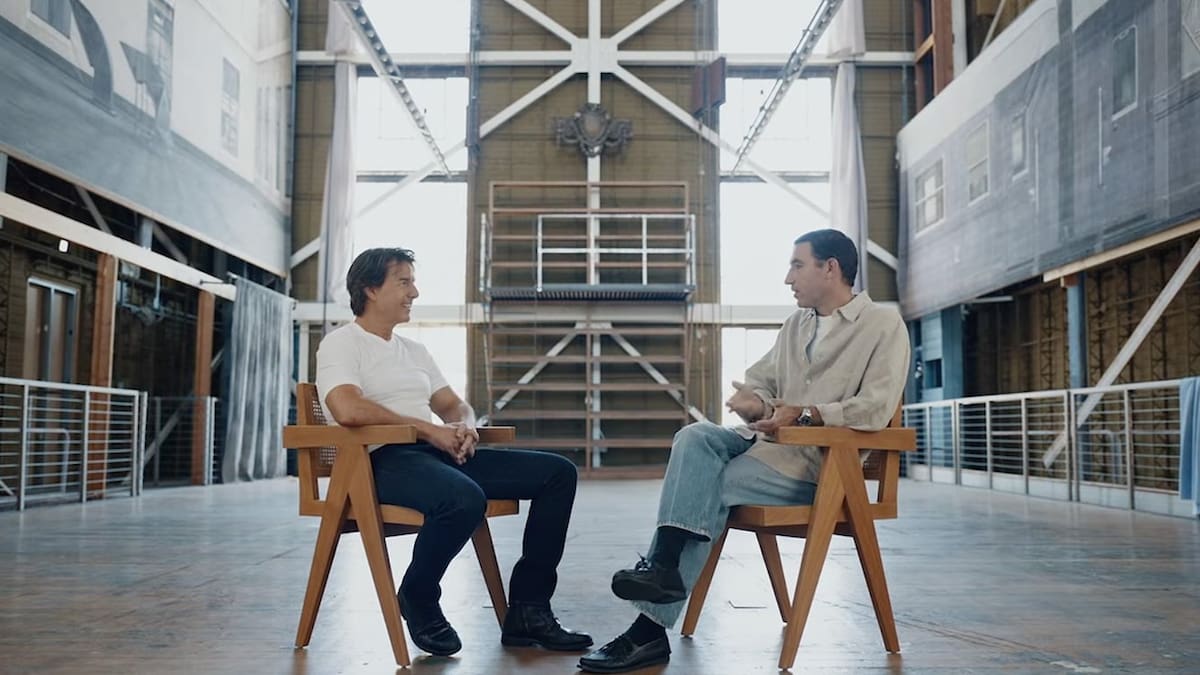
Q: How did this come about? Because, as you noted, Tom Cruise does not do many or any sit-downs.
Baron: The way it came about was that we asked and he said yes. I know that’s a somewhat boring answer, but that’s what it boils down to.
Q: When he says yes, do you try to figure out, “Why is he doing this?”
Baron: You’ll notice that there’s a part in the interview where I ask about this, and people can listen to his answer and see if it makes sense to them or not. If I’m honest, I’m still not sure if I know the answer.
Q: Many of us felt that way. You also ask him about turning 64 and, specifically, “Does that mean anything to you?” He says, “It means I’m 64.” And when you ask why he’s doing the interview, there’s this rambling answer that includes an odd observation that “when people see a movie, you want it to look easy”, and then he’s off talking about going to Prague and China and Dubai.
Baron: You see me, I followed up twice to get an answer there.
Q: Zach, I’m going to preface this question by saying your work has always struck me as quite remarkable and well done. That said, this interview drove me a little bonkers, and I know that I’m not alone. And it makes me think: What do you do in a situation where you have this rare opportunity to get time with somebody who doesn’t ever do interviews, but they basically evade your questions?
Baron: This is maybe a bigger topic than the one you’re writing about today, but you and I both know that journalism has moved toward this style of video interviewing or podcasting, and I actually think in this case it’s really valuable. As a print journalist, it can sometimes be hard to communicate an interaction like the one that you’re describing and the one I experienced. The cool thing about this one is everybody can kind of watch it … You get a lot of information that isn’t always in the form of a quote, which is how Tom and I are interacting and his body language. What is the pause like? What is his laugh like? What do his face and his eyes look like? This is all, I think, really fascinating.
Q: So when you’re sitting there doing that, you know you have cameras on, are you at all tempted to say: “Tom, let’s just stop right here. You are not answering anything.”
Baron: I don’t really think there is a right way for a subject to handle an interview. You can look at me and what I ask and what I don’t ask and the job I do. But you’re asking what I think in that moment. And what I’m thinking is, “This is how this person is responding,” and I’m not judging it much one way or another. And when I say that, I mean that genuinely. I genuinely respect people’s right to answer how they want to answer. I find the way that they answer questions often as illuminating as what they say. And in the case of Tom, I found the way he answered those questions to be quite illuminating, even if you are correct that there are moments where he’s not directly answering my questions.
Q: I also saw a post from a journalist who was not happy that you didn’t mention Scientology or his daughter Suri, among other things. I’d also like to hear about Cruise’s feelings toward Trump or anything political. You didn’t bring up any of this. Were you tempted?
Baron: One of the things I did for this interview is just prepare and read every interview Tom Cruise has ever done. And he’s actually kind of talked extensively about this stuff. I get people’s interest in it. I think that I was trying to have a conversation that was oriented around this modern moment and him as a movie star. Him as a reclusive famous person, him as an object of fascination for a generation. I understand that people kind of want to see him jump on the couch again or have a kind of tabloid moment, where maybe he gets angry or something. I think there’s plenty of moments in this interview where you actually can see him get pretty frustrated. But that wasn’t really the thing I was after.
Geoff Edgers, The Washington Post’s national arts reporter, covers everything from fine arts to popular culture. He’s the author of ‘Walk This Way: Run-DMC, Aerosmith, and the Song That Changed American Music Forever’.