
“A lot of athletes can identify, ‘Okay, I can spot the chaos and see where I’m going to get drawn into it.’ Sometimes they do get drawn into it naturally. It’s having the skills to come back into the middle of it.”
Wilson holds a PhD in Performance Psychology from the University of Wales and has worked with several of New Zealand’s national teams, including the Black Ferns Sevens, the Silver Ferns and the White Ferns. She is now walking alongside the One New Zealand Warriors.
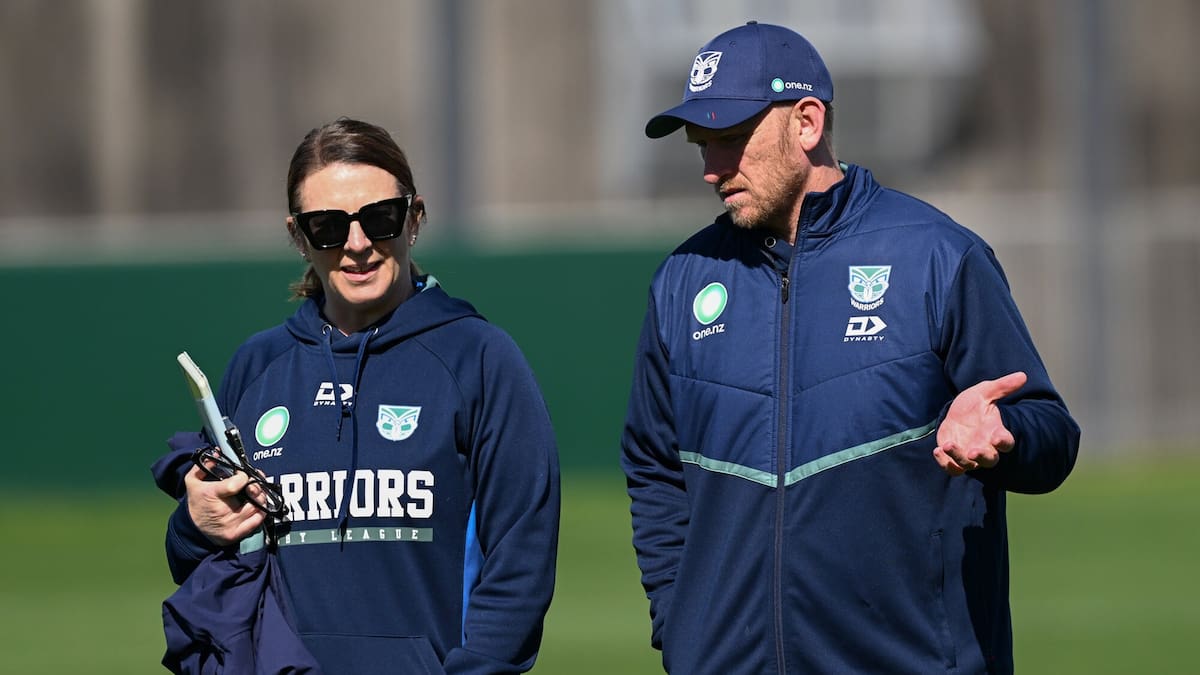
At the Warriors, that means working closely with head coach Andrew Webster, who Wilson describes as one of the most psychologically minded coaches she has worked with.
Mental skills consultant Kylie Wilson with Warriors coach Andrew Webster at training. Photo / Photosport
“He and I will do quite a lot of brainstorming and sharing of ideas and strategies of how we might integrate things, and he will lead it. I will just support his leadership of that, and it feels really integrated.”
Players work in different groups depending on their experience, skillset or areas they want to develop, whether that is proactive performance-skill development or more reactive support.
Wilson, with Webster, works with those groups each week and is also available for players who want to engage in one-on-one sessions. But mental skills aren’t just called upon when things are going wrong.
“It’s important to organise and set up systems and ways of working that set up the likelihood of high-quality performance.”
When a team is going well, Wilson says, finding the eye of the storm can be just as important. The noise might be positive, but it is still noise.
It’s something she has seen first-hand during her two years with the Warriors, as the team has experienced significant positive attention and expectation, much of it being absorbed by a relatively young playing group.
Kylie Wilson: “It’s just harder for young people to shut noise out.” Photo / Photosport
“It’s just harder for young people to shut noise out, to be disciplined enough to keep focusing on the thing that’s going to help you stay grounded.
“It’s not like they’re going to nail it 100% of the time, but it’s certainly part of our environment, naming those traps.”
Curious and observant about human nature from a young age, Wilson’s introduction to sports psychology came through her own experience as a high school rower.
“Without knowing it, I was exposed to mental skills work because of my high school rowing coach. We learnt relaxation techniques and breath work at a young age.”
One exercise in particular stayed with her, rowing with her eyes closed and paying attention to the sound of the oar hitting the water. It sparked a curiosity about the role the mind could play in performance.
As a physical education student at the University of Otago, Wilson began to see the possibilities of mental skills work through her studies.
At the same time, she was playing rugby for Otago University, giving her the opportunity to test on the field what she was learning in lectures.
An opportunity to undertake a PhD at the University of Wales in Cardiff took Wilson overseas and also connected her more deeply with the Welsh side of her family.
Mental skills coach Kylie Wilson at the Tokyo Olympics.
Working under leading sports psychology researcher Lew Hardy, Wilson completed her PhD in motivational climate, examining the relationship between an athlete’s motivational profile and how well it aligned with that of their coach.
Her PhD was funded by British Gymnastics, which also involved part-time applied work within the sport. For a novice practitioner, it was straight into the fire.
“In the gymnastics environment at the time, there were a lot of power differentials, particularly the coach-athlete dynamic and it quickly taught me about the role of power. How do you empower people to own their own journey?”
Working with young gymnasts who were centralised, training fulltime and operating in a highly pressured environment also shaped Wilson’s understanding of her role.
“It made me realise my role as a provider was to bridge the gap between athletes and coaches.”
While in Wales, Wilson coached and continued to play rugby, eventually earning 53 caps for Wales. Coaching the university rugby team also gave her another environment in which to experiment with the concepts she was studying.
Kylie Wilson: “How do you empower people to own their own journey?” Photo / Photosport
Living away from home and working through her own sense of identity gave her an understanding she would later draw on when working with young athletes entering professional programmes.
“I have a real empathy for how challenging growing up and figuring out who you are can be – but trying to do that when there’s a huge amount of scrutiny and pressure, eyeballs on you, standards and demands that are really stretching you beyond where you’re naturally capable.”
Through her work in the UK, Wilson realised how much she loved the applied side of performance psychology, being alongside athletes and teams rather than university lecturing and research.
Returning to New Zealand, she joined High Performance Sport New Zealand and was able to fully immerse herself in her craft.
She also noticed a different attitude towards engaging with a sports psychologist or mental skills coach.
“People who came before me, like Gary Hermansson, Ken Hodge, Dave Hatfield and Gilbert Enoka, set a real openness to the work for our current generation of practitioners. Coaches and athletes in New Zealand have embraced mental skills. In the UK, it felt more difficult.”
For Wilson, the work isn’t about walking into a team environment with all the answers.
Instead, she starts by observing, understanding the environment, its people and where the opportunities for collaboration might sit.
While Wilson spends her professional life helping others navigate chaos, becoming a parent provided an unexpected opportunity to test some of those skills herself.
She laughs that nothing has tested her quite like it.
Despite being comfortable operating in the grey areas of performance psychology, Wilson quickly discovered she had a high need for control or, more accurately, she hated chaos.
“I thought if I could control the chaos, that would eliminate some of it, so that was a great test for me. I had to start practising what I preach more!”
Now with her children approaching their teenage years, Wilson looks back on the support she received while working in netball when they were young.
She remembers one staff meeting where four women around the table were breastfeeding, an image that has stayed with her as an example of an environment where motherhood and high-performance work could coexist.
Parenthood, she says, has also been a great reality check at home and one that has ultimately helped her professionally.
It perhaps reinforces the broader message behind Wilson’s work: these aren’t skills reserved solely for elite athletes.
Alongside fellow performance mindset coaches John Quinn and Jason McKenzie, Wilson is bringing that thinking to a wider audience at the Performance Mindset Conference on October 10, in Auckland.
The full-day programme will bring together athletes, coaches, parents and practitioners with the aim of building a greater understanding of mental skills, how they can be integrated into sports performance and ultimately how they can help in life.
Because whether it’s a packed stadium, a young athlete finding their way in professional sport or simply the chaos of family life, Wilson’s analogy remains the same.
You can’t always stop the storm swirling around you. But you can develop the skills to find your way back to the middle of it.
This story was originally published at Newsroom.co.nz and is republished with permission.