
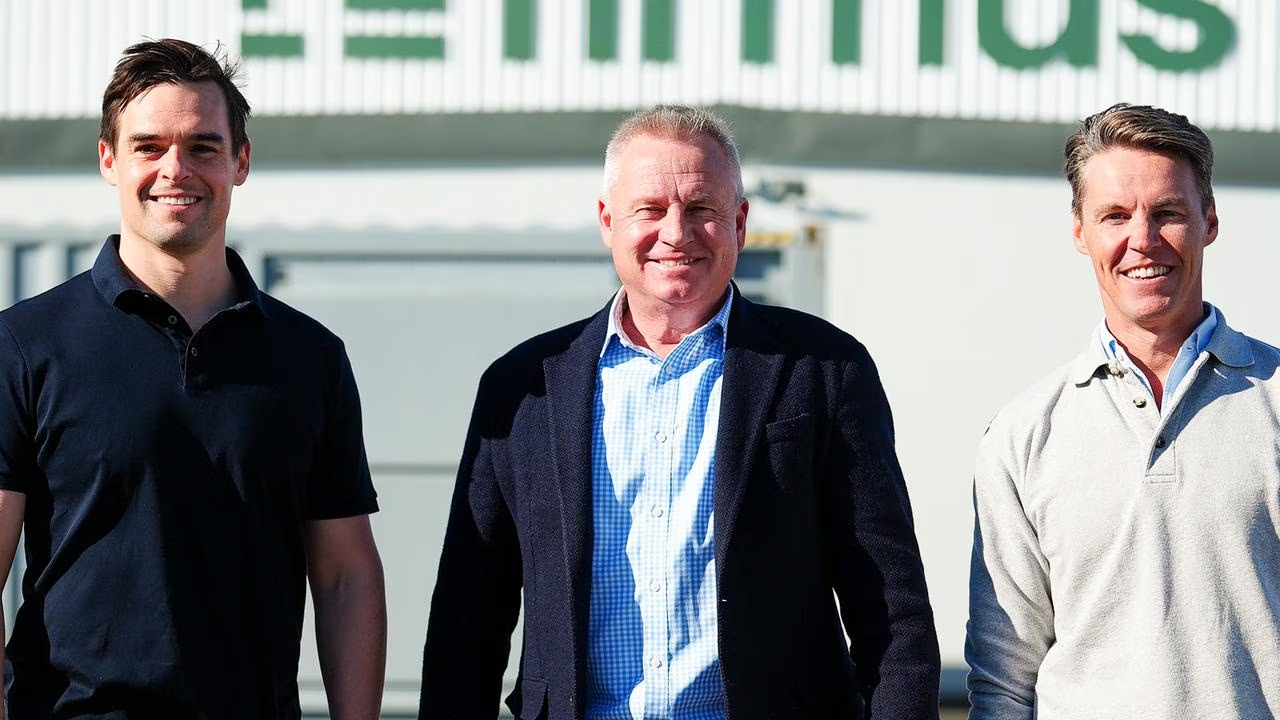
Australia is on the brink of its very own SpaceX moment that could significantly change the nation’s global standing as the AI revolution picks up pace.
Homegrown artificial intelligence infrastructure giant Firmus Technologies is preparing to launch on the ASX in what promises to be the largest float on record — as one of its well-known co-founders and husband of PR maven Roxy Jacenko looks to complete the ultimate redemption story after spending 12 months in jail a decade ago.
Want more finance news? Download our new app for even more coverage
With brokers speculating the company’s market capitalisation could reach an eye-watering $50 billion, the company could soon be worth more than Australian retail giants Woolworths and Coles combined if the IPO, slated to go live in October, is a success.
Much like SpaceX revolutionised rocket launches by manufacturing hardware in-house, Firmus is rewriting the rule book for how artificial intelligence is powered.

The company builds what it calls “AI Factories” — ultra-dense, specialised computing facilities purpose-built from the ground up to train and scale complex AI models.
Rather than relying on traditional data centres that act like giant airconditioned warehouses sucking up massive amounts of grid electricity, Firmus designs its hardware, software and physical buildings in tandem.
Manufactured and prefabricated in regional NSW, its HyperCube platform uses advanced liquid cooling systems to cut energy consumption significantly while halving construction costs. Firmus calls this vertically integrated approach “dirt to token”, regulating power usage in real time like a massive battery — a groundbreaking engineering feat that has captured the attention of the world’s biggest tech and financial powerhouses.
American chip giant Nvidia holds a 7.2 per cent stake in the business, while global investment behemoth Blackstone has bankrolled its rollout with a $7 billion loan facility that could rise to $14 billion, alongside a 6.7 per cent equity stake.
As the company prepares for its landmark initial public offering, mum-and-dad investors are lining up to get a slice of an Australian firm that has transformed itself from a pre-pandemic bitcoin mining operation into a global infrastructure titan.
Mega-deal puts Aussie tech on the world map
The momentum behind the upcoming float reached fever pitch following a landmark multi-year strategic partnership with OpenAI.
The creator of ChatGPT has signed on as an anchor customer, contracting dedicated compute capacity from two of Firmus’ upcoming AI Factory sites in Malaysia.
The high-profile deal pushes Firmus’ total contracted customer capacity past 900 megawatts across its portfolio, which spans seven AI factories in four countries including Australia, Singapore, Indonesia and Malaysia.
Under the contract, Firmus will deploy Nvidia’s next-generation Vera Rubin accelerated computing platform at scale across the region.
The facilities will integrate Nvidia’s Vera Rubin NVL72 rack-scale systems directly with Firmus’ NSW-built HyperCube units to maximise performance and capital efficiency.
Firmus co-founder and co-chief executive Tim Rosenfield said the deal represents a seismic shift for the nation’s technological standing.
“This multi-year partnership marks the moment Asia-Pacific becomes a producer of intelligence, not just a consumer of it,” Mr Rosenfield said, adding that Firmus has spent seven years building a footprint that runs from southeast Asia to Australia.
OpenAI vice president of compute strategy Sachin Katti echoed the excitement, saying the new facilities will help serve growing demand for OpenAI’s products across the region and around the world.
Meanwhile, Nico Caprez, vice president of global AI infrastructure growth at Nvidia, highlighted that Firmus’ HyperCube platform will help bring advanced capacity online faster while producing intelligence at industrial scale.
Alongside its international expansion, Firmus has announced plans to establish an Australian AI Access Program. The initiative aims to provide eligible local researchers and organisations with access to high-performance compute capacity for critical fields such as science, agriculture, energy efficiency and climate resilience.
From jail cell to a $1.2 billion AI fortune
Behind this multibillion-dollar juggernaut is one of the most remarkable redemption stories in Australian business history. Co-founder Oliver Curtis, who owns a 13 per cent stake in Firmus, has landed squarely on the Australian Rich List with an estimated personal fortune of $1.25 billion.
A decade ago, Mr Curtis was at the lowest point of his life. In 2016, he was sentenced to two years in prison — serving 12 months — for his role in a $1.43 million insider trading scheme committed alongside his former Bondi roommate and school friend John Hartman.
The duo relied on encrypted BlackBerry messages between 2007 and 2008 to trade on illegal share price shifts when Mr Curtis was just 21 years old.
By the time he was sentenced nine years later, Mr Curtis and his wife, PR entrepreneur Roxy Jacenko, who had nothing to do with the crime, were two of the most public figures in the country.
Now aged 40 and living in Singapore with Ms Jacenko and their two children, Mr Curtis views Firmus as his shot at redemption.
Speaking candidly on the Rampart Talks podcast with Joe Aston earlier this year, Mr Curtis acknowledged the “gravely stupid” mistakes of his youth.
“20 years ago, I was a young man, a very young man, for that matter,” Mr Curtis said.
“I was silly, I was stupid, and I made a mistake … If I had my time again, of course I’d do different things, naturally. I absolutely know the impact this has had on my life, on my family’s life, on the business’s life.”
Mr Curtis reflected quietly on the emotional toll of his imprisonment during the interview.
“I don’t think there’s a harder thing to do in life than kiss your kids goodbye not knowing when you’ll come back,” he said.
“I’m a pretty tough individual, but it makes me weak at the knees just thinking about it.”
For Mr Curtis, building Firmus alongside his cousin Mr Rosenfield and father Nick Curtis — who own 5.4 per cent and 5.6 per cent respectively — is about setting an example for the future.
“Redemption is not about an ‘f you’ situation to turn around and say ‘f you’ to everybody,” he said.
“It’s more so about turning around and proving that redemption is based off making sure that you can set an example for your children, that you can continue to build a successful business, that you can be taken seriously to deliver on what is a fantastic opportunity.”
The hurdles ahead
Despite the eye-watering projections and blue-chip backing, Firmus still has to prove to prospective public investors that it can turn its massive ambitions into delivered infrastructure. Right now, the company has only two operational sites: a small 5 megawatt facility in Singapore and a 42 megawatt centre operating inside a Melbourne building owned by CDC Data Centres, where Meta is a key customer.
The company’s remaining footprint relies heavily on hitting aggressive development goals over the next 24 months.
While projects in Tasmania have secured development approvals, Firmus is also eyeing a massive project near Gulgong in central western NSW.
Dubbed “Stubbo”, the proposed site would sit adjacent to a 400 megawatt solar farm operated by Philippines conglomerate Ayala. If completed, Stubbo would push Firmus’ total planned capacity to a massive 3.2 gigawatts — almost double Australia’s entire existing data centre capacity combined.
However, building at this scale comes with immense operational challenges. Traditional data centres face mounting backlash from local communities worried about strain on power grids and soaring water consumption.
While Firmus’ liquid-cooled HyperCube technology offers significant environmental savings, the company must still navigate tightening approvals, power grid capacity, material cost inflation, and securing space on subsea cables required to transmit data overseas for global clients.
With investor roadshows underway and global tech giants watching closely, Firmus could be about to make history.
If it can execute its vision, it won’t just break ASX listing records — it could redefine Australia’s place in the global technology ecosystem forever.
Read related topics:Woolworths