
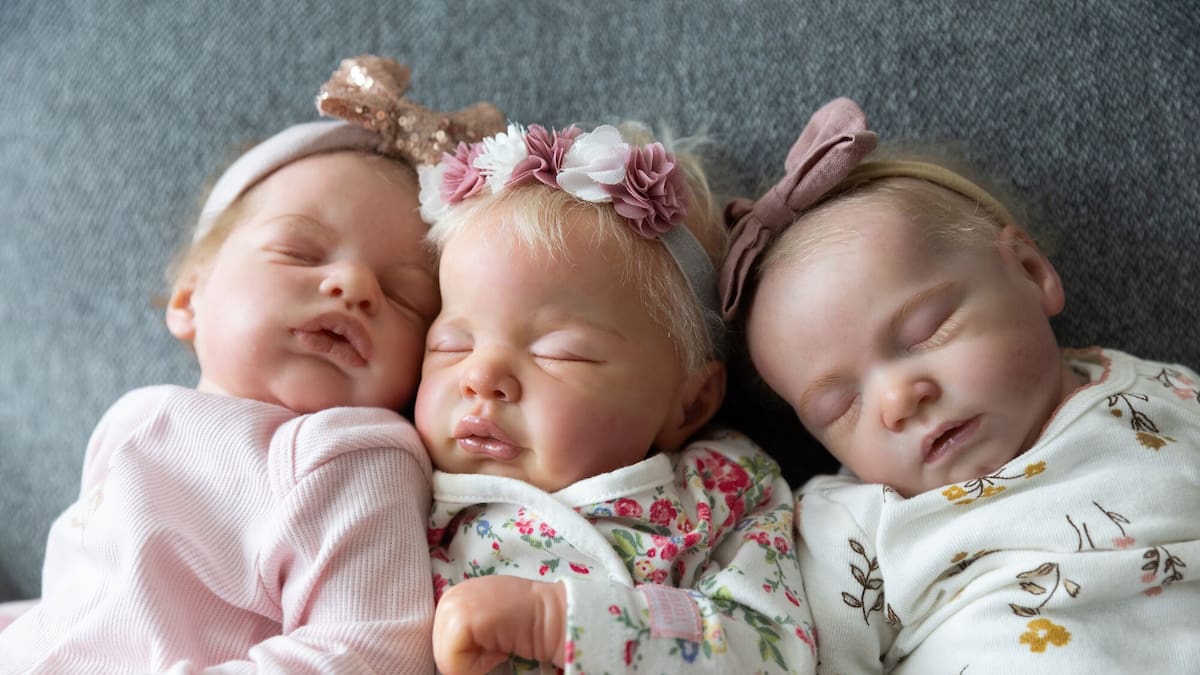
Nicola Vine started collecting reborn dolls six years ago. Photo / Anna Heath.
Reborn dolls, which look and feel remarkably like real babies, usually newborns, emerged in the 90s when United States doll enthusiasts started taking baby dolls and adding realistic features.
“The early reborners would get a play doll … pull them apart, repaint the facial features, usually add a wig and a cloth body, blush them and paint the fingernails – that’s about it”, Lower Hutt reborn doll artist Ngaere Thomson, 67, explains.
Today, the process is often more detailed to achieve a realistic look. And the industry is worth tens of millions globally, with some dolls selling for close to $20,000 overseas.
In New Zealand, the reborn doll community of artists and collectors is small, but growing. Dunedin-based reborn doll artist Annabel Clark says her reborn doll creations have been “selling like hotcakes” and is now looking at branching out to international markets. A private Facebook group for New Zealand-based traders has more than 1600 members.
Reasons for wanting a lifelike baby doll can be deeply personal and varied. For some, they are works of art. Thomson, for instance, has 40 reborn dolls in her private collection and says she “just likes to look at them”.
Others may use them as healing tools, sometimes calling them “therapy babies”, after experiencing trauma such as pregnancy, baby loss, infertility or to help alleviate anxiety.
The artists: ‘A really lovely experience’
For Clark, 37, the dolls are “a hobby that’s also therapy and a real interest”.
Clark, who has been making reborns for nearly half her life, says the therapy is twofold.
“I find the actual process – the painting and the creating – very therapeutic.”
She is an anxious person, and holding a doll has a grounding effect.
“When the reborn baby is complete, and you get to dress it up like a baby and hold it, because they’re weighted … and you get to cuddle that baby, it’s very calming and a really lovely experience.”
Clark and Thomson, who have their own children, are largely self-taught in their artistry. When Clark first started, she read books and watched tutorials, but now there’s more free content available online.
“I know in the US you can actually go to in-person events … But there isn’t really the capability of that in New Zealand yet.”
Making reborn dolls is especially tedious for NZ artists, who struggle with limited local supplies.
After a commission, Thomson explains she buys a blank kit or clay sculpt of the facial features and size the customer wants, paints up to 20 layers of skin tones, then details the fingernails, shading and blushing. Most sculptors and specialised paint brands have to be imported, making the process slower and costly.
But the most laborious part is the baby hair, which is either painted on or rooted using mohair. For the latter, Thomson charges at least $200 more, “because it’s rooted individually with a felting needle, quite often one [strand] at a time, which can take a few days”.
The great-grandmother of two says a vinyl doll can take her a week to complete if working full time, while part-time hours may take her up to a month.
Artist Ngaere Thomson says she’s always been interested in dolls. Photo / Mark Mitchell
Each doll is unique and many are custom-made, so prices vary. Silicone reborns cost thousands. But most opt for vinyl, which typically costs less than $1000 and is faster to make. Thomson sold the vinyl reborn she’s about to work on for $950.
“But I’m probably one of the cheaper ones.”
With the rise of low-cost online marketplaces like Temu and AliExpress, artists say “counterfeit” reborn dolls – when sellers take real sculpts, copy artists’ existing designs, and sell them for a fraction of the price – have affected local demand.
“So much hard work goes into these sculpts – [people] get really ripped off by certain websites,” Clark says.
For an experienced enthusiast, telling the difference between an authentic and a knock-off reborn doll is easy.
“You notice [knock-offs are] a lot lighter; they’re a lot stiffer, the joints don’t move as much,” Vine says.
Thomson has around 40 reborn dolls in her private collection. Photo / Mark Mitchell
The collectors: ‘People shouldn’t have any shame’
Without her reborn dolls, Vine says her life would “feel kind of empty”.
Vine was in her mid-20s when she suffered her first pregnancy loss. Then it happened again. And again.
“It was quite rough,” she says.
Later came postnatal depression. After the birth of her second child, now 5, she knew she didn’t want to carry more babies. But she enjoyed the feeling of having them. Six years ago, she started filling this lingering desire with almost eerily real reborn dolls.
Vine has five reborn dolls in her Christchurch home, including Lulu, who Clark designed. The most she’s spent on one is about $700.
“They fill that void of wanting another child,” she says. “I know they’re not going to ever replace having a child, but they fill those empty arms.”
But the dolls aren’t simply for her healing. Vine says they are also a way to bond with her young daughter.
“She helps me with them, brushes their hair, and we’ll dress them in their little pyjamas,” Vine says.
Three of Vine’s collection of reborn dolls. Photo / Anna Heath
For Tatiana Lane, dolls provide a “safe place”.
The Wellingtonian retiree wanted children more than anything in the world. She also suffered from severe endometriosis.
By the time she was 35, doctors had removed both her ovaries – one of which had a 5cm cyst – and her uterus. After the hysterectomy, she was seated next to a patient awaiting an abortion. She was heartbroken.
Lane, now 53, may not be able to have kids, but she has more than 80 baby dolls. More than half are reborns. She says she’s spent at least $20,000 since she began collecting six years ago.
“Every single baby has something different about them,” she explains.
“The babies provide a positive input in my life … They give me something that nobody else can.”
Some collectors like to role-play with their dolls and engage in activities expected between a mother and her baby.
Vine, for instance, sometimes takes her dolls to the park in a pram, covering them with a blanket out of fear of what others may think.
‘People shouldn’t have any shame in reborn dolls,” says Nicola Vine. Photo / Anna Heath
Lane, on the other hand, enjoys a higher level of roleplay. Some of Lane’s dolls are “drink and wet” types, meaning they have an internal tube system that allows her to feed them with a “pretend bottle” and clean up after it wets its nappy.
Her husband, 77, helps her look after them.
“He supports me; he even burps for my babies,” she says.
Sometimes Lane, who wears a Moby wrap to carry her dolls, takes one to hospital appointments.
“They calm me down,” she says.
Doll enthusiasts often carry the burden of stigma, with some critics finding the hyper-realistic dolls unsettling.
Lane recalls one stranger telling her she “shouldn’t be doing that, it’s not even a real kid”.
“There are a lot of haters out there and I don’t understand why,” she says.
Lane and Vine want to live without judgment.
“I think people shouldn’t have any shame in reborn dolls,” Vine says. “I should get out more myself with them, but I’m just scared of what other people would think.”
Lane says she could be into “way worse things”.
“We’re not hurting anybody,” she says. “Men are allowed to collect trains and cars and war movies and whatever they want, yet it’s not okay for us to have babies?”
Additional photos supplied by Annabel Clark.
Varsha Anjali is a journalist in the lifestyle team at the Herald. She is based in Auckland.