
Woolston has been busy lately. In recent years he’s collaborated with Leonardo DiCaprio for his nature charity Re-Wild, raising over US$40,000 (the artist didn’t receive a cent); produced a series of lush floral installations for Dior as an ode to the couturier’s passion for botany; shown with world-renowned Pace Gallery; exhibited at Frieze London; sold work via Christie’s inaugural Augmented Intelligence auction; and completed a commission for a luxury hotel in Dubai.
Jesse Woolston’s global collaboration with Dior. Photo / Supplied
Finally, for the first time, his work can be seen in Auckland, where he grew up exploring nearby beaches, forests and waterfalls that have become the muses of his immersive digital artworks.
The Infinite Constant Front will appear at Art in the Park this November. This monumental display combines moving images and original music in two parts. The main work is a projection comparable in size to the width of the stadium’s goalposts and is inspired by the power and unpredictability of New Zealand’s environment, where Woolston has tried to distil one moment in time. An offshoot releases the energy into digitised strips that flash around the stadium in changing colour palettes, all referencing the hues of nature – blues, greens, ochres – enveloping the viewer with light and sound.
A digital render of Jesse Woolston’s Art in the Park 2026 artwork installation, ‘The Infinite Constant Front’. Image / Supplied
I want to know if the installation is about our perilous position in the roaring forties, all wind and waves, highs and lows.
“Not necessarily; my work is more bodily. I want to capture the feeling of nature around me. I want to know how we fit into the universe. I often wondered what would happen if I stood in front of a tornado – in an artistic sense of course! It’s gorgeous what nature produces.”
Ideas start flowing: “It’s all connected; how the blood flows in your veins, the steam rises from a kettle, how gases flow across the wing of a plane. I know it all sounds a bit existential … Maybe I should think less about that – more about how lovely it is outside,” he laughs, then adds more seriously.
“It all started in New Zealand and my relationship with the land … if I really try to pinpoint it, I’m trying to articulate the honesty of nature.”
Born in Lower Hutt and raised in Auckland, Woolston was an adventurous kid who didn’t come home until the lights came on.
“I’d disappear into the bush, go swimming at Piha, visit my mate’s farm, camp, hike in the forest under moonlight – all of these experiences get you in tune with nature.”
Jesse Woolston, The Dissolution Waiapu, 2025.
Woolston was still a teenager when he forewent the typical university degree and moved to Los Angeles to pursue electronic music and composition.
“There wasn’t really a degree to fit with what I was doing.”
His parents weren’t keen on him leaving, but a dual passport, care of his American-born mother, was temptation enough for the teen who had something artistic in his heart that required tapping.
“Most people will relate; I thought I have to get out there and see the world. I have only understood this in hindsight, but the backbone of my artistic language comes from home. You only get that reflection when you leave. It’s the land that carries me.”
The multimedia aspect of his work was sparked by his musical inclinations.
“I started thinking: how would a score of music describe the ocean? Electronic music is more about the physics of sound – frequencies, production, the shape of sound. The notes make you feel different things. Then I just added more and more.”
The more was hand-made sketches to form digital renderings of waves and waterfalls, building models of waterways; collating information from New Zealand’s online databases about weather systems, erosion patterns and water flows, to plug into his computer for analysis.
“No matter where I go, or what I do, the voice inside me that speaks to nature is so loud. I can’t make art about anything else. One medium can’t articulate the entire dimensionality of the experience. This crazy, awesome natural phenomena – and I can only use one medium to show that – no way!”
Jesse Woolston, Cacophony in Stillness, 2023.
While many viewers assume his work is AI-generated, Woolston says the only time he touches it is to make sure his “code is not buggy”.
“Six years ago I was really curious about AI – I was keen to know what happens when you remove human bias, but to be honest I haven’t used it since, because it doesn’t feel like art. But whether we like it or not, there is a segment of art that is related to technology and AI, and in the future there will be more expansion, but it’s not replacing traditional art. The paintbrush isn’t that important as a tool when you are standing in front of a painting – I come back to the fundamentals of what I’m trying to communicate. The medium isn’t that important.”
Bright and self-effacing, Woolston is not quite like the packaged artist he presents on his social media, yet you feel he’s completely in control of the narrative.
You won’t find much online about him personally, except stardust sprinkled through his socials: a photo of him suited up with DiCaprio at Art Basel Miami, glimpses of his dazzling installations dotted around the globe, alongside similarly dazzling praise from his 124,000 followers.
Well-produced documentary-style clips on his Instagram and Facebook feeds show the artist at various stages of production for his massive digital installations, some requiring six months or more of coding and hand-building models to emulate water flows, waves or waterfalls, even sculpting and welding steel for surrounding sculptural elements.
For computer coding and sculpting, he brings on board experts, who happen to be friends, to assist, but it’s Woolston who drives the process.
“My hands are on every part of the work, it feels more honest that way.”
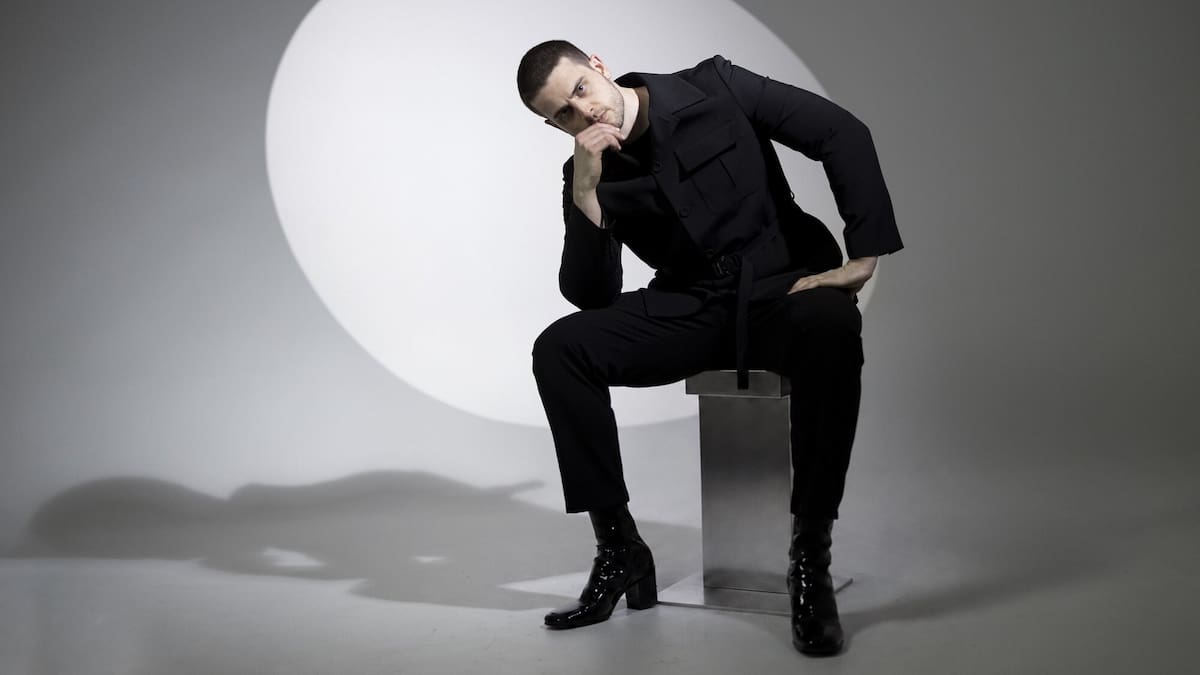
Jesse Woolston. Photo / Ivan Cruz
Big brands have been lured by his talent.
“The Dior job came through as an Instagram DM,” which he says was a pleasant surprise and offered free rein to complete his vision.
“I looked at the Dior job like a well-developed art project. I’m thinking, now I get to play with a new surface – it could be architecture or a hotel wall – it’s all the same framework.”
Woolston sees social media as an important avenue for artists to connect with global brands.
“Artists have evolved; they are their own studios now – they work directly with galleries, brands and curators. With social media, I’m showing this vision of what I can create. Whoever sees it might think ‘Ahh, that’s what this kid wants to do – project these giant simulations of phenomena’.”
But it’s the public aspect of the work that truly drives him.
“I’ve been trying to build a practice around large public installations – it’s not smart! Why would you do that?” he roars with laughter.
“When I started my career – I wanted to make work for everybody – it’s only recently I’ve been selling to collectors.”
But he’s not one to sugarcoat the financials.
“It’s been a struggle.”
Woolston remains determined and positive, and feels he’s making inroads with a mix of public and private funding.
“When you’re dealing with cities, it’s easier to fund these projects.”
Now he’s figuring out other revenue streams with brands and collectors, sometimes offering a part of the completed installation to a collector if they agree to fund its creation from the outset.
But the main driver for Woolston is a feeling he can’t quite encapsulate or tame.
“It’s that thing inside me that lights up when I see a finished work. When I do what I have set out to do. When I stand in front of it and say ‘now that’s correct.’ That’s the best”.
Art in the Park will show at Eden Park, Auckland, from November 12-15 November 2026. artinthepark.co.nz