
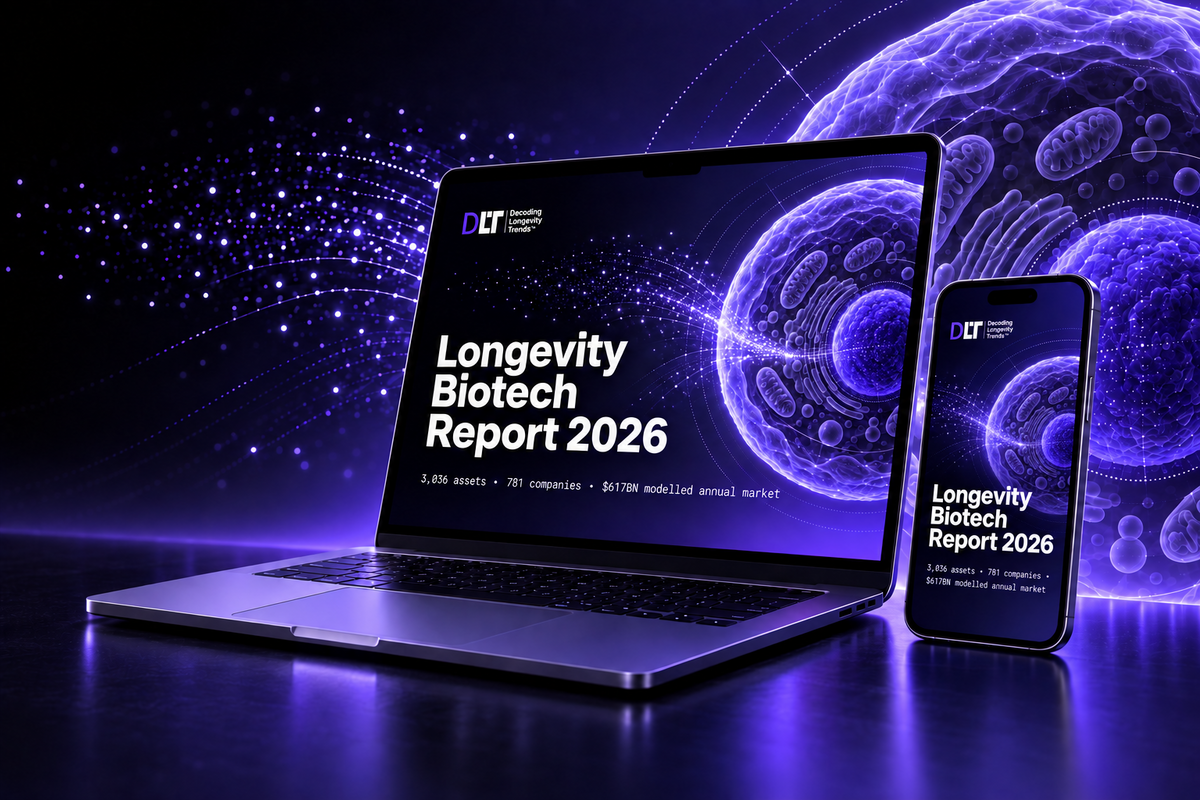
Our new report maps more than 3,000 therapeutic assets, tracing how money, pipelines and pharma appetite are now moving in step.
Longevity biotech could become a $617 billion annual global market by 2045, according to a new Longevity.Technology report that maps the investment, clinical and regulatory forces moving therapies targeting the biology of aging towards mainstream medicine.
The Longevity Biotech Report, released today and supported by MuseCell Innovations, draws on our proprietary DLT dataset covering more than 781 biotech companies and 3,580 therapeutic assets globally; 3,036 assets were individually modeled in its bottom-up pipeline valuation. The analysis estimates $230 billion in risk-adjusted peak annual sales from therapies pursuing existing disease indications under current regulatory pathways – before attributing additional value to future gerotherapeutic approvals.
Longevity.Technology: The headline numbers are large, but the more interesting story may be what is happening underneath them. Longevity biotech no longer needs to wait for aging to become a recognized indication; therapies targeting its biology can reach patients through metabolic, cardiovascular, neurological and other familiar disease pathways, accumulating evidence – and value – as they go. The irony is that prevention, ostensibly the point of geroscience, remains one of the smallest parts of the modeled market; science tells us to intervene upstream, while healthcare systems remain considerably better equipped to pay us once something has gone wrong.
What feels significant now is convergence. Capital is concentrating, pipelines are maturing, pharma is engaging and the regulatory conversation is shifting; these forces are moving at different speeds, but increasingly in the same direction. Regenerative medicine takes that trajectory a step further – from modifying the processes that drive age-related disease towards restoring damaged or depleted biology, with platform technologies potentially spanning tissues, indications and applications.
None of this makes the future market inevitable; biology has never shown much respect for a spreadsheet. But longevity biotech is beginning to build routes to patients and commercial validation before the regulatory destination is fully mapped – and markets have a habit of arriving before we have quite decided what to call them.
Capital changes character
Investment reached $18.4 billion in 2025, up from $4.7 billion in 2024, with a further $12.1 billion invested during 2026 to date. The shape of that funding is changing too: fewer, larger deals are concentrating capital around selected companies and platforms rather than distributing it evenly across the sector.

Phil Newman, Founder and CEO of Longevity.Technology, said: “The significance of this report is not simply the size of the market we project; it is that we can now trace how we get there, asset by asset. Longevity biotech is becoming measurable through the same clinical, regulatory and commercial signals used to assess the wider pharmaceutical industry.”
That assessment includes more than 1,000 programs already in human trials. Under the report’s model, the existing pipeline could generate around $230 billion in risk-adjusted peak annual sales through established disease indications; formal recognition of a gerotherapeutic pathway, modeled from around 2035, could eventually add another $173 billion annually from broader longevity applications.

The $617 billion projection is a separate top-down model, based on assumptions including global adoption, prevention beginning from age 45, pricing broadly comparable with current GLP-1 therapies, 35% peak uptake and a ten-year diffusion period.
Proof before promise
The numbers come with caveats. Gerotherapeutics remain without a dedicated FDA or EMA regulatory category and questions around validated aging biomarkers, meaningful endpoints and trial design are unresolved.
Dr Nir Barzilai, Director of the Institute of Aging Research at Albert Einstein College of Medicine and a reviewer of the report, captures the opportunity succinctly: “The promise of geroscience is that we treat our health rather than our disease.”
Clinical evidence will determine how much of that promise survives contact with patients.
Regeneration enters the chat
That challenge becomes particularly interesting for regenerative medicine. The report separates conventional drug-like assets from regenerative platforms, which carry greater manufacturing and delivery complexity but can potentially apply a validated cell or tissue technology across multiple diseases and clinical pathways.
 (L–R:) Dr Dominik Duscher (President and CEO of MuseCell Innovations), Phil Newman (Founder and CEO of Longevity.Technology) and Dr Nir Barzilai (Director of the Institute of Aging Research at Albert Einstein College of Medicine)
MuseCell Innovations, which supported the report, provides one example through its development of Dezawa Muse Cells – endogenous, stress-tolerant cells being investigated as an allogeneic regenerative platform across several indications. Its accompanying report spotlight examines their damage-directed homing, differentiation and potential applications spanning acute injury and chronic tissue decline.
For Dr Dominik Duscher, President and CEO of MuseCell Innovations, regenerative medicine brings something distinct to the longevity toolkit. As he writes in the report’s foreword: “Regenerative medicine brings a distinct objective to longevity research: restoring tissue function where aging and disease have impaired the body’s capacity for repair.”
That distinction matters as the field moves beyond slowing or modifying the processes associated with age-related disease towards asking whether lost function can be restored. Duscher is careful, however, about what follows from platform potential: each application still requires evidence of meaningful benefit in the patients concerned.
Work in progress
A $617 billion forecast deserves interrogation, not reverence. The more immediate question is whether the scientific, clinical and regulatory pieces continue to move together; if they do, longevity biotech will be shaped not by one defining drug or modality, but by the rather less cinematic business of accumulating evidence.
That work is already under way.
The full Longevity Biotech Report – assets, models and all – is FREE to download here.