
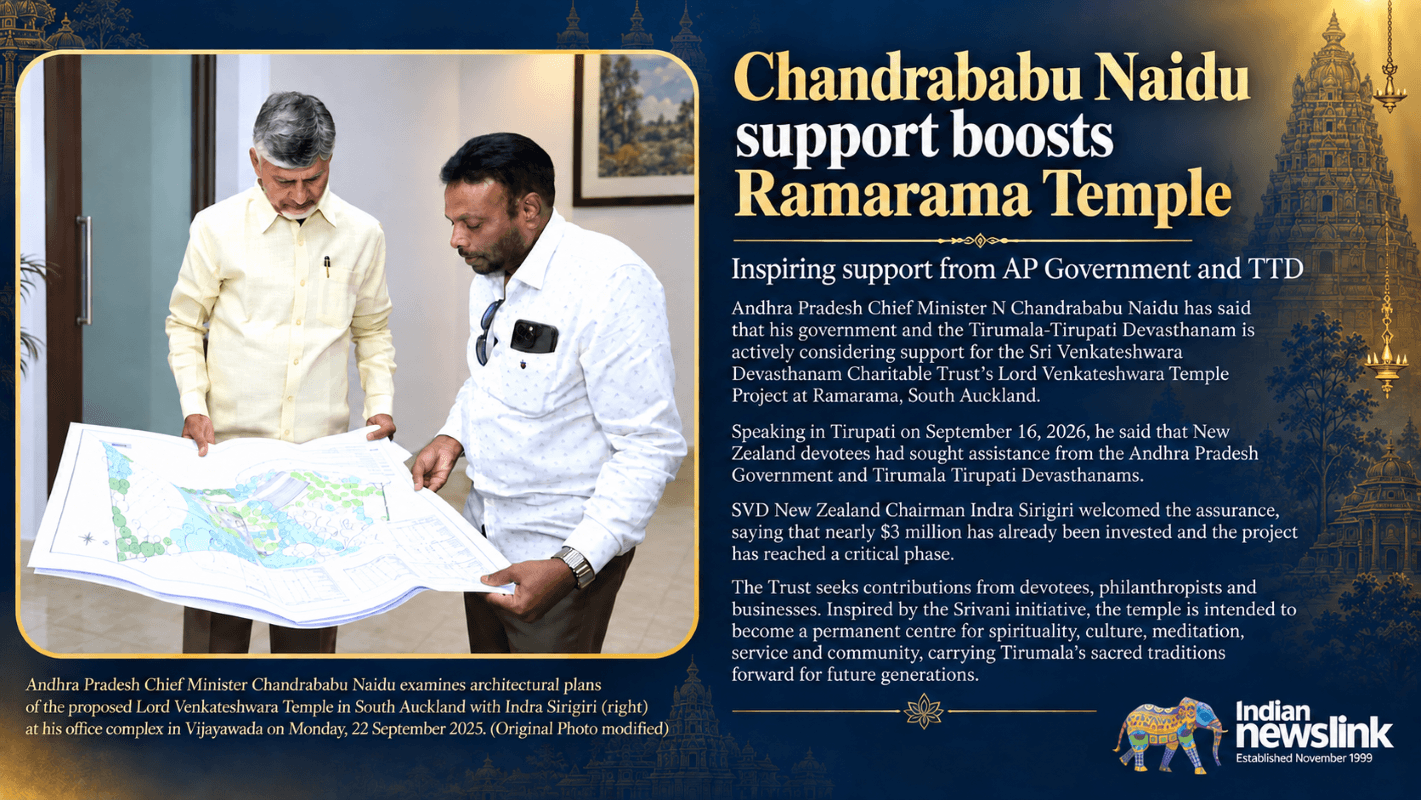
South Auckland Temple proposal gains momentum
Venkat Raman
Auckland, September 20, 2026
Andhra Pradesh Chief Minister N Chandrababu Naidu has said that his government is actively considering support to the Sri Venkateshwara Devasthanam (SVD) Charitable Trust which is constructing a Temple for Lord Venkateshwara in Ramarama, South Auckland.
“Our Devotees in New Zealand have sought the support of the Andhra Pradesh government and the Tirumala-Tirupati Devasthanam Charitable Trust (TTD) in their construction project. We are actively considering their proposal,” he said, speaking to the media in Tirupati on September 16, 2026.
Mr Naidu was in Tirupati to review the operations of the Tirumala-Tirupathi Devasthanam and was accompanied by Endowments Minister Anam Ramanarayana Reddy and TTD Chairman BR Naidu.
Lord Venkateshwara Temple in Auckland
Sri Venkateshwara Devasthanam Charitable Trust (SVD) New Zealand Chairman Indra Sirigiri said that Mr Naidu’s commitment to the Temple Project is reassuring and inspiring.
“We are grateful to Chief Minister Naidu Garu for his expression of support to our Temple which is being constructed in Ramarama, South Auckland. We have thus far spent almost $3 million and the Project has reached a critical stage of development. We are actively seeking donations from devotees of Lord Venkateshwara, philanthropists, businesspeople, professionals and individuals. We also hope to receive substantial support from the Andhra Pradesh government and the TTD management,” he said.
Mr Sirigiri said that Mr Naidu’s proposal has emerged as part of a far more ambitious vision for Tirumala and Tirupati, through which he wants one of Hinduism’s most revered centres of worship to become an international exemplar of spirituality, service, environmental stewardship and modern administration.
“The Chief Minister said that Temples should not be regarded merely as places where devotees performed rituals, but as institutions capable of transmitting faith, culture and civilisational values to succeeding generations. Our Temple will not only be eventually owned by the Community but will also be a Centre for Spiritual, Cultural, Meditational and Social excellence,” Mr Sirigiri said.

The Srivani Initiative and SVD Trust
He said that Sri Venkateswara Aalayala Nirmanam (Srivani) Trust, established by TTD in 2018, supports the development, renovation and preservation of Lord Venkateshwara Temples.
“Its vision is to preserve Tirumala’s spiritual and cultural heritage and carry it forward for future generations through devotion, service and community participation. This vision closely connects with the purpose of Sri Venkateshwara Devasthanam (SVD), New Zealand,” he said.
Mr Sirigiri said that SVD is being developed as a dedicated abode of Lord Venkateshwara, bringing the spiritual traditions and cultural heritage of Tirumala closer to devotees in New Zealand.
“The SVD project aspires to become a centre of devotion, service and community, preserving these sacred traditions for generations to come. In this spirit, SVD seeks to establish a meaningful spiritual and cultural connection with the Srivani initiative and the TTD family,” he said.
Mr Naidu said that his government proposes to construct 5000 Temples for Lord Venkateshwara across Andhra Pradesh over the next two years funded through the Srivani Trust.
The Trust also funds renovation and maintenance of older Temples and community service.
“Srivani Trust today has more than 1.2 million Sevaks (Volunteers). The spiritual and cultural and spiritual inheritance associated with Tirumala had to be preserved and passed to future generations, while the institutions surrounding the shrine had to become models of service and disciplined administration. Those who come for Venkateswara Swamy’s Darshan should surrender ego, serve society, and become better human beings,” he said.
Green Pilgrimage Promotion
Environmental protection occupied an equally prominent place in the programme.
Tirumala has an exceptionally high level of green cover, estimated at about 89.5%, and the government wants to ensure that development does not diminish the ecological character of the sacred hills, Mr Naidu said.
“A major tree-planting initiative would strengthen the green cover, while herbal and medicinal plants would be cultivated across suitable areas. Water conservation would be treated with similar urgency. Rain falling on the seven hills would increasingly be captured through recharge structures, check dams and improved conservation systems rather than being allowed to disappear as run-off,” he said.
Mr Naidu said that Tirumala and Tirupati would ultimately move towards a net-zero model embracing renewable energy, rooftop solar generation, wind power and zero-waste practices.
“Tirumala must remain carbon-neutral. Devotees should feel renewed energy when they arrive here. Flowers offered at temples could be converted into incense, wet waste into useful energy and compost, while treated water could return to plantations. The principle was essentially circular: resources entering the sacred precinct should, wherever practicable, be reused rather than discarded,” he said.
Technology enters pilgrim service
Mr Naidu also sought to demonstrate that technological modernisation need not erode religious tradition. A new pilgrim experience within the queue complexes uses virtual-reality and interactive technology to deepen devotees’ understanding of the history, rituals and spiritual significance of Lord Venkateshwara while they await Darshan.
“Thirty-two electric air-conditioned buses have also been introduced to strengthen cleaner transportation on the hills, improving comfort while reducing local emissions. Pilgrim welfare would extend even to insurance. TTD has introduced an Aadhaar-based paperless insurance arrangement in association with the Life Insurance Corporation, with ₹200,000 (about $3700) payable in the event of a pilgrim passing away during a visit to Tirumala,” he said.
The initiatives reflected an administrative philosophy in which devotion, safety, technology and institutional accountability were expected to reinforce one another.
Mr Naidu said that Tirupati will also under another transformation with urban expansion, roads, parking facilities, transport connections and pilgrim infrastructure, a skywalk between Tirupati railway station and the bus stand and other improvements.
Administrators, in Mr Naidu’s formulation, were custodians of Lord Venkateshwara’s wealth rather than its owners. Transparency was therefore inseparable from trusteeship.
A Spiritual Bridge in South Auckland
For New Zealand’s Hindu community, the most consequential part of Mr Naidu’s wider vision may ultimately lie thousands of kilometres from Tirupati, at Ramarama in South Auckland.
Mr Sirigiri said that Mr Naidu’s vision for New Zealand could prove important for a growing Hindu population living far from the great pilgrimage centres of India.
“A Temple linked spiritually and institutionally with the traditions of Tirumala could provide much more than a sanctum for worship. It could become a centre for religious education, music, language, festivals, charitable activity and the transmission of Hindu traditions to children born and raised in New Zealand,” he said.
Mr Sirigiri appealed to the members of the Indian community to sign up for weekly donations of $11 per person, which will fund the construction of the Temple.
“Every $11 leads to a Mighty Investment; Every $11 is another brick on the wall,” Mr Sirigiri said.
Donations can be remitted to the SVD Trust Bank Account (Number 02-1263-0021465-000) and online at the Temple Website www.srivenkateshwaranz.org
IRD Number 142-305-968; Listed as Donee for Tax Claim.