
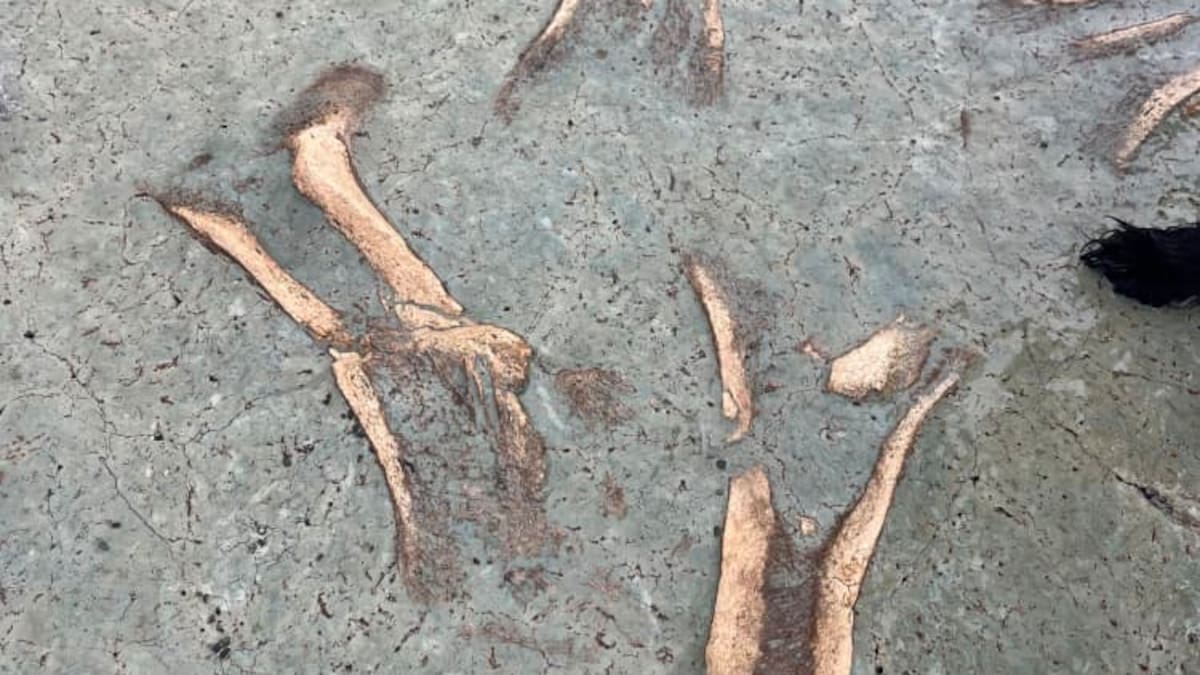
Moa bones discovered on St Andrews Beach, south of Timaru. Photo / Pippa Yates
“I was kind of second-guessing myself though, so I took photos and continued on my walk. It was only on the walk back that I took a second look and was pretty certain.”
Yates said she was concerned about the bones being covered over again or destroyed by the sea – as she had seen happen to ancient trees that were recently unearthed.
“My first thought when I got home was to call the [South Canterbury] museum … they had experts confirm they believed they were moa,” she explained.
This part of what is believed to be a moa’s foot was among several bones discovered by a woman walking at St Andrews Beach. Photo / Pippa Yates
After checking with the museum, Yates’ husband dug up the bones to preserve them.
Then after the initial find, she located more bones.
“I walk the same route every day so the day after I found the ankle/foot bone and a few other small fragments nearby,” she said.
“I found another two larger pieces which I’m going to bring my nieces and nephew to see with their dad.”
Earth Sciences emeritus palaeontologist Dr Hamish Campbell told the Herald it was a “fascinating” discovery.
“Humans modify landscapes by digging up and putting new buildings and things, goodness knows what we’re destroying.
“A lot of people don’t know what they’re walking over.
“In general people are finding them [fossils] less and less, but I do think we will keep finding them.”
Campbell said the first port of call for anyone who has found bones and other fossils would be to tell their local museum.
The Yates family had been scouring the beach for about four years after hearing about a man finding a moa footprint and bones, Yates said.
“I walk looking at my feet basically the entire time where we walk, specifically in all the clay banks, we always look in those areas thinking we might see a footprint, and that’s something I can bring my daughter back to see,” she said.
A larger view of the moa bones a woman discovered during her daily walk at St Andrews Beach, south of Timaru, on Friday.
Yates said her daughter received a sandpit for Christmas with animal bones and gemstones for her to find, “so she is often out there discovering ‘treasures’.”
“You can just imagine how excited she was to see and touch real ‘dinosaur bird bones’.”
Yates said the family planned on keeping a few of the larger bones and possibly piece them together.
“It’s a legacy to have it on display, and any of the tiny little bits, we’re going to put in specimen jars and bring them to the [kindergarten] and the school to have a look at as well.”
The bones today on St Andrews Beach, south of Timaru. Photo / Pippa Yates
She hoped to put them on display in their home for visitors.
“But any of the really obviously bone-looking bones, we’re going to try and give back to the museum, which will be nice to have on display,” she said.
Additional text by RNZ
Sign up to The Daily H, a free newsletter curated by our editors and delivered straight to your inbox every weekday.