
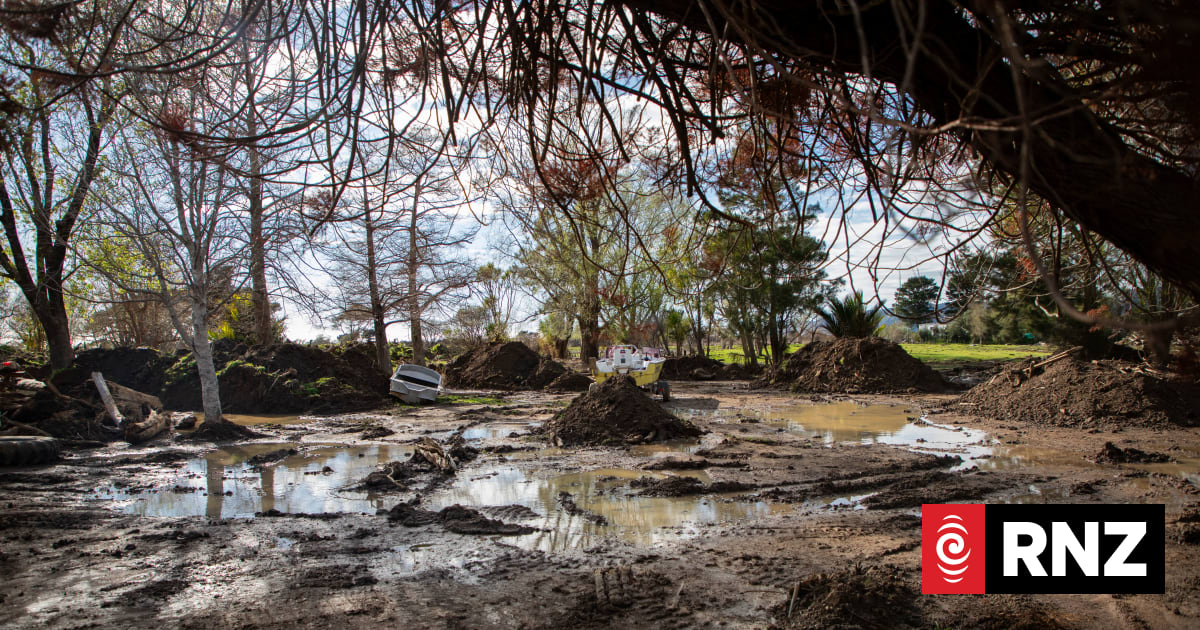
In Te Araroa, one of the East Cape’s famous beach towns, the previously booming tourist industry has virtually ground to a halt as locals continue to grapple with the aftermath of destructive flooding from January. Checkpoint’s Teuila Fuatai reports.
You would be hard pressed to recognise Te Araroa Holiday Park.
Everywhere you look there is mud and water – a far cry from the idyllic gardens which used to greet its visitors.
In fact, when we get to Te Araroa, I drive straight past it. There is no sign marking the spot and the driveway looks like a farm paddock with tyre tracks through sludge.
It doesn’t take long to see why manager Nina McClutchie told my cameraman Baz and I we would need gumboots.
“This is 50 percent better than what it was for us, but we’re a long way off yet,” she says.
For someone arriving seven months into the clean-up, it’s hard to imagine how bad things were immediately after the January storm.
Today, the accommodation blocks and cabins look they’ve been plonked randomly around a dirt wasteland. Some of them are condemned, while others are still having work done.
Nina – who is among a handful of residents that call the park home – shows us the block she used to live in.
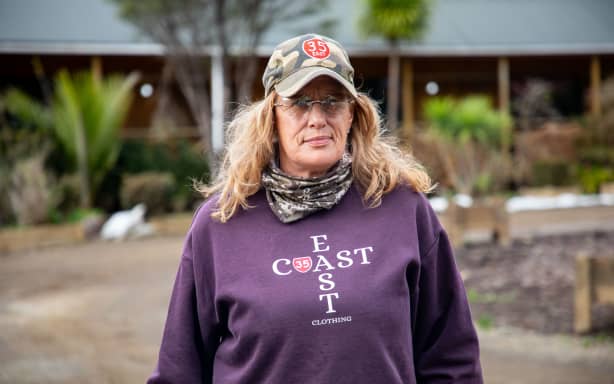
Nina McClutchie, Te Araroa Holiday Park manager and owner of 35 Eat Street.
RNZ / Baz Macdonald
Only the middle unit is still occupied, while the rest have either been yellow or red stickered.
She moved out of her units straight after the storm. When we look inside one of them, her old bed is still there, with a few belongings piled on top. The seven-month-old silt line still marks the door around calf height – an eerie reminder of the storm’s power.
“This is all I’ve got left,” Nina says.
“We’ve just cleaned up as best as we can, but it was all logs and just horrible.
“The roof’s coming down in there… and yeah, the walls, everything – it just now black mould in there.”
‘It’s not hygienically right to be open’
The destructive January storm brought a mass of earth, trees and water through the camp. It also caused widespread damage throughout communities along the East Cape.
Nina says the deluge that hammered the holiday park was a combination of a landslide from Punaruku and the creek running alongside the holiday park breaching. She says things got “really hairy” in the early hours of the morning when the whole camp was awash with debris and water during the storm event.
“I was trapped inside, and just after 2am I tried to get out and I couldn’t.
“I realised that there were big logs and a lot of debris, and a lot of water coming around fast.”
One of the other residents Steve Lamb managed to dig her out around 6am.
“And that’s when I realised [that] we’ve got a massive issue here… and this is catastrophic.”
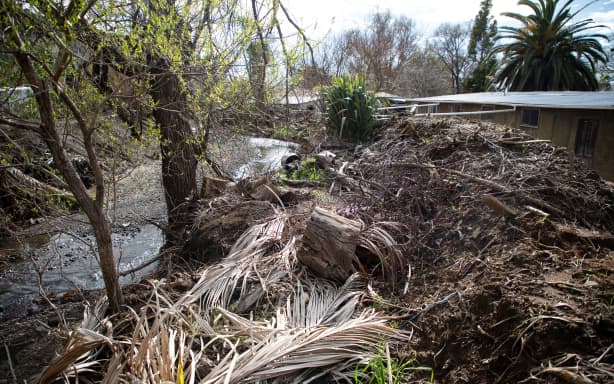
Slash and dirt piled up on the riverbanks of Te Araroa Holiday Park.
RNZ / Baz Macdonald
Nina says a heap of help – including from the army and the Gisborne District Council – landed straight away.
She says the army were instrumental in clearing away the worst of the silt, particularly from around the park’s cabins and accommodation blocks, as well as her own gourmet burger and fries food caravan 35 Eat Street.
However, it’s the ongoing clean-up that is proving tough.
She walks us to the food caravan near the entrance of the camp. It remains shuttered as the rest of the park is prioritised in the flood clean-up,
During the low season, Nina says she’d normally open five nights a week for guests and locals.
Now, there are few tourists around, and the caravan won’t be cleaned until the rest of the park is in better shape.
“I can’t open – that’s just the way it is. It’s not hygienically right to be open, especially with silt dust still flying around.”
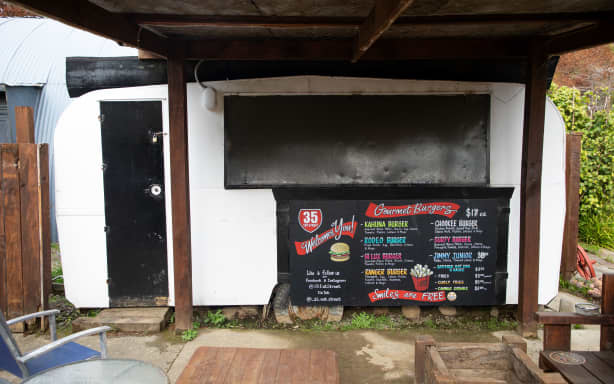
Nina McClutchie’s food business Eat 35, which has been closed since January’s storm.
RNZ / Baz Macdonald
She says while some tourists are still coming through, it’s nothing like previous years, when lots of visitors from the northern hemisphere stayed during winter and spring.
“There has been a couple of times where campers have come through and they don’t want to travel any further and they’re self-contained, then I’ve allowed them to stay up the front.
“They’ve been so thankful for that, and yeah, they just move on.”
‘There’s just tons and tons of it’
For Nina, and a handful or residents and close friends, the days are now spent tackling the muddy mess around them.
When we’re there, Steve is on the digger. He starts up about 8am and goes until it’s too dark to keep working.
It’s been a hard slog, he says.
“We now have to scrape the silt away till we get to the baseline, which is like a grey matter at the moment.
“That gets away all the sticks. We can then, after that… level it.
“it’s just surprising – there’s just tons and tons of it.”
Steve says it has been a tough seven months for the whole community.
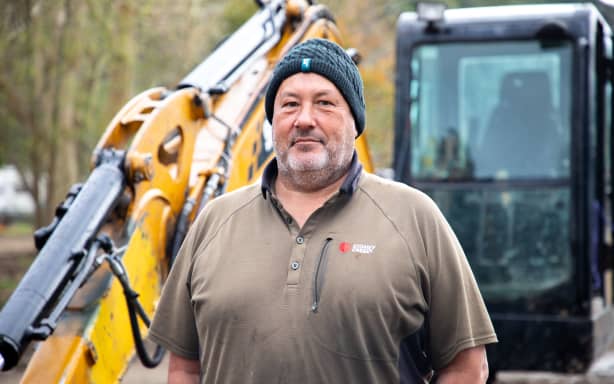
Retired Te Araroa resident Steve Lamb.
RNZ / Baz Macdonald
He points to each side of the holiday park and its neighbours, describing the devastation and hurt for different whānau. Some are still too traumatised to speak to Checkpoint about the storm.
“There were people across the road,” Steve says. “They ended up being on their roof for a number of hours, and when we finally were able to get out of the camp and saw what had happened to them. I mean – there were boulders, and those people have kids.”
The plight of the Ngatai-Cooper family was reported widely when the storm hit. The whānau have been staying with relatives since.
Steve also points to another neighbour’s section, which has massive piles of slash – well over six feet tall – stacked on it.
“What do they do with that?”
‘No one cares’
He and Nina also show us the creek that runs alongside the holiday park and through the area.
It’s filled up with shingle since the storm, when it breached its banks and gushed into the park and surrounding properties.
It is now a major concern for residents.
Nina says unless it is cleared out, which would require its current level to be dug down at least two metres, it will continue to be a flood risk.
“All the stones need to come out, but as you can see, that’s a lot of work. And the creek runs from the road right around the back of the camp.”
So far, she and Steve and their clean-up crew have managed to rebuild the bank providing some protection for the property. But there’s still been a few close calls when the water levels have risen.
“But luckily, the rain’s backed off,” Nina says.
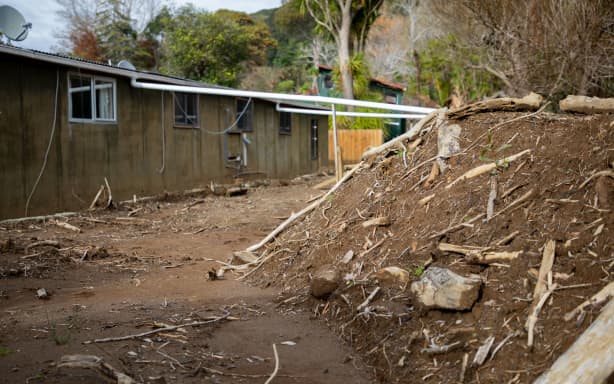
A floodbank built along the river bordering Te Araroa Holiday Park.
RNZ / Baz Macdonald
Steve says they have come a long way since January, though it hasn’t been without its challenges – especially after the initial support finished.
Simply put, he thought more help would be available after such a damaging weather event. Park owner Bill Martin estimates the cost of the park clean-up to now be about $300,000.
“You can’t rely on other people,” Steve says.
“You have to be self-sufficient, but I expected more and more professionalism from local government.
“It seems like they came, they did their bit, they’re gone, no one cares”
He is not the only local who’s expressed that sentiment.
Down the road from the holiday park, residents around Tokata road are experiencing ongoing flooding.
Carl Mullany – who lives on the section where the flooding starts – says its because the stream bed running through his land filled up with shingle from the January storm. As a result, the water that comes down from the maunga behind his property, doesn’t have a path. Instead, it spreads across his land and the neighbouring properties.
He and other affected residents have been trying to work with Gisborne District Council to find a solution.
They have also met with their local East Coast MP – National’s Dana Kirkpatrick – about the problem.
She described conditions in the area as “pretty demoralising”.
Seven months on from flood Te Araroa faces massive clean up
“I’ve lived through a few floods in my time….and I understand the sheer demoralising situation it is when you look out every day and you see things that you can’t control and you can’t fix, and the desolation that it brings.”
Local MP: ‘I’ll do whatever I can’
Kirkpatrick pointed the finger squarely at Gisborne District Council, labelling the lack of support for locals after seven months as frustrating.
She says the council told her in July they were undertaking a report on the area, however after two months, neither her nor the landowners have received anything.
“I am frustrated by them because these people are living this day-by-day.
“I just go back to the point…that regional councils are responsible for river management, flood protection, flood control schemes, catchment management, and drainage networks.
“So, they might say that the stream is on private land…but actually the responsibility for that lies with the council.”
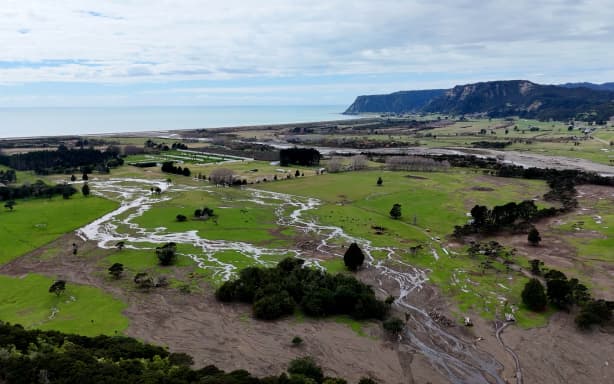
Rivers diverted across properties in Te Araroa following January’s storm.
RNZ / Baz Macdonald
The council has confirmed to Checkpoint it has completed “the technical assessment of the stream and surrounding catchment”.
It also says it needs to have further discussions with landowners about potential options, however it has no budget currently to do any work.
As a result, the council says it “will explore the case for seeking Crown funding”.
Kirkpatrick is urging them to get in touch immediately.
“I’ve already given them the undertaking that I’ll do whatever I can. But the first thing we need to know is how much it’s going to cost and what needs to be done.”
Christmas reopening: ‘Fingers and toes crossed’
In the meantime, Nina says they’ll continue working seven-days-a-week to get the holiday park ready for summer.
She’s opened accommodation to road crews, who continue to fix multiple slips on the coastal road from January’s storm.
“We only have the Downer’s road crews staying there. They’ve been here for the last three months doing recovery work.
“They stay here from Monday to Friday, so I’ve been very grateful to them to have the mahi.”
She says they’re aiming for a Christmas reopening, and with all their work, she reckons they’ll do it.
“Fingers and toes crossed,” she says.